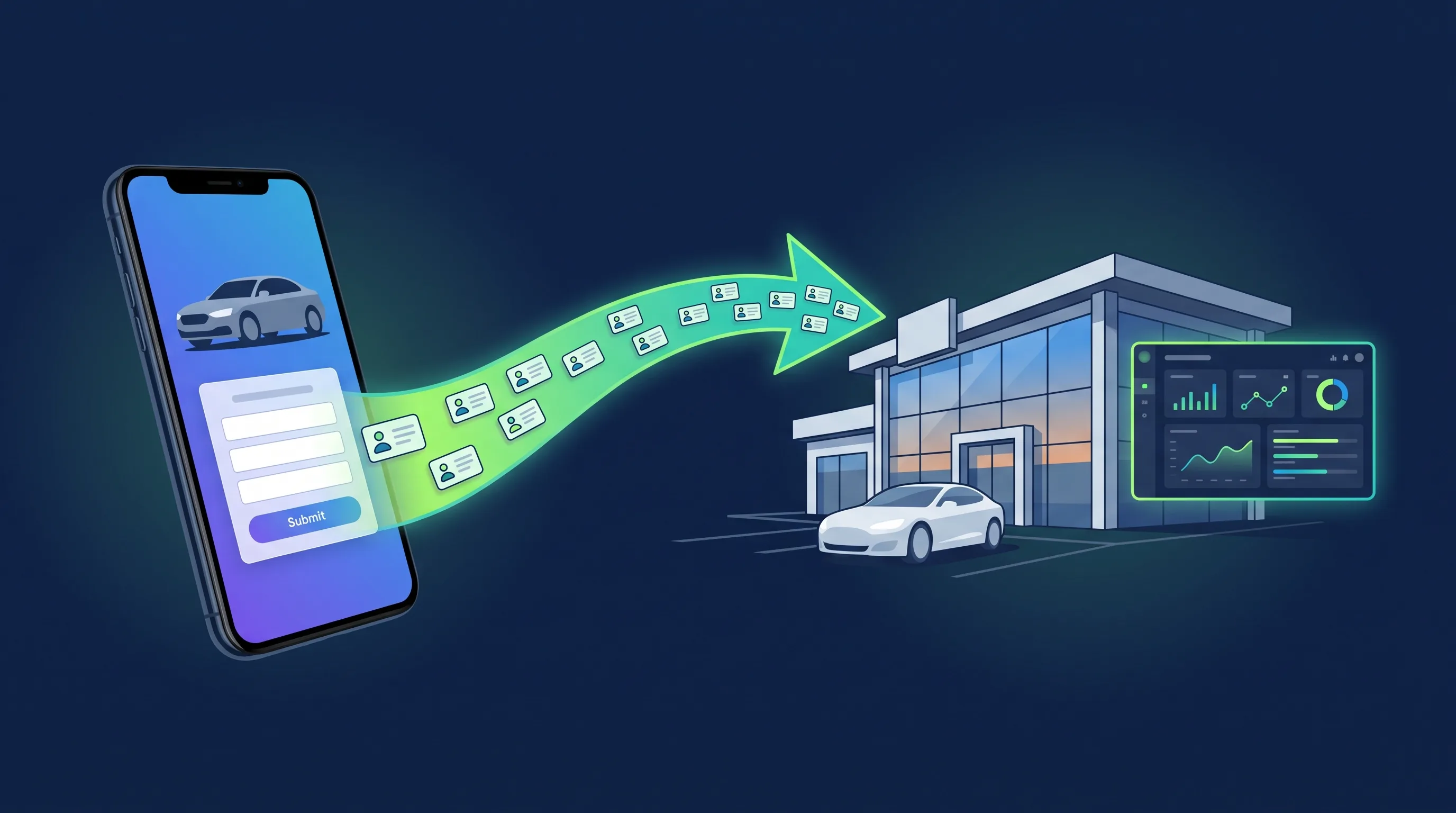
A car shopper who taps “What’s my trade worth?” and submits a form Facebook has already filled in has just told you three things: they own a car, they are thinking about replacing it, and they want a number. That is a better lead than most dealership websites produce all week. Facebook lead ads exist to capture exactly that moment, and car dealerships use them for trade-in valuations, test drive bookings, pricing requests and service specials.
This guide is a full rewrite of the version we first published in 2021. It also absorbs our automotive lead generation strategies post and our old automotive case study roundup, so everything a dealership needs for Facebook and Instagram lead generation now lives on one page: which Meta ad format to use, the offers that work, the rules for financing ads, what leads cost, and how to get every lead into your dealer CRM before the shopper’s attention moves to the next dealership.
Why Facebook lead ads work for car dealerships
Car buying starts online and on a phone. The shopper compares models, reads reviews, and checks what their current car is worth long before they visit a showroom. Meta’s platforms are where they spend the gaps in between.
Lead ads fit that behaviour because the form never leaves Facebook or Instagram. The shopper taps the ad, sees a short form with their name, email and phone already filled in from their profile, answers one or two questions and submits. There is no dealership website to load and no inventory page to navigate. Compared with sending the same traffic to a landing page, instant forms convert at a higher rate because nothing slows the shopper down.
The catch is intent. Someone who submits a lead form in three taps is curious, not committed. Dealers who do well with lead ads accept that and design the whole system around it: an offer specific enough to attract the right shopper, a form that asks the questions a salesperson needs, and a response fast enough to turn curiosity into an appointment.
There is also room in the market. When we analysed the pages running Meta lead ads through LeadSync for our 2026 industry report, automotive pages had by far the largest audiences (1.15 million followers on average) but adoption was concentrated in national brands and large groups. Independent and regional dealers were barely using lead ads at all.
Lead ads, inventory ads or Marketplace?
Meta gives dealers three ways to reach car shoppers, and they do different jobs.
| Lead ads (instant forms) | Automotive inventory ads | Marketplace | |
|---|---|---|---|
| What the shopper sees | One offer and a short pre-filled form | The right vehicle from your catalog, chosen by Meta | Individual vehicle listings |
| Best for | Trade-ins, test drives, pricing requests, service | Showing inventory to in-market shoppers and retargeting VDP visitors | Used-car stores posting a handful of units by hand |
| What you get | Name, phone, email and your custom answers | Clicks to a vehicle detail page, or a lead if paired with a form | Messenger conversations |
| Setup | Ad account, page, form | Vehicle catalog feed plus pixel events | Manual listing, one vehicle at a time |
| Scales across the lot? | No, one offer per ad | Yes, whole catalog | No |
Automotive inventory ads (AIA) are Meta’s catalog format for vehicles. You upload a vehicle feed with VIN, make, model, year, trim, price, mileage and photos, and Meta chooses which car to show each shopper based on what they have browsed. Meta’s own catalog setup guide for automotive inventory ads covers the feed requirements. AIA is excellent at reach, but it sends shoppers to a vehicle page where most of them leave without identifying themselves.
Marketplace used to be a free inventory channel. Meta stopped distributing partner inventory feeds to Marketplace on September 13, 2021, so vehicles no longer flow there automatically from providers like Cars.com or Edmunds (AutoSweet). Dealers can still list vehicles by hand, and inventory ads can appear in Marketplace ad placements, but it is no longer a lot-wide channel.
The practical setup for most stores: inventory ads for reach and retargeting, lead ads for the offers that start a conversation, and one pipeline that sends every lead from either format to the CRM.
Financing ads and Meta’s special ad category
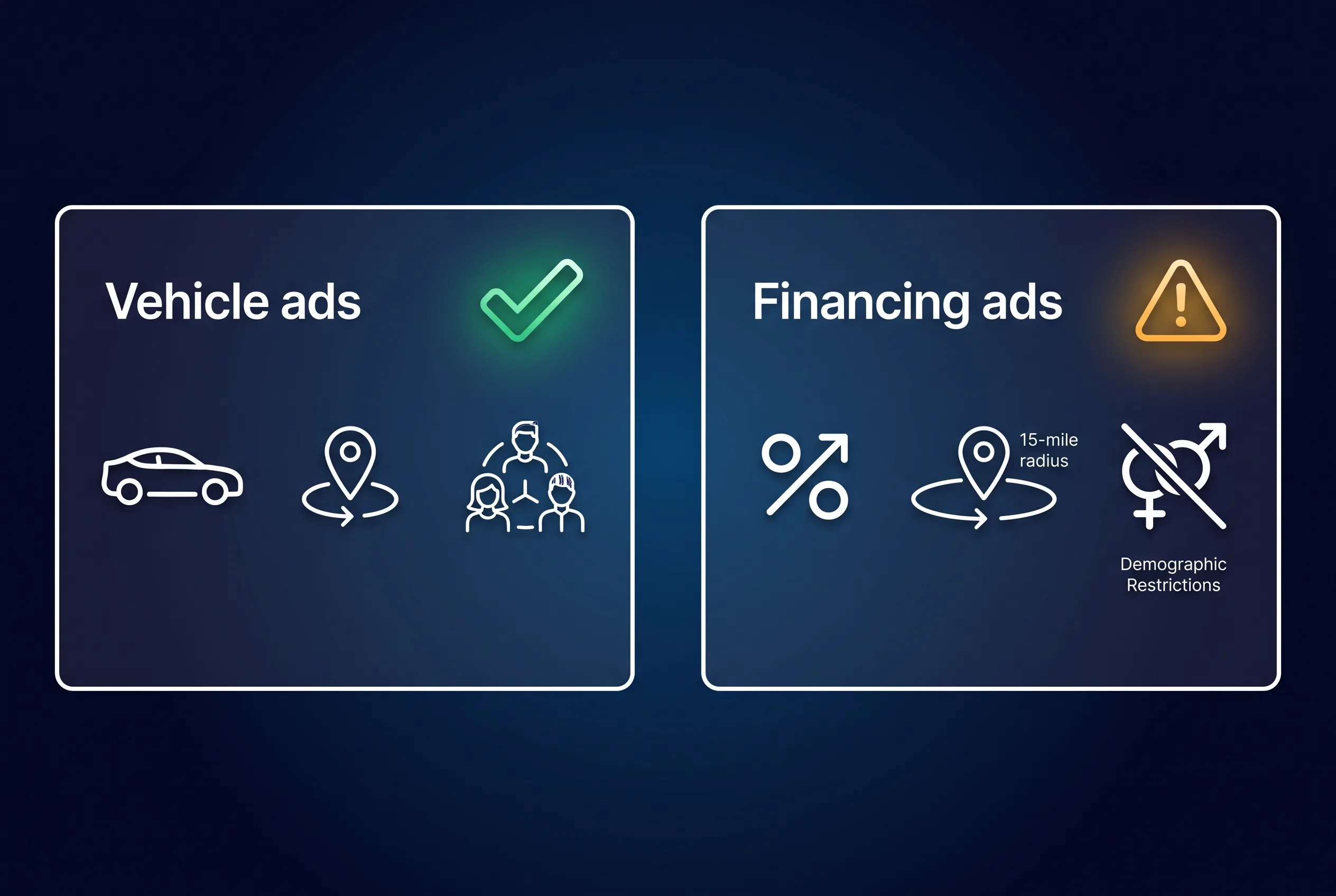
This is the rule that catches dealers out. In the US, Meta requires ads for credit opportunities, including auto loans, to run under the Financial Products and Services special ad category. The category became mandatory on January 21, 2025 and widened the old Credit category to cover banking, insurance and investment products as well (Data Axle, Meta Transparency Center).
Once an ad is declared in that category:
- Age is fixed at 18 to 65+ and all genders are included.
- ZIP code targeting is gone. Location targeting needs a radius of at least 15 miles around a city or address.
- Behaviour and demographic targeting is removed, and only an approved list of interests remains, with no exclusions.
- Lookalike audiences are unavailable. Special Ad Audiences, which once replaced them, were retired in 2022. Custom Audiences and Advantage+ Audience still work.
What triggers it is the message, not the business. An ad for a used SUV with a price does not need the category. An ad that says “0% APR for 60 months”, “bad credit? get approved today” or “$299 a month” is promoting credit terms and does. If you declare the category when you did not need to, you only lose targeting. If you skip it when you did need to, the ad is rejected, and repeat rejections put the ad account at risk. Our guide to Meta’s special ad categories covers the other categories in detail.
Working inside the rules is easier than it sounds for a dealership. Your market is already a radius around the store, the offer itself filters the audience (nobody without a car taps “value my trade”), and customer list audiences built from your own CRM still work for non-credit ads. Keep finance offers in their own campaign so the restrictions do not spill onto your vehicle and service ads.
Six offers that work for dealership lead ads
A lead ad is only as good as its offer. These are the six that dealers keep funding.
1. The trade-in valuation
“Find out what your car is worth in 60 seconds.” It is the dealership version of the free home valuation, and it works for the same reason: the shopper wants the number, and only an owner of a car wants it. Ask for year, make, model and mileage on the form, and optionally the condition. The follow-up call has an obvious opening line, because you are calling with their number.
2. Test drive booking
Pick one model, show it in the creative, and let the shopper choose a preferred day and time on the form. This works best for new launches and high-demand models where the shopper genuinely wants to sit in the car. The form answer becomes the appointment, so the salesperson’s first job is to confirm it, not to sell it.
3. The out-the-door price on one vehicle
“Get today’s price on this 2024 RAV4.” One specific car, the real photo, and a form that asks whether they have a trade-in. Shoppers are tired of advertised prices that grow at the desk, so an ad that promises the full price earns the tap. Keep any payment or financing language out of the ad unless you are running it under the Financial Products and Services category. In California, the CARS Act (SB 766) requires a defined total price on any advertisement that references a specific vehicle from October 1, 2026, so check the ad copy with your compliance team (California Legislature).
4. Service specials
Oil changes, tire deals, brake inspections and seasonal checks. Service offers have the widest audience of any dealership ad (everyone with a car in your radius) and usually the lowest cost per lead. Ask for the vehicle and a preferred day. A service customer who has a good experience is also the easiest future sales lead a dealership will ever get.
5. Incoming inventory and waitlists
“Be first to hear when the new Tacoma lands.” A waitlist form for models that are allocated or back-ordered collects shoppers who are already decided on the vehicle and just need the call. Ask which trim and colour they want.
6. Lease-end and equity offers
“Your lease ends soon. See your options.” Run these to a customer list from your CRM of owners approaching lease-end or with positive equity. Be careful here: if the ad mentions payments, rates or financing terms, it belongs in the Financial Products and Services category, and in the US customer list audiences are restricted inside that category. An ad that only offers an upgrade conversation is simpler to run.
For more creative ideas across industries, see our Facebook lead ad examples by industry.
Setting up a dealership lead ad campaign, step by step
If you have never built a lead ad, our full campaign walkthrough covers every screen. The dealership-specific version:
- Open Ads Manager and choose the Leads objective. Pick Instant forms as the conversion location.
- Declare a special ad category only if the ad promotes credit. Financing, APR or payment offers go under Financial Products and Services. Vehicle, trade-in, test drive and service ads do not.
- Set the location to your market. A radius around the store, usually 15 to 40 miles depending on how far customers will drive. Exclude areas another rooftop in your group covers.
- Leave detailed targeting broad. Meta’s delivery finds in-market shoppers better than interest targeting does in 2026. Use your CRM customer list as an exclusion (for conquest offers) or as the audience (for service and lease-end offers).
- Build the form as “Higher intent” if lead quality matters more than volume. It adds a review screen before submission, which cuts accidental submissions.
- Add your questions. Vehicle of interest, trade-in details, purchase timeframe. See the next section.
- Write a thank-you screen that sets the next step. “A member of our team will call you within 10 minutes” is a promise that makes people answer an unknown number.
- Connect the form to your CRM before the ad goes live. Then send a test lead with Meta’s lead ads testing tool and confirm it arrives in the CRM with every field in the right place.
What to ask on the form
Every question is a trade: fewer submissions, better leads. Dealers do best with the pre-filled contact fields plus two or three questions that tell the salesperson what to do next. The right-hand column shows where each answer lands when the lead is delivered to a dealer CRM as ADF/XML.
| Question | Why it matters | Where it lands in the CRM (ADF) |
|---|---|---|
| Full name, phone, email (pre-filled) | Contact details | Customer contact block |
| Which vehicle are you interested in? | Tells the salesperson which car to have ready | Vehicle of interest (year, make, model) |
| New or used? | Routes to the right sales team | Vehicle status |
| Do you have a trade-in? Year, make, model, mileage | Opens the valuation conversation | Trade-in vehicle block |
| When are you planning to buy? | Separates this month from someday | Customer comments |
| Preferred day and time (test drive or service) | Turns the lead into an appointment | Customer comments |
Name and phone are the only fields you truly need. If your cost per lead is fine but too many leads never answer, add a timeframe question or switch to the higher intent form type. Our guide to qualifying leads with Facebook lead ads goes deeper on question design, and multi-step lead forms covers when a longer form is worth it.
What automotive leads cost on Facebook
Automotive is one of the more expensive industries on Meta, because the audience is narrow at any given moment and every dealer in the market is bidding for it.
| Metric (leads objective) | Automotive (For Sale) | All industries |
|---|---|---|
| Cost per lead | $35.52 | $27.39 |
| Conversion rate | 4.15% | 8.54% |
| Click-through rate | 2.29% | 2.70% |
| Cost per click | $2.01 | $1.80 |
Source: LocaliQ Facebook advertising benchmarks, published September 23, 2026.
Two things to read into those numbers. First, a $35 lead is cheap next to what dealers pay for third-party leads and next to the gross on one vehicle, so the cost per lead is rarely the problem. Second, the low conversion rate says the average dealership ad is not specific enough. An ad for one car at one price, or a trade-in value in 60 seconds, converts better than “Great deals at Bayside Motors”.
Service offers and trade-in offers usually come in below the benchmark because more people qualify. New-vehicle offers on popular models sit above it. For benchmarks across every industry, see our Facebook lead ads cost per lead guide.
Getting Facebook leads into your dealer CRM
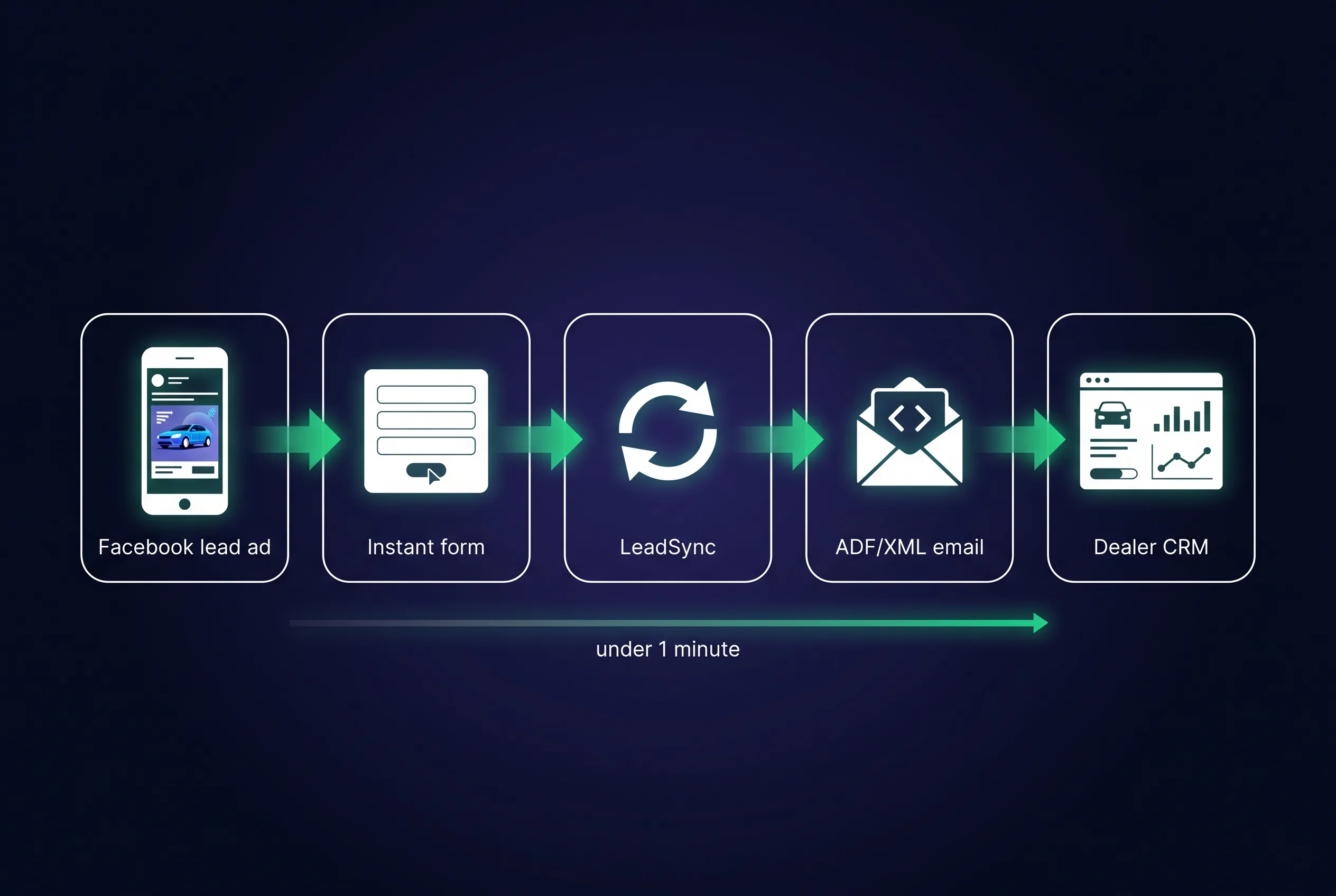
Facebook stores lead ad submissions in your page’s Leads Center and keeps them for 90 days. It does not send them to your CRM. Left alone, a dealership ends up with someone downloading a CSV from Facebook each morning, which means the average lead is hours old before a salesperson sees it.
The automotive industry solved lead delivery decades ago. ADF (Auto-lead Data Format) is an open XML standard for sending a shopper’s details and vehicle interest to a dealership, and it is how AutoTrader, Cars.com, CarGurus, TrueCar, Edmunds, KBB and most OEM lead programs deliver leads (Ringlead). Every major dealer CRM gives each rooftop an intake email address that accepts ADF/XML, and it creates the lead record from the XML automatically.
That means a Facebook lead can arrive in your CRM exactly like a Cars.com lead, with the vehicle of interest and trade-in in their proper fields and your workflow rules firing on it. LeadSync converts each Facebook, Instagram, Google, LinkedIn and TikTok lead into ADF/XML and emails it to your intake address the moment the form is submitted. There are no API keys to request and no IT ticket at the dealership. You need the intake address, which your CRM provider can give you.
Still choosing a CRM? Our comparison of the best automotive CRMs for car dealerships covers all of these on features, DMS fit and pricing. The CRMs we deliver to today:
| CRM | Common with |
|---|---|
| VinSolutions (Cox Automotive) | US franchise dealers |
| DealerSocket | US mid-market and independent groups |
| eLead CRM (CDK Global) | US enterprise groups |
| DriveCentric | Growth-stage US dealers |
| Reynolds & Reynolds Focus | Large dealer groups |
| FordDirect | Ford and Lincoln dealers |
| ProMax | Independents |
| AutoRaptor | Used-car and BDC-heavy stores |
| Keyloop | UK and EU dealers |
| Pentana DealerPRO | Australian and New Zealand dealers |
| Any ADF/XML CRM | Everything else |
The step-by-step setup, including where to find the intake address in each CRM and how to map vehicle fields, is in our guide to sending Facebook leads to your dealer CRM. The same pipeline works for Google Ads lead forms to your dealer CRM. The full list lives on our automotive CRM integrations page.
If your store runs a CRM that is not automotive-specific, LeadSync also sends leads to HubSpot, Salesforce, GoHighLevel, Zoho and 60 other destinations, or to any system with a webhook.
Respond in the first five minutes
Most of the money in a dealership lead ad campaign is won or lost after the form is submitted.
The shopper who asked for a trade-in value at 7:14pm has usually asked two other dealerships the same question in the same session. MIT research covered in our speed to lead guide found that a lead contacted within five minutes is 21x more likely to qualify than one contacted at thirty minutes. The first dealership to call gets the conversation. Everyone else gets compared on price.
The industry is getting better at this, but unevenly. Pied Piper’s 2026 Internet Lead Effectiveness study submitted inquiries to 3,290 dealership websites and scored the industry at 74 out of 100, up on prior years thanks to more text message replies. Dealer group scores still ranged from 54 to 93 (Pied Piper, May 2026). Facebook leads often fare worse than website leads, because they sit in Leads Center where the BDC never looks.
A pipeline that closes the gap:
- The lead lands in the CRM as ADF/XML within a minute, so your existing round-robin and BDC rules assign it straight away.
- The assigned salesperson gets an alert on their phone. An SMS or email notification with the name, phone, vehicle and trade-in answer, sent the moment the form is submitted.
- The shopper gets an automatic text. A text message to the lead within sixty seconds (“Hi Sarah, it’s Mike at Bayside Toyota. Got your trade-in request for the 2019 Camry, I’ll call you in a few minutes with a number.”) keeps the conversation with you while the call is being made.
- A cadence for the ones who do not answer. Call and text on day one, a follow-up with the valuation range on day two, a call on day four, then monthly. The how often to follow up guide has the full schedule.
Multi-rooftop dealer groups
Groups have a routing problem, not a lead problem. A single campaign for the group brand generates leads that belong to different stores, and a shared inbox is where they go to die.
Two setups work:
- One form per rooftop. Each store runs its own campaigns from its own page or with its own forms, and each form is connected to that store’s CRM intake address. Clean, and reporting per store is automatic.
- One form, several destinations. A group-level campaign sends every lead to the central BDC’s CRM and also to the nearest store’s intake address. LeadSync sends the same ADF/XML to every address on the list at once.
Either way, map the fields per connection. Different stores often ask slightly different questions, and each CRM should get clean data rather than a comments field full of answers it cannot use.
Beyond Facebook: the rest of a dealership’s lead mix
Facebook and Instagram lead ads are one channel. The dealers who get the most from them run them alongside:
- Google Ads with lead forms. Search captures the shopper who already knows the model. Lead form assets on Google feed the same ADF pipeline; see our Google lead form ads guide.
- The dealership website. Vehicle detail pages, finance applications and chat still produce the highest-intent leads a store gets. Make sure the Meta pixel fires ViewContent and Lead events on them so inventory ads can retarget visitors.
- Third-party lead providers. AutoTrader, Cars.com, CarGurus and TrueCar already send ADF/XML, so they share the same CRM workflow as your Facebook leads.
- Referrals and past customers. Your CRM is also your best ad audience. Past buyers and service customers make the strongest custom audiences for service and upgrade offers.
- Local search. A complete Google Business Profile with current hours and recent reviews is still the cheapest lead source any dealership has.
Measuring the campaign: five numbers that matter
Cost per lead is the number Ads Manager shows you, and it is the least useful one on its own. Track these, per offer:
- Cost per lead. Compare against the $35.52 benchmark and against your third-party lead costs.
- Contact rate. The share of leads a salesperson actually spoke to. Below 50% usually means response time or phone number quality is the problem, not the ad.
- Appointment set rate. Contacted leads who booked a test drive, appraisal or service visit.
- Show rate. Appointments that turned up.
- Sold rate and cost per sale. The only number that justifies the budget.
If contact rate is low but response time is fast, the form is too easy: switch to the higher intent form type or add a timeframe question. If appointment rate is low, the offer is too vague. Then feed the outcome back to Meta. Sending sold and appointment events through the Conversions API for lead ads teaches Meta which leads turn into customers, and improving lead quality with CAPI shows how dealers use that to lower the cost per sale rather than the cost per lead.
The ad starts the conversation. Speed closes it.
Facebook lead ads will not sell cars on their own. They are a cheap, fast way to find people who are thinking about a car right now and willing to give you a phone number. The dealerships that make them pay pick one clear offer, ask the questions a salesperson needs, run financing ads under the right category, and get every lead into the CRM and onto a phone while the shopper is still looking at their screen.
LeadSync handles the last part. Every Facebook and Instagram lead goes to your dealer CRM as ADF/XML, plus a text or email alert to the salesperson, within a minute of submission. Setup takes about ten minutes and there is a free trial.
Frequently Asked Questions
Do Facebook ads work for car dealerships?
Yes, when the ad asks for a small commitment the shopper actually wants to make: a trade-in value, a test drive time, or the price of one specific car. LocaliQ’s September 2026 benchmarks put Automotive (For Sale) lead campaigns at $35.52 per lead, which is cheap next to third-party lead providers, but the leads only turn into sales when they reach a salesperson within minutes.
How much do Facebook leads cost for a car dealership?
LocaliQ’s September 2026 Facebook benchmarks put Automotive (For Sale) at $35.52 per lead on the leads objective, with a 2.29% click-through rate, a $2.01 cost per click and a 4.15% conversion rate. The cross-industry average is $27.39. Trade-in and service offers usually come in cheaper than new-car offers because more people qualify.
Should a dealership use automotive inventory ads or lead ads?
Both, for different jobs. Automotive inventory ads pull every vehicle from your catalog and show the right car to the right shopper, which is good for browsing and retargeting. Lead ads collect a name and phone number on a pre-filled form inside Facebook, which is good for trade-in, test drive and pricing offers. Most dealers run inventory ads for reach and lead ads for conversations.
Do car dealer ads need a special ad category on Facebook?
Only ads that promote credit. In the US, any ad about auto loans, financing offers, credit approval or payment terms must be declared under the Financial Products and Services special ad category. That removes age, gender, ZIP code and detailed targeting and sets a 15-mile minimum location radius. Ads for vehicles, trade-ins, test drives and service do not need it.
What should a car dealership lead form ask?
Name, phone and email pre-fill from the profile. Then ask one or two questions that tell the salesperson what to do next: the vehicle of interest, whether there is a trade-in (with year, make, model and mileage), and when they plan to buy. Keep it under six fields. Each extra question lowers the conversion rate but raises lead quality.
How do I get Facebook leads into VinSolutions, DealerSocket or eLead?
Send them as ADF/XML to your CRM’s lead intake email address. Your CRM provider gives you that address; it is the same one AutoTrader and Cars.com send to. LeadSync converts each Facebook lead into ADF/XML with the vehicle and trade-in fields mapped and emails it the moment the form is submitted, so the lead appears in the CRM within about a minute.
How fast should a dealership respond to a Facebook lead?
Inside five minutes. MIT research on lead response found a lead contacted within five minutes is 21x more likely to qualify than one contacted at 30 minutes. The shopper who submitted your form has usually submitted two or three others, so the first dealership to call gets the appointment.
Can Facebook lead ads work for a dealership service department?
Yes, and service offers are often the cheapest leads a dealership can buy. An oil change special, a tire deal or a pre-winter inspection with a lead form that asks for the vehicle and a preferred day works well, because the audience is anyone with a car nearby rather than people in market to buy one.
What budget should a dealership start with on Facebook lead ads?
Twenty to fifty dollars a day per offer is enough to learn. At around $35 per lead that is roughly one lead a day, which gives you enough data inside two weeks to judge cost and lead quality before scaling. Test three or four creatives against one offer rather than four offers at once.
Can a dealer group route Facebook leads to different rooftops?
Yes. Give each rooftop its own Facebook page or its own lead form, and point each one at that store’s CRM intake address. LeadSync can also send one lead to several ADF addresses at once, for example the store’s CRM and a central BDC.