Most B2B marketers still treat Facebook as a consumer channel. Their buyers do not. The plant manager who signs off on a AU$30,000 machine, the operations director choosing a software vendor and the owner of a 40-person firm all scroll Facebook and Instagram in the evening like everyone else, and Meta’s lead ads let them request a quote or a demo in two taps with their job title and work email already filled in.
This guide covers what actually works for B2B Facebook ads in 2026: the targeting options that survived Meta’s pruning, why lead ads are the right format, six form examples by offer, a real six-month campaign with its numbers, how to qualify and follow up, and when LinkedIn is the better spend.
Do Facebook Ads Work for B2B?
Yes, and the reasons are mundane. Meta’s audience is close to everyone, so it includes every buyer you want. Its ad delivery is cheap next to LinkedIn’s. And its lead ads pre-fill the fields that matter in B2B, so a prospect can raise a hand without typing.
The numbers back it up. Powered by Search’s Meta ads benchmark roundup, updated March 2026, puts the cross-industry average CTR at 1.51%, CPC at $0.83 and cost per action at $19.68, with B2B SaaS returning a 1.24 ROAS. Meta’s own B2B success stories describe the same pattern: cheap reach, in-app forms, and follow-up that decides whether it converts.
The case below is more concrete.
Case Study: 1,081 B2B Leads at AU$3.74 Each
An Australian manufacturer of automation machinery for the building and manufacturing industries ran Facebook lead ads for six months in the first half of 2022. Their machines sell for a minimum of AU$5,000, an average of about AU$15,000 and up to AU$50,000 for larger automation lines. Head office is in Australia, with a factory in the EU and sales across Europe.
Campaign setup
- Platform and format: Facebook, carousel ads showing the machinery working
- Audience: men 25 to 64; interests in manufacturing; industries in architecture and engineering, construction and extraction, production, installation and repair
- Geography: Australia plus 22 European countries
- Budget: AU$22.50 a day
The lead form. The advertiser wanted sales to have context before the first call, so the instant form asked qualifying questions alongside the pre-filled contact fields:
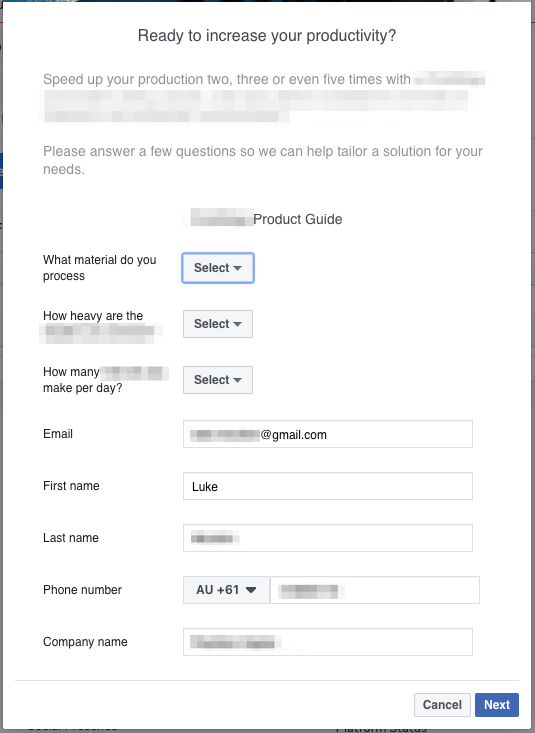
Follow-up. Every lead triggered an email notification to the sales team and was created in their Pipedrive CRM at the same time.
Results over six months
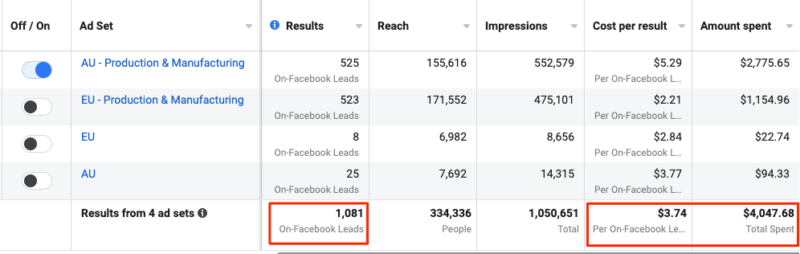
| Metric | Result |
|---|---|
| Total spend | AU$4,048 |
| Leads generated | 1,081 |
| Cost per lead | AU$3.74 |
At an average sale of AU$15,000, converting one lead in a thousand would have paid for the campaign. The qualifying questions were what made the volume useful: sales could see who was a buyer and who was a curious tradesperson before dialling.
B2B Targeting on Facebook in 2026
This is where most B2B advice about Facebook is out of date. Meta has pruned detailed targeting options repeatedly since 2022, and a large share of the job title, employer and industry segments that older guides rely on are gone or thin. Treat any “target CFOs by job title” advice with suspicion and build your audiences from what still works.
Custom audiences from your own data. Upload your customer list, your prospect list and your CRM’s closed-lost contacts as custom audiences. Retarget website visitors with the Meta pixel and people who opened a previous lead form. For B2B this is the highest-quality audience you will ever have, because you built it.
Lookalike audiences. A 1% lookalike of your best customers, seeded from a list that includes company email domains, is the closest thing Meta has to firmographic targeting. Seed it with buyers, not with every lead.
Business decision-maker behaviours. Under Behaviours, Meta still offers segments for business decision-makers and business decision-maker titles and interests, plus small business owners and Facebook Page admins. They are broad, but stacked with an industry interest they narrow well.
Interest stacks. Combine interests that only your buyer would have: the software they use, the trade publications they read, the industry associations they belong to, the trade shows they attend. A plant manager is hard to target by title and easy to find through the three industry magazines they follow.
Geography and language. Narrow to the regions you actually sell into. The manufacturer above ran Australia plus 22 European countries and nothing else.
Advantage+ audience. Meta’s automated audience expansion works surprisingly well for B2B once your pixel and CRM signals are flowing back, because the algorithm learns from who converts rather than from who you guessed. Give it your custom audiences as suggestions and let it widen from there.
Our Facebook ads targeting guide lists every option in detail.
Why Lead Ads Are the B2B Format
Sending B2B clicks to a landing page throws away the one advantage Facebook has: the form is already filled in. Meta instant forms pre-fill the person’s name, email and phone, and for B2B they also pre-fill job title, work email and company name from the profile. A prospect on a phone at 9pm can request a quote without typing a character.
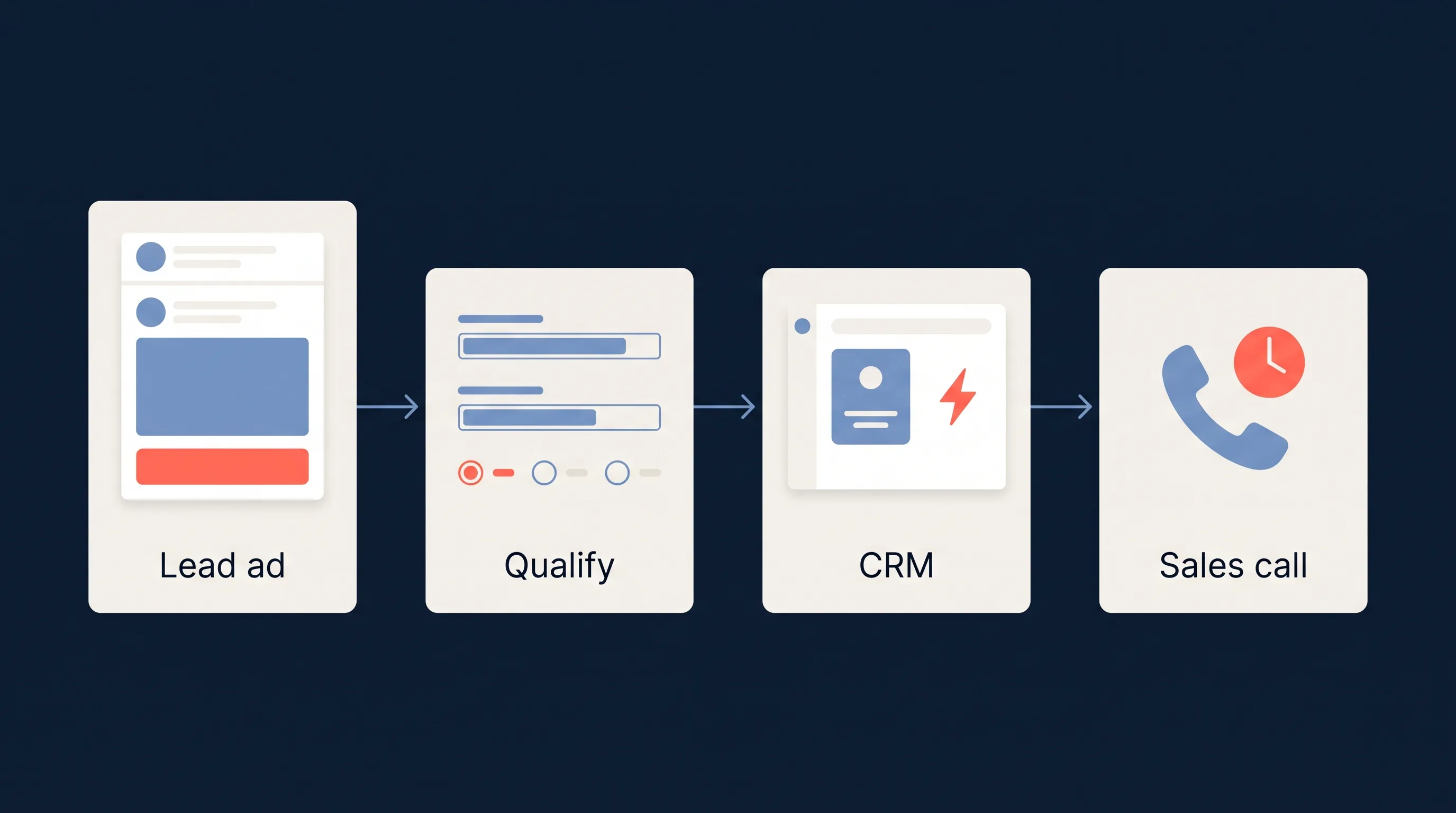
Three features turn that convenience into qualified pipeline:
- Custom questions. One multiple-choice question that predicts a sale: company size, the product they need, when they plan to buy. It costs a little completion and saves sales hours. Conditional questions let you branch, so a “manufacturing” answer leads to a different second question than “construction”.
- Higher intent form type. Adds a review screen before submission, which removes most accidental leads. For B2B, where every lead costs a phone call, it is usually worth the volume it trades away.
- Pre-filled business fields. Ask for work email rather than email, and add job title and company name. The fields cost nothing in friction and tell you who you are talking to.
Which fields can be pre-filled, and their quirks, are covered in our guide to Facebook lead ad fields that can be pre-filled.
6 B2B Facebook Lead Ad Examples
The right form depends on the offer. Six that work, with the fields, the one question worth asking, and where the lead should land.
1. Equipment or machinery quote
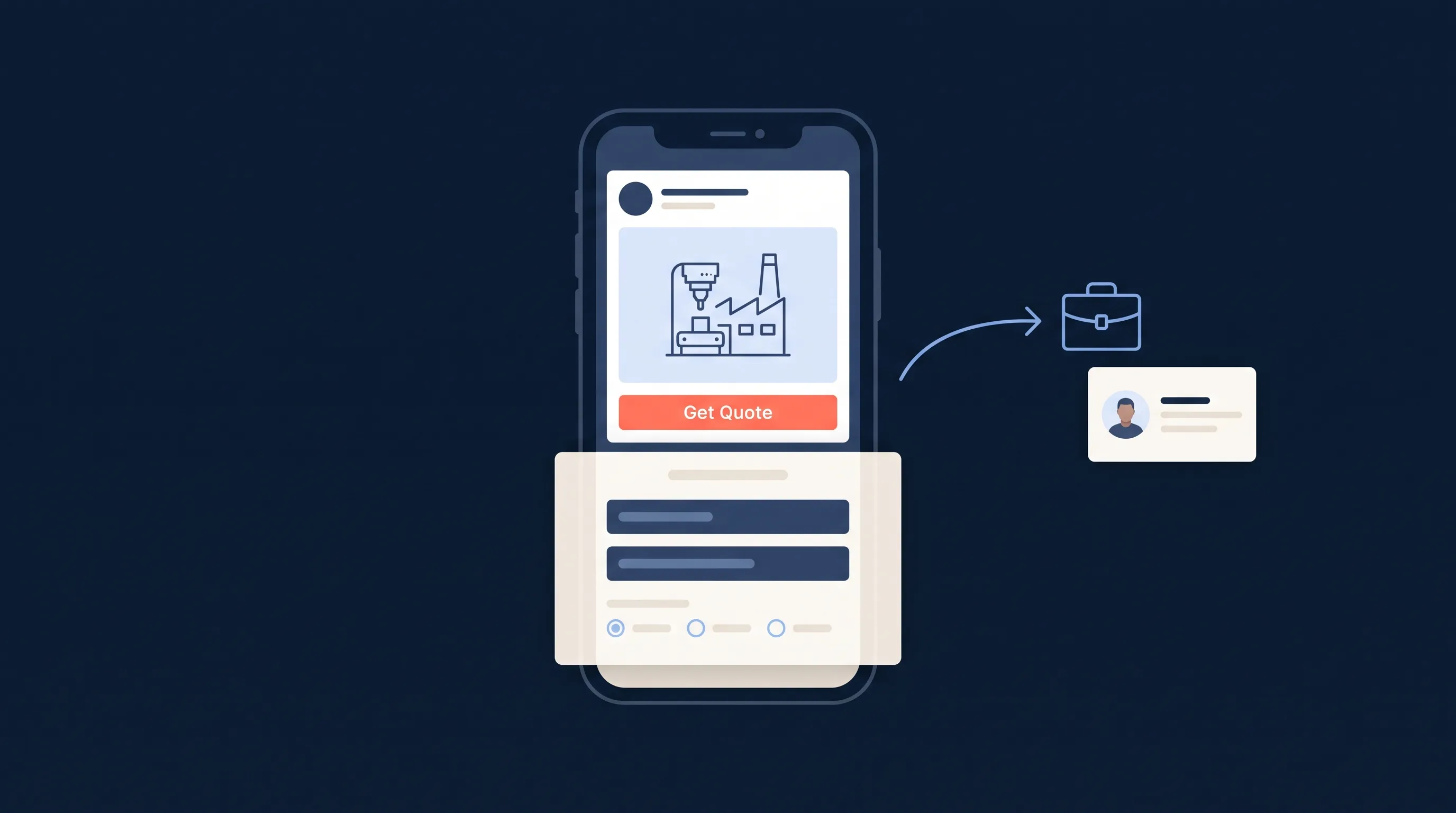
The manufacturer’s play. A carousel or short video of the machine working, a “Get a quote” button, and a form with name, work email, phone and company name pre-filled plus one question on the application or the volume they need. The lead goes to the CRM and to the salesperson’s phone as an SMS alert, because a quote request goes cold in hours.
2. Software demo request
A screen recording of the product doing the one thing the buyer cares about, with a “Book a demo” CTA. Pre-fill name, work email, job title and company name; ask company size as multiple choice. Use Higher intent. The lead lands in HubSpot or Salesforce as a new deal, assigned by company size.
3. Gated report or benchmark
A research report or industry benchmark for a niche audience. Name, work email, job title, company name; no custom question. Put the download on the thank-you screen and sync the lead to the email platform, tagged by asset, so the nurture sequence starts automatically. Lowest cost per lead of the six, softest intent.
4. Wholesale or trade account signup
For distributors, wholesalers and suppliers selling to trade customers. “Open a trade account” with name, phone, company name and a multiple-choice question on business type (retailer, contractor, installer). Route the lead to the account manager for the right channel.
5. Free tool, template or calculator
A cost calculator, a compliance checklist, a spreadsheet template. Three fields: name, work email, job title. No question. Deliver the file from the thank-you screen and follow up by email a day later with the next step.
6. Webinar or industry event
Pre-fill name, work email, job title and company; ask one short question on what they want covered. Sync to the webinar platform and the CRM at the same time so the invite and the sales record are created together.
Across all six, the pattern is the same as any Facebook lead ad campaign: match the number of fields to the size of the ask, use one question only when its answer changes what you do next, and decide before launch where the lead is going.
Creative and Copy That Works for B2B on Facebook
B2B ads on Facebook fail for the same reason most B2B content does: they talk about the company instead of the buyer’s problem.
- Lead with the outcome for the decision-maker. “Cut changeover time on the line by 40%” beats “Industry-leading automation solutions”.
- Show the product working. The manufacturer used carousels of machinery in operation. Screen recordings, before-and-after shots and short demo clips outperform brand imagery and stock photos of handshakes.
- Look native, not like a banner. Feed-style creative with a plain caption reads as content and gets read. Big headline text on a stock photo reads as an ad and gets skipped.
- Design for a phone. Almost all Facebook traffic is mobile. Vertical video, large text, one message per frame.
- Use social proof that a buyer would recognise. Customer logos, a named quote from a plant manager, a trade certification. Not star ratings.
- Test three creatives per ad set. Different image or video, same offer. Kill the losers after a week. Our Meta ads best practices and Facebook lead ads tips go deeper on both.
Qualifying B2B Leads from Facebook
Facebook gives you volume; the form and the follow-up give you quality. Four levers, and they stack.
- One qualifying question on the form. Multiple choice, and only if the answer changes routing or priority.
- SMS verification. Verify the phone number before the lead counts, so sales never dials a fake number.
- Lead scoring in the CRM. Score the custom question answers, the pre-filled job title and the company against your ideal customer. Our B2B lead scoring examples give four frameworks with point values.
- Conversion Leads through the Conversions API. Send the outcomes that matter (qualified, quoted, won) back to Meta and optimise for Conversion Leads instead of raw form fills. Meta’s published results are a 19% lower cost per quality lead on average, 21% for instant forms, and a 44% higher quality-lead rate. The CAPI for lead ads guide explains the setup; LeadSync sends the events for you.
Following Up B2B Leads Fast
A B2B buyer who requests a quote from three suppliers usually talks seriously to the first one who calls. Speed to lead is the highest-leverage B2B metric there is, and Facebook works against it by default: leads sit in Meta’s Leads Center with no notification until someone downloads a CSV, and Meta deletes them after 90 days.
The fix is the same one the manufacturer used. LeadSync reads each lead the moment Meta records it and delivers it where the sales team works:
- Into the CRM, including HubSpot, Salesforce, Pipedrive, Zoho CRM and Odoo, with every custom question answer mapped to a field
- To the rep by email, SMS or Slack, so the call happens in minutes
- Into a shared sheet with the Google Sheets sync for teams without a CRM yet
- Back to the lead with an email autoresponder that confirms the request and sets the expectation for the call
If you are choosing a CRM for the first time, our best CRM for Facebook leads comparison covers the options by team size.
Facebook vs LinkedIn for B2B Lead Generation
The question is not which platform, it is which job.
| Facebook and Instagram | ||
|---|---|---|
| Targeting precision | Interests, behaviours, your own lists and lookalikes | Job title, seniority, company, industry, skills |
| Cost per lead | Single to low double digits for a clear offer | Typically $75 to $130 |
| Lead form pre-fill | Name, email, phone, job title, work email, company | Name, work email, job title, company, seniority, size |
| Audience size | Almost everyone | Professionals, skewed to corporate and tech |
| Best for | Broad offers, lead magnets, SMB buyers, retargeting, volume | Named accounts, senior roles, enterprise, narrow ICPs |
| Minimum useful budget | Low | Meaningfully higher; learning is slower |
Use LinkedIn when the deal size justifies a $100 lead and the buyer is defined by title. Use Facebook when the buyer is also a business owner, when the offer travels (a guide, a tool, a quote), when you are retargeting people who already know you, or when the budget cannot absorb LinkedIn’s CPM. Most B2B teams end up running both: Facebook to fill the top of the funnel cheaply, LinkedIn to reach the accounts that matter. Our guides to LinkedIn Lead Gen Ads and B2B lead generation on LinkedIn cover the LinkedIn side, and Google, Meta, LinkedIn and TikTok lead ads compared puts all four side by side.
Frequently Asked Questions
Do Facebook ads work for B2B?
Yes, when the offer and the follow-up are built for it. Decision-makers use Facebook and Instagram personally, and Meta lead ads let them request a quote, a demo or a guide in two taps with their job title and work email pre-filled. Cost per lead is typically a fraction of LinkedIn’s; the trade-off is that you qualify on the form and in follow-up rather than through targeting alone.
How much do B2B Facebook ads cost?
Far less per lead than LinkedIn for the same offer. Published Meta ads benchmarks put the cross-industry average cost per action around $20 with CPCs under a dollar, and a real machinery manufacturer we tracked paid AU$3.74 per lead across 1,081 leads. LinkedIn lead gen forms typically cost $75 to $130 per lead. Your number depends on industry, offer and how tightly you qualify.
Can you target job titles and companies on Facebook?
Only in a limited way. Meta has removed many detailed targeting options since 2022, including a large share of job title, employer and industry segments. The reliable B2B options in 2026 are custom audiences built from your customer list or website traffic, lookalikes of those audiences, the business decision-maker behaviour segments, and interest stacks around business software, trade publications and industry associations.
Should B2B campaigns use lead ads or a landing page?
Lead ads for lead capture, landing pages for education. Meta instant forms pre-fill business fields and convert far better on mobile, which is where most Facebook traffic is. Use a landing page when the offer needs a long explanation, when you want the pixel hit for retargeting, or when the sale is complex enough that a form would attract the wrong people.
How do you qualify B2B leads from Facebook lead ads?
On the form and in the follow-up. Add one multiple-choice custom question that predicts a sale (company size, role, timeline or budget band), use the Higher intent form type to add a review step, verify phone numbers with SMS, and score the answers in your CRM. Then send qualified outcomes back to Meta through the Conversions API so the algorithm optimises for the leads that closed.
Facebook or LinkedIn for B2B lead generation?
Both, for different jobs. LinkedIn gives you precise job-title and company targeting at a high cost per lead, so it suits high-value, narrow-audience offers. Facebook gives you cheap reach and pre-filled lead forms, so it suits broader offers, retargeting, lead magnets and any market where the decision-maker is also a small business owner. Many teams use Facebook to fill the top of the funnel and LinkedIn to reach named accounts.
What is a good cost per lead for B2B Facebook ads?
There is no universal figure. Judge cost per qualified lead against your deal size and close rate rather than a benchmark. As a sanity check, single-digit to low double-digit costs per lead are common for B2B lead ads with a clear offer, and anything that keeps cost per qualified lead under a few percent of average deal value is working.
How do you reach decision-makers on Facebook?
Start from people you already know. Upload your customer and prospect lists as a custom audience, build a lookalike from your best customers, and retarget website visitors and past lead form openers. Layer Meta’s business decision-maker behaviour segments and interests tied to your industry, then let the creative and the offer do the filtering that targeting no longer can.
What should a B2B Facebook lead form ask?
Pre-fill full name, work email, phone number, job title and company name, then ask one multiple-choice question that changes how you route the lead: company size, the product or service they need, or when they plan to buy. Keep it to five or six fields. Every extra question lowers completion, and the pre-filled business fields already tell you most of what you need.
How do B2B leads get from Facebook to my CRM?
By default they sit in Meta’s Leads Center for 90 days waiting for a CSV download. A sync tool like LeadSync delivers each lead to your CRM, email platform, spreadsheet or inbox the moment it is submitted, with every custom question answer mapped to a field, and can alert the rep by email, SMS or Slack at the same time.
Start Generating B2B Leads on Facebook
The manufacturer’s campaign was not clever. A carousel of machines working, a form with three qualifying questions, an email to sales and a Pipedrive record for every lead. AU$22.50 a day. The part that made it work was that every lead reached a salesperson while the prospect still had the ad on their screen.
Next steps: build the campaign with our Facebook lead ad campaign guide, design the form with the Meta instant forms guide, or set up SMS verification before the first lead lands.