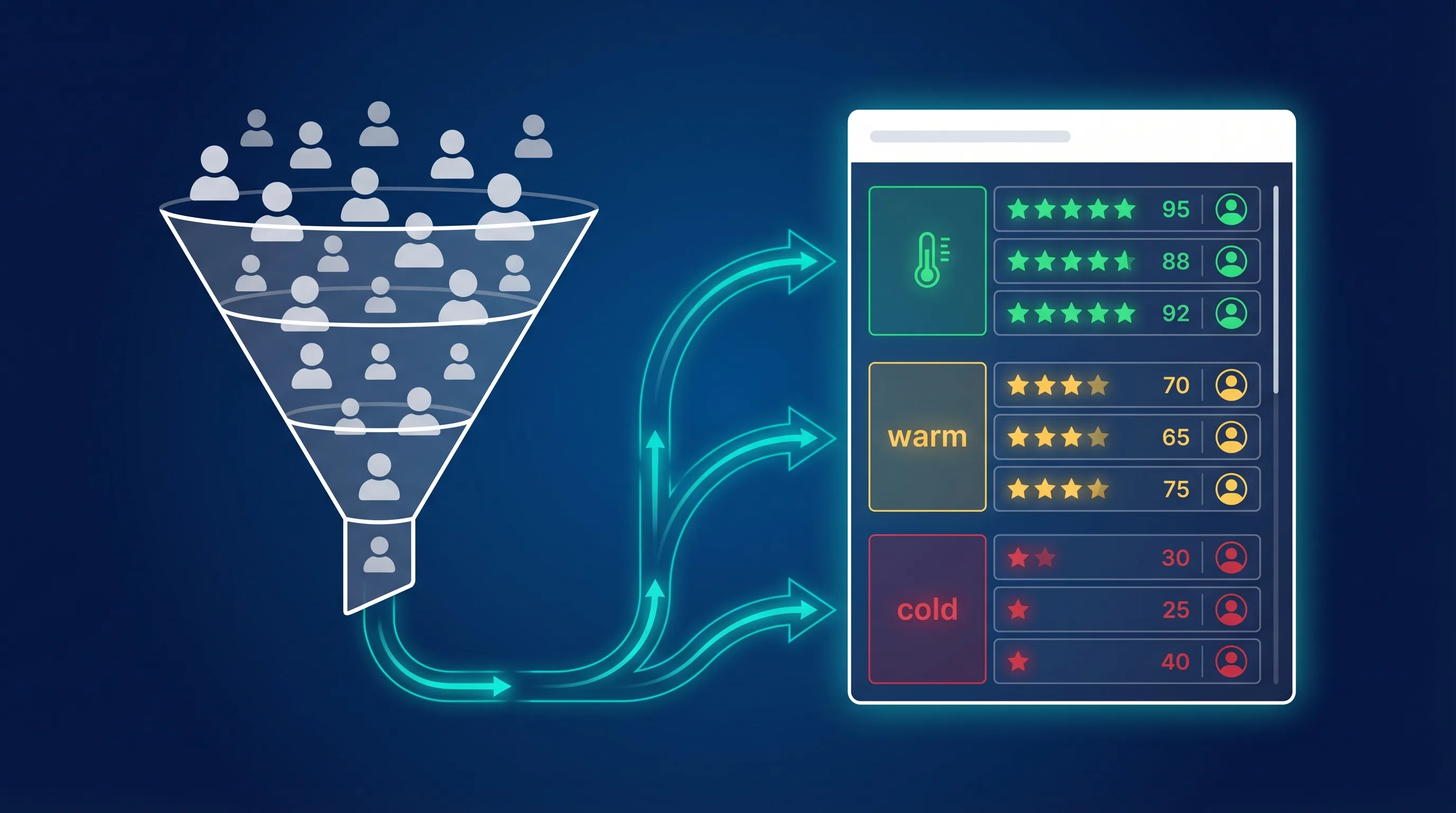
Most articles on B2B lead scoring will tell you it matters, explain the difference between explicit and implicit scoring, and then leave you to invent your own point values from scratch. That gap – between “you need a scoring model” and “here is a scoring model that actually works for a company like mine” – is what this post is for.
Below are four B2B lead scoring frameworks with real point-value criteria, each calibrated to a specific business model: B2B SaaS, a marketing agency selling to SMBs, a professional services firm, and an enterprise sales motion. Copy whichever fits closest to your business and adapt the weights from there.
If you want the conceptual primer first – what scoring is, the four scoring models, lifecycle stages, AI scoring – start with our lead scoring guide. This post is the example library that sits underneath it.
Key Takeaways
- B2B lead scoring is two scores, not one. Score the fit (firmographic + demographic match) and the engagement (behavioural + intent signals) separately, then combine them into a final tier. A high-fit lead with no engagement is a nurture; a high-engagement lead with no fit is a tyre-kicker.
- Start with 8–12 criteria, not 50. Almost every B2B scoring model that fails was over-engineered on day one. Pick the criteria you can actually measure and that you already know matter from closed-won data.
- Use negative scores aggressively. “Personal email address,” “competitor company,” and “student / job seeker” should all subtract points. Without negative scoring, every lead drifts upward over time.
- Calibrate against closed-won. Pull your last 50 customers, score them with your draft model, and check that your real customers actually clear the SQL threshold. If they don’t, the model is wrong, not the customers.
- Re-score monthly. B2B buying behaviour shifts. A model that worked in 2024 will misfire by 2026 if you don’t review the weights against actual outcomes.
What Makes B2B Lead Scoring Different
Before the example tables, a quick framing. B2B lead scoring has three structural differences from B2C scoring that change the math:
- Fit matters more than behaviour. A retail buyer’s purchase intent is dominated by behaviour – they’re either ready to buy or they’re not. A B2B buyer’s intent is dominated by fit – wrong company size, wrong industry, wrong role inside the company, no amount of engagement matters.
- Account-level signals trump lead-level signals. Three people from the same target account opening your pricing page is a stronger signal than one person opening it three times. B2B scoring models need to roll up to account-level scores wherever possible.
- Sales cycles are long, so recency decay is critical. A “free trial started” event from 14 months ago should not count the same as one from yesterday. Every behavioural score needs a decay function, typically halving the score every 30–60 days.
With that framing, here are the four frameworks.
Example 1: B2B SaaS (Product-Led Growth)
Context: A SaaS product with a free trial or freemium tier, selling to SMB and mid-market businesses (10–500 employees). Most leads sign up themselves; sales engages once they hit a usage threshold. Typical ACV: $5,000–$30,000.
Fit Criteria (max 50 points)
| Criterion | Points |
|---|---|
| Company size: 50–500 employees | +20 |
| Company size: 10–49 employees | +10 |
| Company size: 1–9 employees | +5 |
| Company size: 500+ employees | +15 |
| Industry: target vertical (e.g. SaaS, e-commerce, agencies) | +15 |
| Industry: adjacent vertical | +8 |
| Job title: Director / VP / C-level | +15 |
| Job title: Manager / Lead | +10 |
| Job title: Individual contributor | +3 |
| Country: tier-1 market (US/CA/UK/AU/EU) | +5 |
| Negative: personal email domain (gmail, yahoo, etc.) | −10 |
| Negative: student, intern, or job seeker keywords in role | −15 |
| Negative: competitor company domain | −25 |
Engagement Criteria (max 50 points, with 60-day decay)
| Criterion | Points |
|---|---|
| Signed up for free trial | +20 |
| Invited a team member | +15 |
| Connected an integration | +20 |
| Completed onboarding checklist | +10 |
| Visited pricing page 2+ times in 7 days | +10 |
| Viewed enterprise feature page | +8 |
| Started but didn’t finish onboarding | +3 |
| Replied to a sales email | +15 |
| Booked a demo | +25 |
| Negative: unsubscribed from email | −10 |
| Negative: no logins in 30 days post-signup | −5 |
Tier Thresholds
- SQL (sales-qualified): Fit ≥30 AND Engagement ≥40
- MQL (marketing-qualified): Fit ≥20 AND Engagement ≥20
- Nurture: Fit ≥20 AND Engagement <20
- Disqualified: Fit <10 OR negative-score-dominated
The key for B2B SaaS scoring is that fit and engagement are both gates. A free trial signup with a personal email and a 1-person “company” is not your customer, no matter how much they click around.
Example 2: Marketing Agency Selling to SMBs
Context: A marketing agency (paid ads, SEO, or full-service) selling to local and SMB businesses. Leads come from inbound content, paid social, and referrals. Typical retainer: $2,000–$10,000/month. Sales cycle: 2–6 weeks.
Fit Criteria (max 50 points)
| Criterion | Points |
|---|---|
| Annual revenue: $1M–$10M | +20 |
| Annual revenue: $250K–$1M | +12 |
| Annual revenue: <$250K | +3 |
| Annual revenue: $10M+ | +15 |
| Industry: target vertical (e.g. trades, e-commerce, professional services) | +15 |
| Industry: outside focus | −5 |
| Currently running paid ads | +15 |
| Currently using marketing automation | +10 |
| Job title: Owner, CEO, CMO, Marketing Director | +15 |
| Job title: Marketing Manager / Coordinator | +8 |
| Negative: in-house marketing team of 5+ (likely won’t outsource) | −10 |
| Negative: business under 12 months old | −10 |
| Negative: competing agency | −25 |
Engagement Criteria (max 50 points, with 30-day decay)
| Criterion | Points |
|---|---|
| Filled out “Get a Proposal” form | +25 |
| Filled out “Get Pricing” form | +20 |
| Booked a discovery call | +30 |
| Downloaded a case study | +10 |
| Visited services page 2+ times | +10 |
| Watched a customer testimonial video (≥75% completion) | +12 |
| Read a blog post about a service we offer | +5 |
| Engaged with us on LinkedIn | +8 |
| Referred by an existing client | +20 |
| Negative: opened email but bounced from site within 10 seconds | −3 |
Tier Thresholds
- Call within 5 minutes: Fit ≥30 AND Engagement ≥40 (especially booked discovery calls)
- Call within 24 hours: Fit ≥20 AND Engagement ≥25
- Nurture sequence: Fit ≥15, Engagement 10–24
- Disqualified: Fit <10 or competing agency
For agency lead scoring, the “currently running ads” signal is unusually load-bearing – it tells you the prospect already understands paid acquisition and isn’t going to bristle at the budget conversation. We’ve written more about agency-specific funnel mechanics in our agency lead generation playbook.
Example 3: Professional Services (Accounting, Legal, Consulting)
Context: A professional services firm (accountancy, law, business consulting) selling to mid-market businesses. Leads come from referrals, content marketing, and LinkedIn. Engagements: $5,000–$100,000 per project. Sales cycle: 4–12 weeks.
Fit Criteria (max 50 points)
| Criterion | Points |
|---|---|
| Company size: 20–250 employees | +20 |
| Company size: 250+ employees | +15 |
| Company size: under 20 employees | +5 |
| Industry: target vertical | +15 |
| Industry: regulated industry (finance, healthcare, manufacturing) – if relevant | +10 |
| Job title: CFO, COO, General Counsel, Owner | +20 |
| Job title: Director / Head of Department | +12 |
| Job title: Manager | +5 |
| Geography: in-service-area | +10 |
| Existing referral relationship (introduced by client/partner) | +20 |
| Negative: revenue under $1M (rarely fits service tier) | −10 |
| Negative: looking for “free advice” indicators in form notes | −10 |
Engagement Criteria (max 50 points, with 45-day decay)
| Criterion | Points |
|---|---|
| Filled out consultation request form | +25 |
| Filled out “speak to a partner” form | +30 |
| Visited service-area page 3+ times | +12 |
| Downloaded a whitepaper or industry report | +10 |
| Attended a webinar or in-person event | +20 |
| Engaged with partner on LinkedIn (followed, commented) | +10 |
| Read 3+ articles on the same service topic | +12 |
| Provided phone number on form (not just email) | +5 |
| Negative: only ever visited careers page | −10 |
Tier Thresholds
- Partner outreach within 24 hours: Fit ≥35 AND Engagement ≥40 (especially referral introductions)
- Senior associate follow-up: Fit ≥25 AND Engagement ≥25
- Nurture / newsletter: Fit ≥15
- Polite decline / referral out: Fit <15
Professional services scoring leans heavily on the referral signal and the seniority of the role. A General Counsel filling out a form is qualitatively different from an admin assistant filling it out on their boss’s behalf, and the scoring should reflect that.
Example 4: Enterprise Sales (Mid-Market & Enterprise Software)
Context: An enterprise software vendor selling to companies with 500+ employees. Account-based selling motion. Six-figure ACVs. Sales cycle: 3–9 months. Multiple stakeholders per deal.
Fit Criteria (max 50 points)
| Criterion | Points |
|---|---|
| Company size: 1,000+ employees | +20 |
| Company size: 500–999 employees | +15 |
| Company size: 250–499 employees | +5 |
| Company in target account list (named accounts) | +20 |
| Industry: target vertical | +10 |
| Job title: VP, SVP, EVP, C-level | +20 |
| Job title: Director | +12 |
| Job title: Senior Manager / Manager (decision influencer) | +6 |
| Technology fit: uses complementary tools in our stack | +10 |
| Compliance / security requirements that we meet | +5 |
| Negative: not in target account list AND <500 employees | −15 |
| Negative: country / region outside our enterprise coverage | −10 |
Engagement Criteria (max 50 points, account-rolled-up, with 90-day decay)
Enterprise scoring rolls multiple people’s engagement into a single account score:
| Criterion | Points |
|---|---|
| 3+ people from the account engaged in last 90 days | +20 |
| 2 people from the account engaged in last 90 days | +12 |
| Pricing page visited by anyone at the account | +10 |
| Security / compliance page visited | +10 |
| Demo requested | +25 |
| RFP / RFI received | +30 |
| Procurement contact engaged | +15 |
| Custom landing page (ABM) viewed | +15 |
| Attended an exec dinner / private event | +25 |
| Negative: incumbent vendor renewal recently announced publicly | −15 |
Tier Thresholds
- AE outreach + ABM motion activated: Account fit ≥35 AND engagement ≥40
- SDR sequence: Account fit ≥25 AND engagement ≥15
- Account-based nurture (long horizon): Account fit ≥30, engagement <15
- Removed from active pursuit: Fit <15 or incumbent recently signed
The defining feature of enterprise scoring is that the unit of analysis is the account, not the individual lead. A single high-engagement lead at a target account is more interesting than ten high-engagement leads at non-target accounts. Set up your CRM and marketing automation to roll engagement up to the account record, not just the contact.
A Note on Where the Lead Data Comes From
All four of these frameworks assume one thing: that the data you need to score on actually makes it into your CRM in a form your scoring engine can read. In practice, this is where most B2B scoring efforts collapse.
The most common failure is that ads-platform leads (Meta Lead Ads, LinkedIn Lead Gen Forms, Google Lead Form Ads) land in the CRM with only name, email, and phone – none of the firmographic enrichment or behavioural breadcrumbs that the scoring model needs. The fix isn’t to lower the bar of the scoring model. It’s to:
- Enrich at ingestion: use a lead enrichment tool to append firmographic data (company size, industry, revenue, tech stack) the moment a lead lands.
- Map custom Meta Lead Ad form questions to scoring fields – annual revenue range, role, company size are all askable on the form itself.
- Send lead quality back to Meta via Conversions API so the ad algorithm starts optimising for high-fit leads instead of just form fills.
Without that data infrastructure underneath, even a beautifully calibrated scoring model will produce garbage scores, because the inputs are garbage.
Frequently Asked Questions
What is a good lead scoring model for B2B?
A good B2B scoring model has two parallel scores – fit (firmographic + demographic match) and engagement (behavioural signals with time decay) – combined into a tier threshold. Most working models use 8–12 criteria per score, not 50, and include explicit negative scoring for disqualifiers like personal emails, competitors, and out-of-market leads.
How many points should each criterion in a B2B lead scoring model be worth?
Anchor the highest-weight criterion at 20–25 points and scale others relative to it. Don’t fall into the trap of giving every criterion 5 points “for fairness” – that flattens the signal and makes the score useless. The goal is for two leads with different scores to genuinely behave differently.
What’s the difference between MQL and SQL in B2B scoring?
An MQL (marketing-qualified lead) clears the basic fit threshold and has shown initial engagement – they’re ready for nurture sequences but not yet for a sales call. An SQL (sales-qualified lead) clears both fit and engagement thresholds and has demonstrated purchase intent (demo request, pricing inquiry, RFP). Sales should treat SQLs as their working queue; marketing should keep MQLs warm.
Should I score leads at the contact level or the account level for B2B?
For SMB and mid-market sales: contact level is usually fine because deals typically have one decision-maker. For enterprise and account-based selling: account level is essential – you need to see that three people from the same target company are engaged, not just one. Most CRMs support both; set up account-level rollup if your motion is ABM.
How often should I recalibrate a B2B lead scoring model?
Review monthly, recalibrate every quarter. Pull your last 50–100 closed-won deals and score them with your current model. If your average customer doesn’t clear the SQL threshold, the model is wrong. If everyone clears it, the threshold is too generous. Adjust weights and re-test.
How do I score leads from Facebook or LinkedIn Lead Ads?
Add scoring-relevant custom questions to the lead form itself – annual revenue range, role, company size, primary need. Pipe those answers through to your CRM via LeadSync and use them as direct inputs to the fit score. Then send the resulting lead quality back to the ad platform via the Conversions API so the algorithm starts optimising for fit, not just form fills.
Putting Your B2B Scoring Model Together
The four frameworks above are starting points, not endpoints. The actual work, and the actual moat – is calibrating your model against your own closed-won data, not somebody else’s templates.
Three practical steps to make any of these frameworks real:
- Pull your last 50 customers. Score them with the framework that matches your business model. Note where the model rates them.
- Pull your last 50 unqualified leads (rejected, no-shows, ghost-after-demo). Score them with the same framework. Note the gap.
- Set your SQL threshold at the midpoint of those two distributions, then move it up or down monthly based on what your sales team actually closes.
A scoring model that survives contact with your real pipeline will look meaningfully different from a scoring model that survives contact with a blog post. The point of the blog post is to spare you the part where you stare at a blank spreadsheet wondering what counts as +5 versus +20. The frameworks above give you the +5/+20 calibration. The rest is data and iteration.
For the conceptual foundation behind these examples – what scoring is, the four scoring models, lifecycle stages, and AI-augmented scoring – see our complete lead scoring guide.