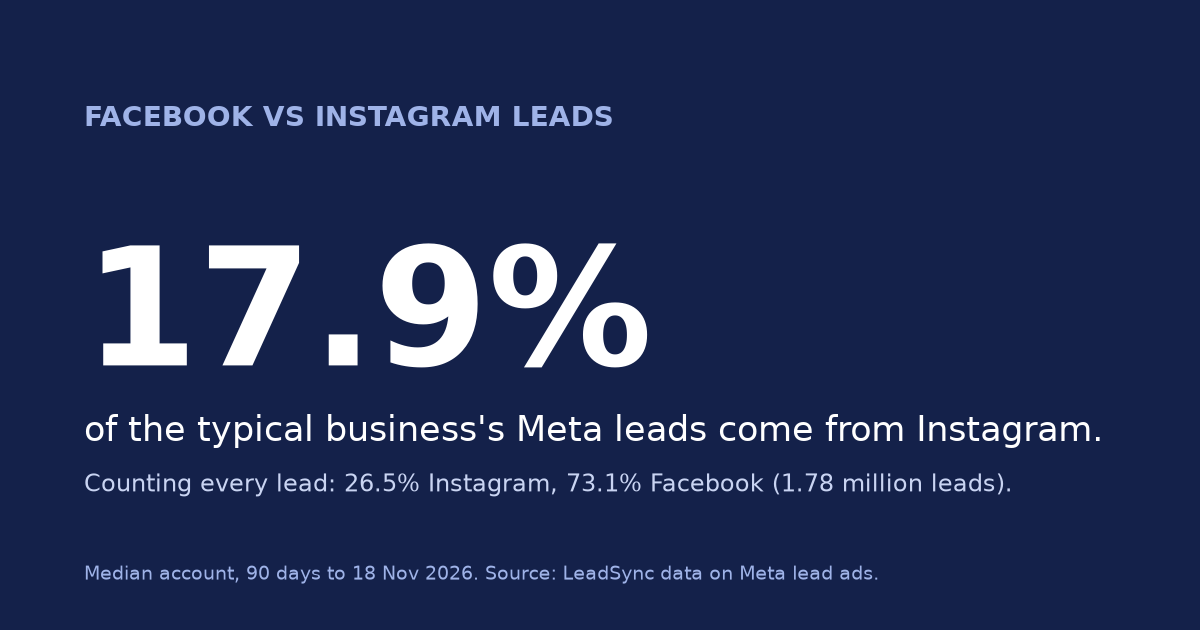
As of November 2026, the typical business running Meta lead ads gets 17.9% of its leads from Instagram and nearly all of the rest from Facebook. That is the median across the LeadSync accounts that received at least 20 Meta leads in the 90 days to 18 November 2026.
Count every lead instead of every business and the number goes up. Of the 1.78 million unique Meta leads LeadSync received between 27 November 2025 and 18 November 2026, 26.5% came from Instagram and 73.1% from Facebook.
Where do these numbers come from? LeadSync delivers lead ad leads to CRMs, spreadsheets, inboxes and phones. Meta labels every real lead with the app it came from (fb for Facebook, ig for Instagram, an for Audience Network, Meta’s network of partner apps), and we store that label with the lead. We haven’t found anyone else publishing this split for lead ads, so here it is, with the data free to download.
How much of a typical business’s leads come from Instagram?
For most businesses, less than a fifth. We looked at each LeadSync account with at least 20 Meta leads in the 90 days to 18 November 2026 and worked out what share of its leads came from Instagram:
- The median account got 17.9% from Instagram.
- Half of the accounts fell between 8.3% and 31.7%. Above 31.7% puts an account in the top quarter.
- A few accounts got no Instagram leads at all. We can’t see campaign settings, so we don’t know why. Instagram placements being switched off is one possible reason.
- About 1 in 10 accounts got half or more of their leads from Instagram. None got all of them.
If Instagram brings you somewhere between about one lead in twelve and one in three, you’re in the middle half of the accounts we see.
Counting every lead, about a quarter come from Instagram
Counting every lead gives the biggest advertisers the most weight, and a few very large advertisers in our data get an above-average share from Instagram. That pulls the lead-weighted figure above the typical account’s.
| App | Unique leads | Share |
|---|---|---|
| 1,299,300 | 73.1% | |
| 471,612 | 26.5% | |
| Audience Network | 6,196 | 0.3% |
Unique Meta leads LeadSync received, 27 November 2025 to 18 November 2026.
In the same 90 days as the typical-account figures, 27.2% of all leads came from Instagram, while the median account got 17.9%. If you want to know what to expect for one business, use the median. If you want Instagram’s share of all the leads in our data, use 26.5%.
Has Instagram’s share changed over the year?
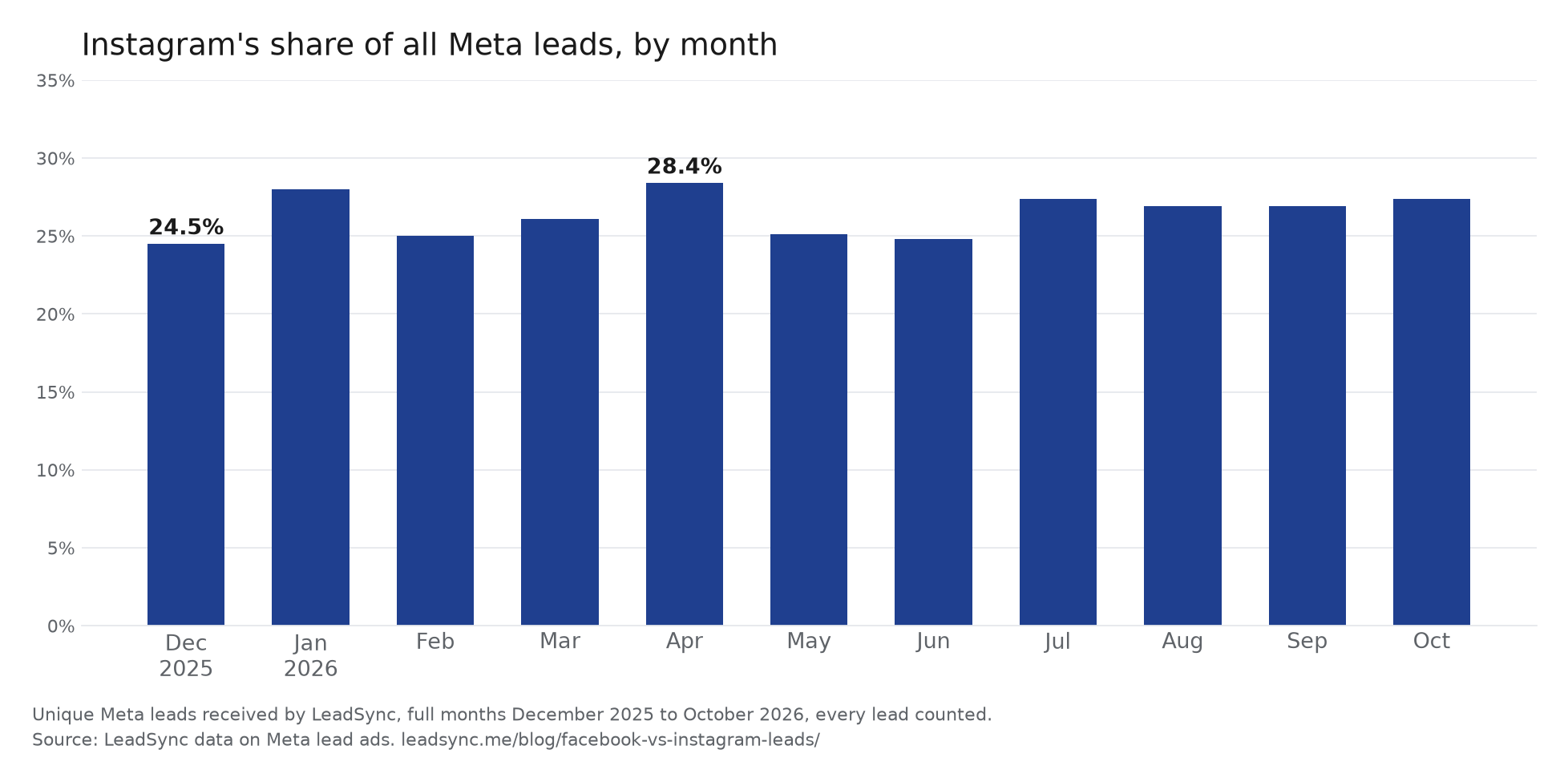
Not much. In full months, Instagram’s share of all Meta leads stayed between 24.5% (December 2025) and 28.4% (April 2026). It moved up and down from month to month without a steady rise or fall.
| Month | Unique Meta leads | From Instagram |
|---|---|---|
| Nov 2025 (from 27 Nov) | 20,770 | 23.3% |
| Dec 2025 | 172,306 | 24.5% |
| Jan 2026 | 157,717 | 28.0% |
| Feb 2026 | 123,228 | 25.0% |
| Mar 2026 | 135,592 | 26.1% |
| Apr 2026 | 154,310 | 28.4% |
| May 2026 | 135,576 | 25.1% |
| Jun 2026 | 134,352 | 24.8% |
| Jul 2026 | 183,766 | 27.4% |
| Aug 2026 | 177,953 | 26.9% |
| Sep 2026 | 159,958 | 26.9% |
| Oct 2026 | 146,020 | 27.4% |
| Nov 2026 (to 18 Nov) | 75,564 | 28.9% |
The first and last rows are part months, so don’t read much into them. Instagram leads also peak about an hour later in the evening than Facebook leads (10pm against 9pm), which we covered in our report on when Facebook leads come in.
Which industries get the most leads from Instagram?
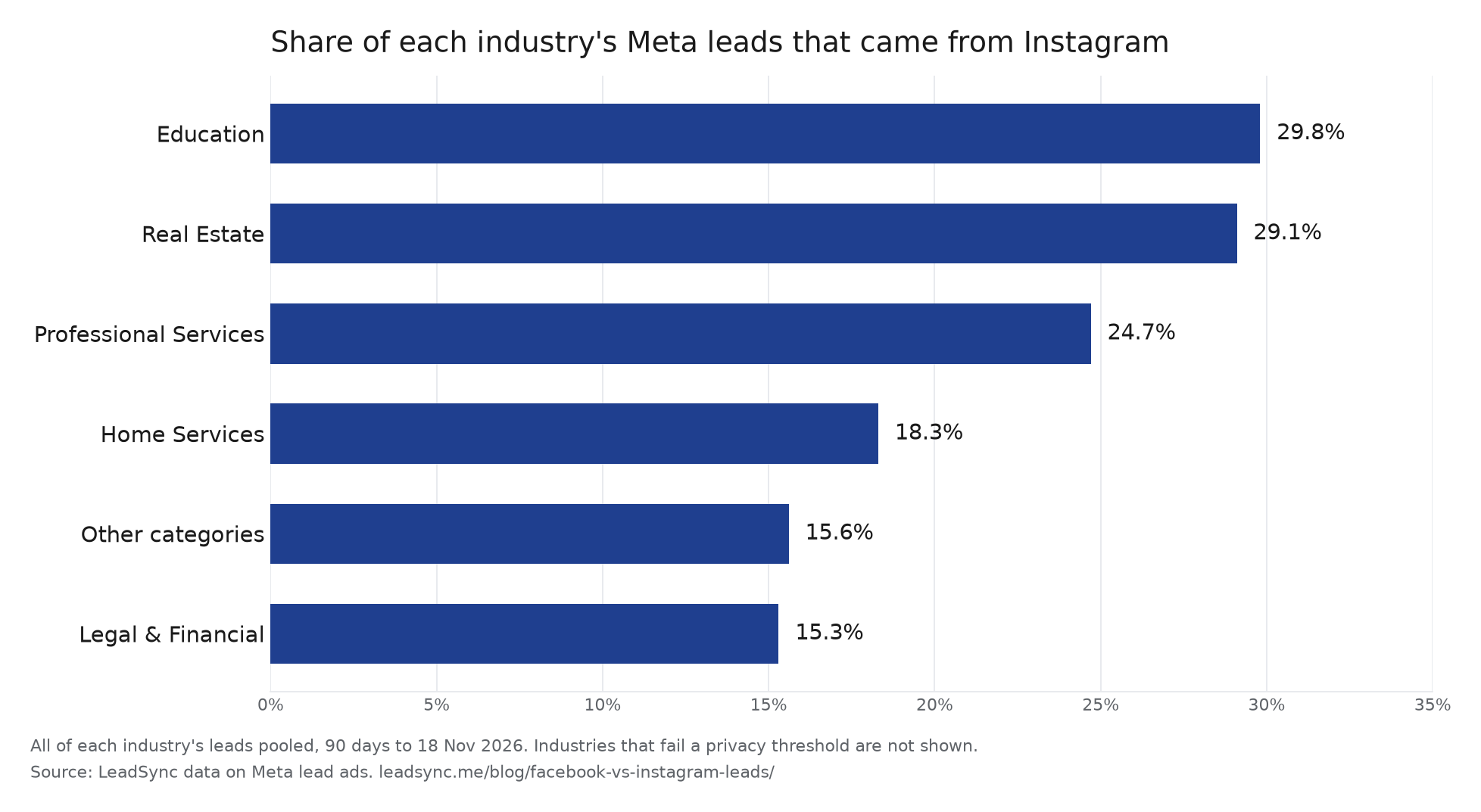
Real estate and education. In the 90 days to 18 November 2026, close to 30% of their Meta leads came from Instagram. Home services, legal and financial businesses, and accounts with no industry match got 15% to 18%.
| Industry | From Instagram |
|---|---|
| Education | 29.8% |
| Real Estate | 29.1% |
| Professional Services | 24.7% |
| Home Services | 18.3% |
| Other categories (no industry match) | 15.6% |
| Legal & Financial | 15.3% |
These are pooled figures: all of an industry’s leads counted together, not the typical account in that industry. In the smaller groups, one or two large advertisers can move the number. To protect customer privacy, industries that don’t have enough accounts are not shown, and their leads are not in any row. Our industry report has more on which industries run Meta lead ads in the first place.
Does a higher Instagram share mean Instagram works better?
Not on its own. These are shares of leads, not of ad spend or cost per lead. Advantage+ placements (formerly automatic placements), Meta’s default, lets Meta choose where each ad appears, so the split reflects Meta’s delivery as well as how people respond. We can’t see which accounts had it switched on.
To compare the two apps on your own account:
- In Ads Manager, open your lead campaign, use the Breakdown menu and choose Platform. Compare cost per lead for Facebook and Instagram. Meta says these breakdown values are estimates.
- Send the platform value with every lead to your CRM or spreadsheet, then check which app’s leads become customers. Our Instagram lead ads guide shows how to tell Instagram leads apart and where the platform field lives.
- Only then think about switching placements off. Narrowing placements can push costs up, which we cover in how to lower your Facebook lead ads cost per lead.
Methodology
- Leads: unique Meta lead ad leads that LeadSync received between 27 November 2025, when our per-lead records begin, and 18 November 2026. Each lead is counted once, however many destinations it went to. Counting only leads delivered to at least one destination gives almost the same split (26.7% Instagram).
- App label: the app value Meta sends with each lead. Test leads from Meta’s testing tool carry no app label and are excluded, along with LeadSync’s own account. About 5,900 real leads from late November 2025 to February 2026 were stored without an app label, so they are left out too. Four leads carry both app labels, which is why the app rows add up to four more than the 1,777,104 distinct leads. The monthly rows add up to 1,777,112, eight more than the distinct total, because a handful of leads are counted twice in the monthly figures.
- Typical account: each account with at least 20 unique Meta leads in the 90 days to 18 November 2026 gets its own Instagram share; the figures above are the median and quartiles of those shares.
- Industries: the industry figures include every account with at least one Meta lead in the 90 days to 18 November 2026, and an account with Pages in more than one industry is counted in each. Industry groups were formed by matching keywords in Meta’s Page category names (for example “plumbing” or “roofing” into Home Services). Pages with general categories such as “Product/service” or “Local business”, and some that match no keyword (such as “Estate agent”), fall into Other, and marketing agencies count as Professional Services. An industry is shown only when it includes enough accounts that no single business’s figures can be worked out from it.
- Who is in the sample: LeadSync customers, who are not a random sample of all Meta advertisers.
Download the data
Download the data as a CSV (every figure on this page, one row per number).
The data and charts are published under CC BY 4.0. You can use, share and adapt them, including commercially, as long as you credit LeadSync, link to this page and to the licence, and say if you changed anything. A suggested citation:
Moulton, L. (19 November 2026). Facebook vs Instagram Leads: How Many Come From Instagram? LeadSync. https://leadsync.me/blog/facebook-vs-instagram-leads/
Frequently Asked Questions
What percentage of Meta leads come from Instagram?
For the typical business, about 18%. Across LeadSync accounts with at least 20 Meta leads in the 90 days to 18 November 2026, the median account got 17.9% of its Meta leads from Instagram, and half of the accounts got between 8.3% and 31.7%. Counting every lead instead of every business, 26.5% of the 1.78 million unique Meta leads LeadSync received from November 2025 to November 2026 came from Instagram, because a few very large advertisers get an above-average share from Instagram.
Do Facebook lead ads get more leads than Instagram lead ads?
For most businesses, yes. In LeadSync’s data, Facebook supplied 73.1% of all Meta leads, and the typical account got less than a fifth of its leads from Instagram. Advantage+ placements, Meta’s default, lets Meta choose where ads run, so the split reflects Meta’s delivery as well as how people respond. Compare cost per lead by app in Ads Manager before deciding one app works better.
Which industries get the most leads from Instagram?
In the 90 days to 18 November 2026, education (29.8%) and real estate (29.1%) had the highest share of Meta leads from Instagram in LeadSync’s data, followed by professional services (24.7%). Home services (18.3%) and legal and financial businesses (15.3%) got the least. These are pooled figures for each industry, and some industries are not shown to protect customer privacy.
Get every lead with its app label
LeadSync sends each Facebook and Instagram lead to your CRM, Google Sheet, inbox or phone within seconds. Every real lead carries its platform value, so you can map it and see your own split instead of ours. Try LeadSync free for 7 days. No credit card required. Start your free trial.