Most “Meta Ads best practices” posts stop at creative. They tell you to shoot 9:16 video, hook hard in the first three seconds, run Advantage+ – then leave you at the “publish campaign” button.
That’s the easy half. The part that actually decides whether your campaign pays back is what happens after a prospect submits the form.
We’ve processed over 11 million Meta leads through LeadSync since 2016, and we currently see live traffic from 400+ active Meta Lead Ads accounts across 50+ countries. That view – from the inside of the platform, across every industry and budget size – is the lens for this guide. The best practices that consistently separate advertisers who scale from advertisers who get stuck aren’t creative tricks. They’re a full-funnel set of habits that start at the ad and end when the lead is in a CRM, being called, and sending signal back to Meta via the Conversions API.
We’ve broken down the industry-level patterns we see in our 2026 Meta Lead Ads industry report. This post is the distilled playbook – what to actually do based on what’s working.
Below are the 18 Meta Ads best practices – grouped into eight categories – that we see actually move the needle in 2026.
Key takeaways
- 1 in 3 Meta Lead Ads accounts in our platform is in real estate, and home services punches above its weight as the quiet #2 – smaller audiences, higher commitment to automation. Full industry breakdown →
- The cross-industry average Facebook Lead Ad converts at 7.72% and costs $27.66 per lead (WordStream, 2025) – CPL is up 21% year-over-year, so 2026’s margin for error is smaller than 2025’s.
- Cost per lead varies ~24x between industries: from $3.16 (restaurants) to $76.71 (dentists). Benchmark against your vertical, not the overall average.
- Leads contacted within 5 minutes are 21x more likely to convert than leads contacted after 30 minutes. Speed-to-lead is the single highest-ROI best practice, and the one most advertisers still skip.
- Audience size is not the input – lead capture efficiency is. In our data, the industries with the largest Facebook audiences (automotive brands averaging 1.15M followers) rank near the bottom for paid Lead Ads usage. The 500-follower plumber with automated routing outperforms them every time.
- Three patterns separate winners from losers in every account we see: specific creative + offer, short qualifying form (3-5 fields), follow-up in under 5 minutes. Everything else is a rounding error.
Creative Best Practices
Creative is the single biggest driver of Meta Ads performance. In 2026 it matters more than targeting, because Advantage+ Audiences is doing more of the audience work automatically. Spend your optimization time on the asset, not the audience.
1. Default to 9:16 vertical video
Vertical video is the native format on Reels, Stories, and the Facebook feed. Square (1:1) and landscape (16:9) creative still work, but they consistently underperform vertical in cost per lead – partly because they get cropped on mobile, and partly because Meta’s delivery algorithm favors formats that fit placements where users actually spend time.
If you only have one asset, make it 9:16. If you have budget for two, make the second one 1:1 so it performs on desktop and in-feed.
2. Win the first three seconds
Most Meta users scroll past an ad in under 1.7 seconds. The hook – the first frame, first line of copy, or opening sound – is the entire ad.
Strong openers we see repeatedly in high-performing accounts:
- Pattern interrupt: an unexpected visual or statement that stops the thumb
- Specific claim: “We cut this dentist’s CPL from $82 to $19 in 14 days”
- Direct question: “Paying more than $40 per lead on Meta? Watch this”
- Before/after cut: on fitness, renovation, automotive, landscaping
Generic brand openers (“At Acme Roofing, we’ve been serving…”) are the fastest way to waste spend. For more, see our full guide on writing ad copy for Facebook lead generation.
3. UGC consistently beats polished production
In 2026, a selfie-style customer testimonial or a tradesperson explaining a job from the work site outperforms a $5,000 studio-shot ad in nine out of ten accounts we’ve looked at. It’s not that production quality doesn’t matter, it’s that production quality reads as ad, and ad-shaped creative gets ignored.
Budget for UGC first, branded video second. See our user-generated video content playbook for specific sourcing, briefing, and editing patterns.
4. Keep video length honest to the platform
Reels and Stories reward 15-30 second videos. Feed rewards 30-60 seconds. Anything over 90 seconds on Meta is rarely worth it, even if your story is that complex, breaking it into a short hook ad + a remarketing video to warm audiences usually outperforms a single long ad.
Our best video length for Facebook Ads breakdown covers placement-by-placement benchmarks.
Targeting Best Practices
Meta’s 2026 targeting philosophy is the opposite of 2019’s – fewer filters, not more. The algorithm gets better than human targeters once it has enough signal. Your job is to give it that signal cleanly.
5. Default to Advantage+ Audiences with a creative-led budget
For most lead-gen accounts in 2026, the cleanest setup is Advantage+ Audiences + a broad geographic filter, letting Meta’s delivery model find the ICP from your creative, offer, and conversion signal. Suggested audience inputs (interests, behaviors) become hints rather than hard constraints.
This is a directional shift – a few years ago, narrow interest stacks were the right call. Today, unless you have strong conversion data already flowing back, Advantage+ Audiences will match or beat manual targeting at a fraction of the setup effort.
6. Use custom audiences from closed-won, not form fills
The biggest targeting upgrade most advertisers can make in 10 minutes: upload a list of your closed-won customers (not your lead list) as a custom audience, and create a 1% lookalike from that seed.
A lookalike built from form fills will find you more form fills. A lookalike built from closed-won will find you more customers. The distinction is worth 20-40% on downstream ROI in almost every account we’ve audited. See our full custom audiences for lead gen guide for the exact list hygiene.
7. Layer geo, then let Meta handle the rest
For local lead gen (home services, real estate, medical, legal), the one manual filter that still matters is geographic targeting at your serviceable radius: typically 5-15 miles around your locations. Outside of geo, trust Advantage+.
This matches what we see in our data: the US (~240 accounts) and Australia (~155 accounts) alone account for more than half of Meta Lead Ads activity on our platform, and the dominant verticals in those markets are hyper-local (real estate 35% of pages, home services 13%). Lead Ads concentrate where the geo is tight.
Our targeting guide walks through the full 2026 setup – including the trade-offs between “People living in this location” vs. “People traveling in this location,” which trips up more than half of local advertisers.
Form Design Best Practices
The form is where conversions are won or lost. You’ve already paid for the click – now everything comes down to whether the prospect finishes the form.
8. Cap your form at 3-5 fields
Every field you add above 5 costs you conversions. The sweet spot for most industries is name, email, phone, and one qualifying question: that’s four fields, three of which Meta pre-fills from the user’s profile. Each extra field drops completion rates by 5-15%.
If you need more data, capture it after the form submit – in a follow-up email, a booking page, or the first phone call. See our 12 ways to increase lead form conversions for the full hierarchy of what to cut.
9. Turn on the “Higher Intent” confirmation step
Meta’s Higher Intent form type adds a review-and-confirm screen after the form fields. You get fewer total leads, but the leads you get are 2-3x more likely to be real, intentional, and reachable.
For any business where lead quality matters more than lead volume – legal, finance, B2B, higher-ticket services – Higher Intent should be the default.
10. Use conditional questions to pre-qualify
Adding 1-2 conditional qualifying questions (e.g., “What’s your budget range?” or “When do you need this completed?”) lets you disqualify bad-fit leads at the form stage. Yes, your form-fill count drops. Yes, your cost per qualified lead usually drops with it.
This is the pattern that stands out in our legal and financial customers – 10% of our active accounts, and some of the highest-value leads on the platform. A single legal client can be worth $5,000 to $50,000+; at that math, filtering out bad-fit leads at the form is cheaper than filtering them out with intake-coordinator time.
Our conditional answers for Facebook lead ad forms walks through the exact Meta setup. Pair it with the lead qualification framework to design the questions themselves.
Testing & Optimization Best Practices
Most accounts we look at are over-testing. Running 12 ad variants at a $50/day budget means nothing is statistically significant – Meta’s delivery phase hasn’t finished, and you’re iterating on noise.
11. Test one variable at a time, and let it finish
A disciplined Meta Ads test changes one thing: the creative, or the headline, or the offer, not all three. And it waits until each variant has cleared Meta’s learning phase (~50 optimization events) before reading the result.
Moving too fast is the single most common reason accounts plateau. Our A/B testing framework for Facebook Lead Ads covers sample sizes, learning-phase mechanics, and the specific variables worth testing in order.
12. Kill losing ads on a schedule, not on instinct
Once a test is statistically clear, turn off the losers. Keep the best 2-3 ads running; don’t emotionally attach to a concept that isn’t performing. Our testing guide covers the read-and-decide cadence that works for most budgets.
Conversions API Best Practices
Conversions API (CAPI) is Meta’s server-side event channel. Instead of (or alongside) the browser pixel, your server sends lead and conversion events directly to Meta. In 2026, after three years of iOS privacy changes and tracking-prevention rollouts, CAPI is no longer an optimization, it’s table stakes.
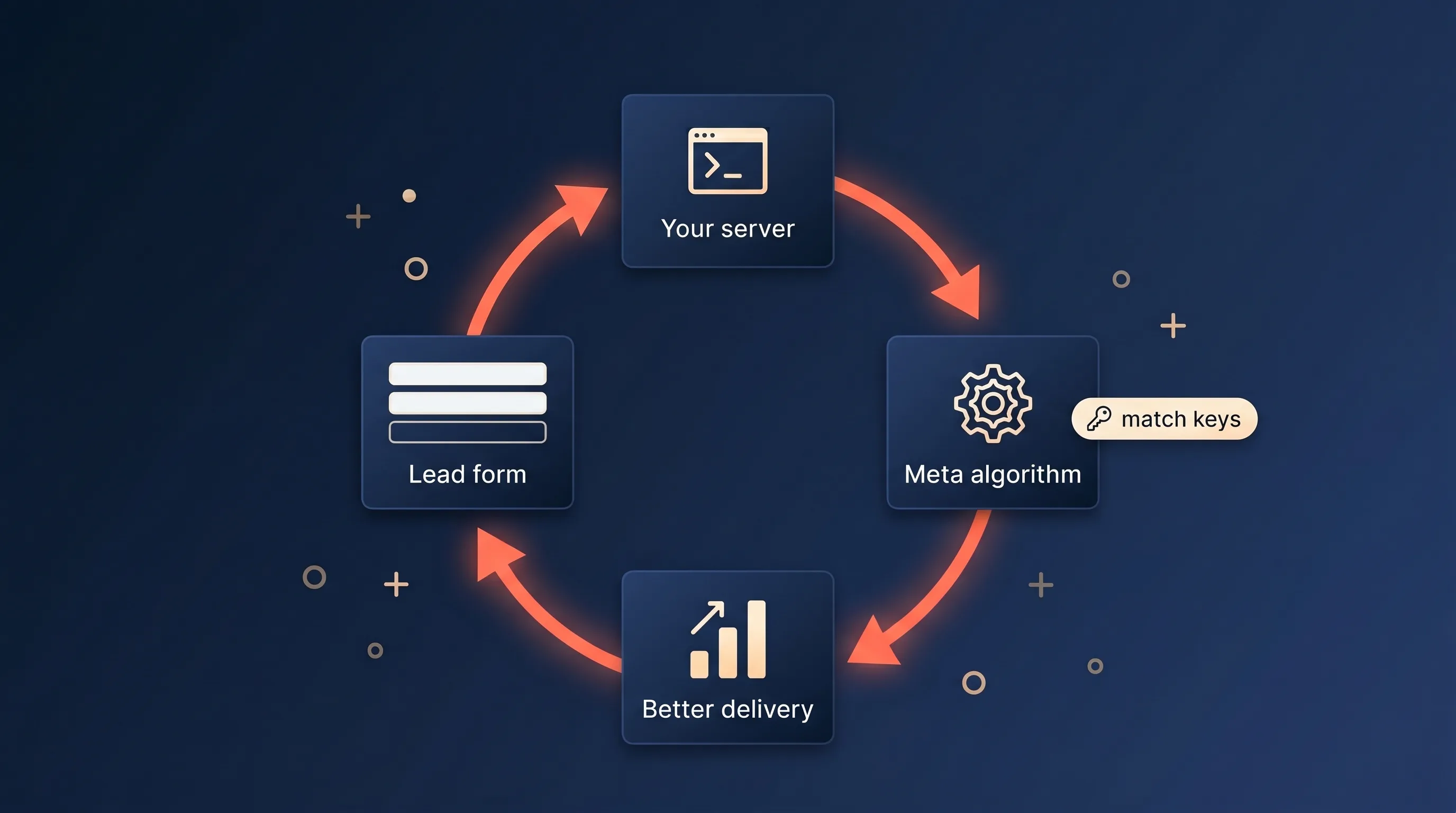
13. Send every lead event via CAPI, with match keys
Every time a prospect submits a lead form – whether on Meta directly or on your own landing page – that event needs to flow back to Meta with the match keys (hashed email, hashed phone, fbp, fbc, IP, user agent). Without match keys, CAPI can’t tie the event to the user who saw the ad, and the algorithm can’t learn.
Our full Meta Conversions API for lead ads guide covers the exact payload structure, fbp/fbc capture, and deduplication with the pixel, and the Facebook standard events reference covers which event name to send for each step.
14. Send closed-won status back to Meta – it changes the entire algorithm
The real unlock is sending downstream conversion signal back to Meta. When a lead becomes a customer, fire a server-side Purchase or Schedule event tagged with the original lead’s match keys.
Meta then optimizes delivery toward people who look like your customers, not just people who fill in forms. This is the single biggest lever for improving lead quality. Advertisers who run this loop consistently see 15-30% lower CPL with higher win rates. See our improving Facebook lead quality with CAPI breakdown for the specific event schema.
Speed-to-Lead & Follow-Up Best Practices
If you take one thing from this post, take this section. The gap between excellent speed-to-lead and average speed-to-lead is the difference between a profitable Meta account and a losing one.
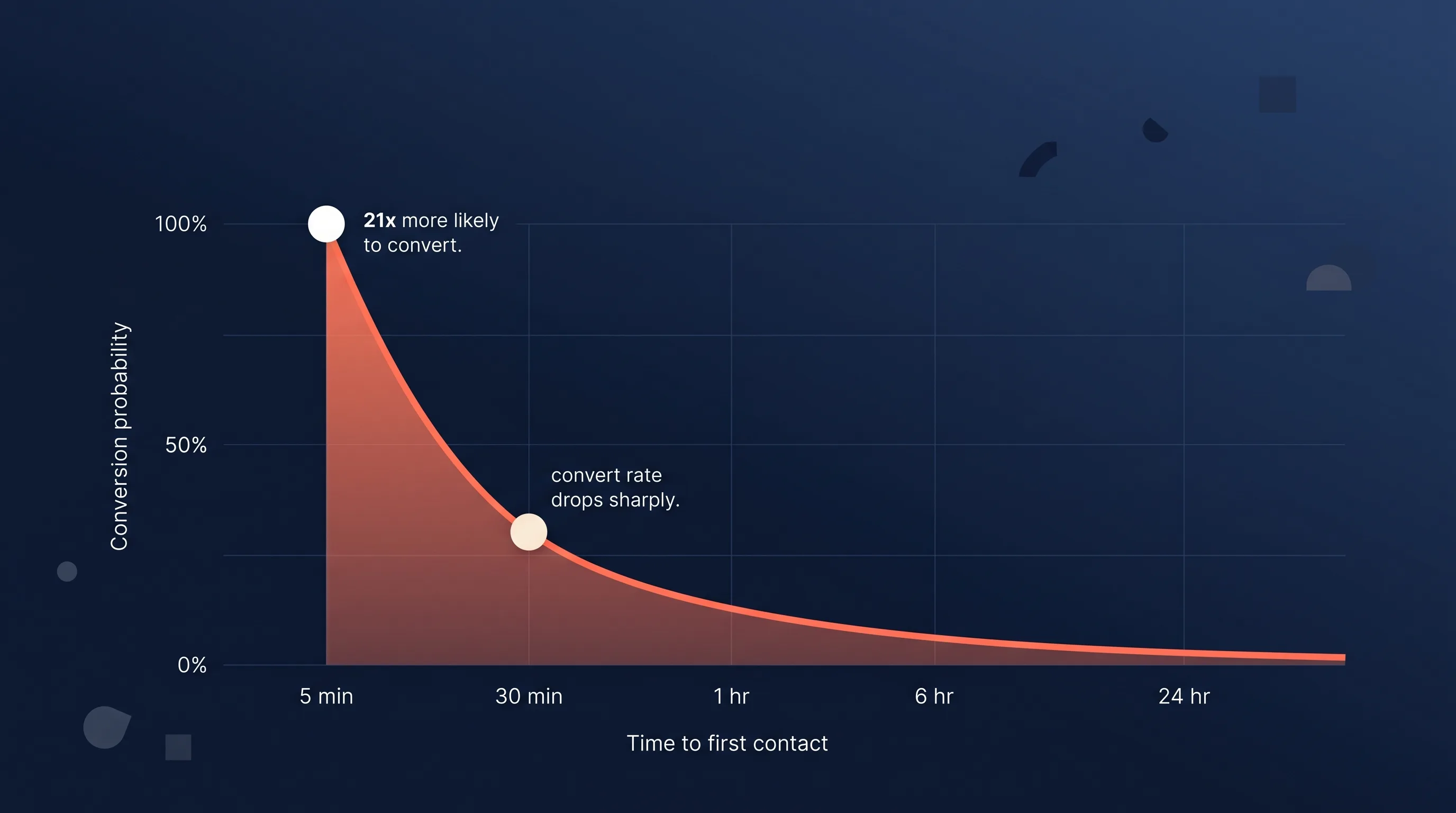
15. Contact every lead within 5 minutes
Research going back to the 2007 MIT / InsideSales study and replicated every year since shows that leads contacted within 5 minutes are 21x more likely to convert than leads contacted after 30 minutes. Wait an hour and your odds drop to roughly 1/10th of a 5-minute response. Wait a day and you may as well not have spent the ad budget at all.
In 2026, this is no longer a sales-ops curiosity, it’s a survival trait. Our speed-to-lead deep-dive unpacks the underlying mechanism (prospect intent decays because they’re submitting multiple quote forms, not just yours) and the exact channels to respond on.
16. Get the lead into your CRM in under 60 seconds, not your email inbox
The single most common failure mode we see: leads sit in the Meta Ads Manager “Leads Center” for hours, or dump into a shared inbox where nobody picks them up until end of day. By the time someone sees the lead, the 5-minute window is long gone.
The clearest example in our own data is home services. Plumbers, electricians, HVAC techs – these businesses run lean, average page audiences of ~500 followers, and they rank #2 by paid LeadSync users despite being only #3 by page count. That gap is entirely about automation: the businesses that pay for instant lead routing are the ones that convert, and they cluster in the trades. The national automotive brand with 1.15 million followers and no automation is often getting beaten by the 500-follower plumber who gets a lead SMS inside 60 seconds.
The fix is automated delivery – lead → CRM + SMS + autoresponder – in under 60 seconds. This is what LeadSync exists to do: connect Meta lead forms to instant email notifications, SMS, and every major CRM so the 5-minute rule becomes achievable, not aspirational.
Benchmarks: Know What “Good” Looks Like for Your Industry
Meta Ads performance varies enormously by industry. A $50 CPL is a disaster for a restaurant and a bargain for a personal-injury law firm. Before you judge your numbers, compare them to your vertical.
17. Compare against your industry, not the overall average
Here’s a summary of 2025-2026 Facebook Lead Ads benchmarks from WordStream and our own platform data:
| Industry | Conversion rate | Cost per lead |
|---|---|---|
| Restaurants & Food | 18.25% | $3.16 |
| Attorneys & Legal | 10.53% | $18.17 |
| Education & Instruction | 10.08% | $28.22 |
| Real Estate | 9.53% | $16.61 |
| Arts, Entertainment & Travel | 9.34% | $18.17 |
| Financial Services / Insurance | ~9.09% | ~$58.70 |
| Dentists | 6.38% | $76.71 |
| Health & Fitness | 5.63% | $52.98 |
| Home & Home Improvement | 5.22% | $41.26 |
| Cross-industry average | 7.72% | $27.66 |
For a full breakdown by industry with the ad examples that produce these numbers, see our Facebook lead ad examples post. For the diagnostic playbook when your CPL is above benchmark, see our cost per lead deep-dive.
18. Industries with the biggest upside also have the biggest downside
Specific verticals reward Meta Ads disproportionately – see our guides for Facebook lead ads for real estate and Facebook Ads for contractors as worked examples. But the same verticals are brutal when your fundamentals (creative, form, follow-up) are weak, because the auction is competitive and your ad spends against advertisers with real loops running.
One counter-intuitive pattern from our platform data: audience size and Meta Lead Ads effectiveness are barely correlated. Automotive pages average ~1.15M followers but rank near the bottom for paid Lead Ads usage. Real estate pages average just 3,000 followers and dominate the platform at 35% share. The big-audience brands treat Lead Ads as a bolt-on; the small-audience local operators treat it as the business. The results track accordingly. Full breakdown in our industry report →
Common Mistakes to Avoid
The best practices above are easier to adopt when you know what to avoid:
- Broad targeting + broad creative. If nothing about the ad identifies who it’s for, Advantage+ can’t find the audience. Specific beats broad.
- Forms over 7 fields. Conversion rate drops off a cliff. If you need the data, get it post-submit.
- Ignoring mobile layout. 80%+ of Meta impressions happen on mobile. Preview the full flow on a phone before publishing.
- No Conversions API. Every event you don’t send server-side is signal Meta’s algorithm isn’t learning from.
- No follow-up automation. The 21x advantage evaporates if a human has to notice the lead. Automate the delivery.
- Changing ads during the learning phase. Meta needs ~50 optimization events to exit learning. Pausing or editing before that resets the clock.
- Measuring CPL instead of cost per customer. CPL makes you chase cheap leads; cost per customer makes you chase right leads.
Frequently Asked Questions
What are Meta Ads best practices in 2026?
The highest-leverage Meta Ads best practices in 2026 are: lead with short (9:16) video creative, default to Advantage+ Audiences over manual targeting, keep forms to 3-5 fields, send every lead event via Conversions API with match keys, and contact every lead within 5 minutes. Creative and follow-up speed matter more than audience tweaking – the algorithm handles most of the targeting if you give it clean signal.
What is the best creative format for Meta Ads?
9:16 vertical video is the default best format for Meta Ads in 2026 because it fits Reels, Stories, and in-feed placements without cropping. A strong hook in the first three seconds and UGC-style production consistently outperform polished studio-shot ads at equivalent budgets.
How many form fields should a Meta lead ad have?
Three to five form fields. Meta pre-fills name, email, and phone from the user’s profile, so the prospect only has to confirm – then you add 1-2 custom qualifying questions if lead quality matters. Every field above five drops completion rates by 5-15%.
How do I lower my Meta Ads cost per lead?
Lower CPL comes from three places: better creative (the single biggest lever), shorter forms, and a working Conversions API loop so Meta can optimize on real conversions rather than raw form fills. If your CPL is above your industry benchmark, audit creative and form first, not audience settings. See our cost per lead guide for the full playbook.
What is the Meta Conversions API and do I need it?
The Meta Conversions API is a server-side channel for sending ad events directly from your server to Meta, complementing the browser pixel. In 2026, after years of iOS privacy changes and ad blockers, CAPI is effectively required for lead-gen advertisers – without it, Meta’s algorithm is learning from a fraction of your conversions, and your CPL reflects that.
How quickly should I follow up on Meta lead ads?
Within 5 minutes. Leads contacted inside 5 minutes are 21x more likely to convert than leads contacted after 30 minutes, and the curve drops off sharply after the first hour. The practical implication is that follow-up has to be automated – a human-in-the-loop workflow can’t meet that window reliably.
How long should a Meta Ads video be?
15-30 seconds for Reels and Stories, 30-60 seconds for feed placements. Anything over 90 seconds almost always performs worse than a shorter hook ad plus a separate warm-audience remarketing video. Hook in the first three seconds matters more than total length.
Is Advantage+ better than manual targeting in 2026?
For most lead-gen advertisers, yes. Advantage+ Audiences matches or beats manual interest stacks in the majority of accounts we audit, especially once a Conversions API signal loop is running. Manual targeting still wins in very narrow cases – tightly regulated industries, highly niche B2B audiences, but the default starting point in 2026 should be Advantage+.
Start Putting These Best Practices to Work
The advertisers who compound on Meta Ads in 2026 aren’t running different creative than everyone else – they’re running the same kinds of creative with tight form design, a working Conversions API loop, and 5-minute follow-up underneath it. That’s the part most “best practices” posts leave out, and the part that actually moves cost per customer.
If you want to close the speed-to-lead gap without rebuilding your stack, try LeadSync free for 7 days – Meta lead forms to your CRM, SMS, and email in under 60 seconds, with Conversions API built in. That one change is worth more than 90% of the creative tweaks on this list combined.