A mortgage lead is worth more in 2026 than it was when we first published this guide, for the plainest reason: there are fewer of them. First-time buyers were 21% of purchasers in the National Association of Realtors’ 2025 profile, the lowest share since the survey began in 1981, and their median age reached 40. The 30-year fixed rate was 6.76% in the second week of September 2026 (Freddie Mac), high enough to keep refinance volume thin and purchase volume cautious. Every broker is fishing in a smaller pond, which is why the same LendingTree lead now goes to five of them.
This is a full rewrite of the 2024 version. It covers the three ways a broker or loan officer gets a lead in 2026 (buy it, build it or borrow it), what each costs per lead and per funded loan, the credit-category rules that govern mortgage ads on Meta and Google, what changed in the TCPA consent rules, how to work with real estate agents without a RESPA problem, and the five minutes after the lead arrives that decide whether any of it turns into a loan.
The three ways to get a mortgage lead
| Buy | Build | Borrow | |
|---|---|---|---|
| Source | LendingTree, Bankrate, Zillow | Your own Facebook, Instagram and Google ads | Agents, past clients, other professionals |
| Cost per lead | $30 to $200 | $30 to $100 | $0 at delivery |
| Who else has it | Up to five lenders | You only | You, and the agent’s shortlist |
| First lead | Same day | One to two weeks | Months, then steady |
| Main risk | Price wars, low contact rates | Learning curve, credit rules | RESPA if money changes hands |
The rest of this guide takes each in turn, then the compliance and follow-up work that applies to all three.
Buying mortgage leads: what the aggregators charge, and who else gets the lead

Buying is the fastest way to have a phone ringing by lunchtime, and the vendors are open about the trade. HousingWire’s October 2025 review of lead sellers and Zeitro’s July 2026 comparison put the going rates at:
| Source | Lead type | Exclusive? | Price per lead |
|---|---|---|---|
| LendingTree | Purchase and refinance marketplace | Shared | $30 to $100 (some report under $30) |
| Bankrate | Rate shoppers, SMS-verified | Shared | $100 to $200 |
| FreeRateUpdate | Refinance and purchase rate shoppers | Shared | Quoted; claims an 80% contact rate |
| Zillow | Purchase, from listing traffic | Shared | Quoted; described as expensive |
| LoanBright | Subscription | Shared | About $500 a month for five leads a day |
| Mortgage Research Center | FHA, VA and USDA borrowers | Semi-exclusive | Quoted |
| Exclusive lead generators (LeadPops, Good Vibe Squad, Kaleidico, Hova) | Purchase and refinance | Exclusive | $15 to $100, or a monthly retainer |
Two numbers explain why a $40 lead is not cheap. First, a shared lead is commonly sold to up to five lenders, so the borrower’s phone rings five times in the hour after they submit, and the lender who answers first with the lowest rate wins. Second, the contact and conversion rates that follow from that. Vendors selling the alternative put shared-lead contact rates at roughly 25% and conversion at 0.5 to 2%, against a 65% contact rate and 3 to 5% conversion for an exclusive lead worked inside five minutes. They have an interest in that comparison, but the direction is not in dispute among brokers who have bought both.
Do the arithmetic per funded loan rather than per lead. At $40 a lead and a 1% close rate, a closed loan costs $4,000 in leads before anyone’s time is counted. At $50 for an exclusive lead closing at 4%, the same loan costs $1,250. Prices also move with the rate: when refinance demand spikes, aggregator prices climb to the $80 to $200 range because every lender wants the same borrowers in the same fortnight.
When buying still makes sense: to fill a pipeline gap while your own campaigns learn, to reach a loan type your ads cannot target efficiently (VA and FHA borrowers through a specialist source, for example), or as a controlled test where you know your contact rate and close rate before you scale. If you buy, buy from a vendor that documents consent, and treat speed as the only variable you control.
Building your own leads on Facebook and Instagram
Meta is where most brokers generate their own leads, because a lead ad opens a form inside the app with the borrower’s name, email and phone already filled in, and because the audience is enormous. It is also where the credit rules bite first.
Mortgage ads run under Meta’s Housing and Financial products and services Special Ad Categories (the second replaced the old Credit category in 2024). Anything promoting a home loan, refinance, pre-approval, home equity product or mortgage broker service has to be declared, and once declared, Ads Manager removes age, gender and ZIP-code targeting, strips most detailed interests, disables lookalike audiences, and sets a minimum 15-mile radius around any location pin. Our guide to Special Ad Categories covers the mechanics. The practical consequence is that the offer targets the borrower, because the audience settings no longer can.
We know which offers work because we ranked them by runtime. For our analysis of 60 mortgage broker Facebook ads, 45 had been running for more than 90 days when we captured them, 14 for over a year, and the longest since January 2022. Three hooks dominate the survivors:
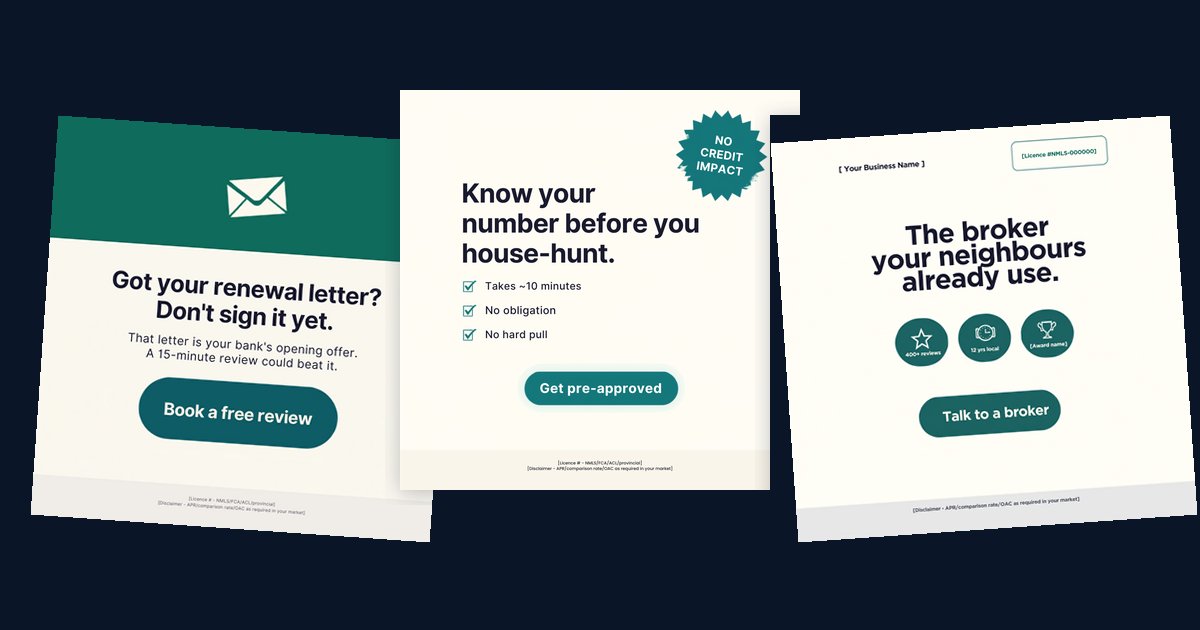
- The renewal or rate-expiry interrupt. “Got your renewal letter? Don’t sign it yet.” This powers several multi-year runners in Canada and the UK, where most mortgages reset every two to five years, and its US cousin is the rate-drop alert aimed at anyone who locked above 7% in late 2023.
- Pre-approval with no credit impact. A soft-check pre-approval removes the borrower’s main fear about starting, and it is the natural offer for purchase leads.
- The trust stack. The licence number (NMLS, FCA, ACL or provincial) in the page name or the creative, the lender panel, the review count. The winning ads treat compliance as a badge rather than fine print.
For first-home buyers, the guide offer works as it does in real estate: a plain-English guide to the grants, deposit rules and loan programs in the borrower’s state or province, traded for an email and a phone number. Ask one qualifying question on the form (purchase timeframe, or renewal date) and no more.
On cost, Finance and Insurance leads from Meta lead ads run about $30 to $60 in the benchmark data we track, which puts a self-generated mortgage lead at or below the price of a shared aggregator lead, with nobody else holding the number. Budget a few hundred dollars per creative to test, copy a proven pattern rather than inventing one, and judge each ad on cost per qualified conversation. The mortgage edition of our lead ad library has the 12 longest-running ads and three free templates to start from.
Building your own leads on Google Search
Google reaches the borrower who has already decided to act and is typing what they need. The click is dearer than Meta’s, and so is the lead, but the intent is real. LocaliQ’s 2026 search benchmarks put Finance and Insurance at a 9.83% click-through rate, a $3.39 average cost per click, a 2.64% conversion rate and a $74.44 cost per lead, against $66.69 across all industries. Mortgage terms sit at the expensive end of that category:
| Keyword | US searches / month | Avg. CPC | What the searcher wants |
|---|---|---|---|
| mortgage calculator | 2,740,000 | $1.89 | A calculator. Leave it alone. |
| mortgage rates | 550,000 | $5.37 | A rate table. Leave it alone. |
| how much house can i afford | 90,500 | $3.26 | A calculator with a guide attached |
| fha loan requirements | 49,500 | $6.36 | A guide; good lead-form entry point |
| first time home buyer programs | 49,500 | $7.97 | A guide to grants and programs |
| first time home buyer loan | 33,100 | $12.14 | A lender who handles first-timers |
| refinance rates | 110,000 | $14.32 | A rate, then a lender |
| mortgage lenders near me | 22,200 | $19.73 | A local lender now |
| best mortgage lenders | 12,100 | $21.49 | A shortlist |
| mortgage broker near me | 14,800 | $21.52 | A local broker now |
| cash out refinance | 22,200 | $26.16 | A lender, soon |
| mortgage pre approval | 40,500 | $39.74 | A pre-approval this week |
| get pre approved for a mortgage | 3,600 | $43.14 | A pre-approval this week |
| home equity loan | 90,500 | $57.10 | A lender, with banks bidding against you |
| va loan | 40,500 | $66.32 | A VA specialist, with lenders bidding hard |
Source: Google Ads keyword data via DataForSEO, United States, September 2026.
The pattern is the same one we found for Google Ads in real estate: the terms with the most volume belong to Bankrate, NerdWallet and the calculators, and a broker bidding on them pays for people who wanted a number. The terms worth buying are the local ones (“mortgage broker near me”, “mortgage lenders near me”) and the pre-approval terms, plus the guide-style first-home-buyer and FHA queries where a lead form asset attached to the ad can capture the details for a guide at $6 to $8 a click.
Two things make Google workable for a broker with a modest budget. Lead form assets put the form inside the Search ad, pre-filled from the Google account, and for Financial Services run about $40 to $100 a lead in our customer data against $75 plus for a click sent to a website; our Google lead form ads guide covers setup and delivery. And Google’s credit policy mirrors Meta’s: for ads about mortgages and other credit products in the United States and Canada, Google removes age, gender, parental status, marital status and ZIP-code targeting, and flags campaigns that use them. Radius targeting down to 1 km still works, which is tighter than Meta allows.
Borrowing leads: real estate agents, without a RESPA problem
Eighty-eight per cent of buyers in NAR’s 2025 profile bought through an agent, and 43% found that agent through a referral. The agent meets the borrower before the broker does, and in most markets the agent’s recommendation decides who writes the loan. Referral relationships are the cheapest lead source in this guide and the one with a federal statute attached.
RESPA Section 8 prohibits giving or receiving any fee, kickback or thing of value in exchange for referring settlement service business, and mortgage origination is a settlement service. A broker cannot pay an agent per referral, per closing, or through a “marketing agreement” whose payments track the referrals. The CFPB’s RESPA Section 8 FAQs are explicit that a marketing services agreement is lawful only when the payments are reasonably related to the value of marketing services actually performed, and that an arrangement designed to disguise payment for referrals is not.
What that leaves is a lot:
- Speed as the referral engine. Agents refer the broker whose pre-approvals come back the same day and whose files do not fall over a week before settlement. That is a service standard, not a marketing tactic, and it is the one most brokers underinvest in.
- Genuine co-marketing at fair market value. A first-home-buyer seminar, a co-branded guide, or a joint Facebook lead ad campaign where each party pays its share of the actual cost in proportion to the exposure it receives. Document the split, keep the invoices, and let the leads flow to both parties on their own merits.
- Being useful to the agent’s clients. A pre-approval letter within hours, a rate-and-repayment sheet the agent can hand to buyers at an open house, and a monthly market note the agent can forward. None of it involves a payment, and all of it keeps you top of the list.
- Other professionals. Accountants, financial planners, divorce lawyers and property managers all meet people who are about to need a loan. The same rule applies: no fee for the referral, and be the fastest, cleanest file they have ever sent.
If you also run ads to buyers directly, note that Housing and Financial products and services are separate categories on Meta: an agent’s listing ads run under Housing, your loan ads under Financial products and services (usually alongside Housing), and a co-branded campaign can declare both, because the category field accepts more than one.
The database you already own
Every closed loan is a future refinance, renewal or move, and a borrower you have already served answers the phone. In Canada and the UK the trigger is the renewal or fixed-rate expiry, on a two-to-five-year cycle you already know the date of. In the US it is the rate: anyone you closed above 7% in late 2023 or 2024 is a refinance conversation the moment the 30-year drops far enough, and a rate-watch email list is the cheapest campaign a broker can run.
The tools have caught up. Home-value and equity trackers such as Homebot send your past clients a monthly note on what their home is worth and what their equity could do, with your name on it, and the reply-rate on those notes is where a good share of repeat business now comes from. A plain email list with a monthly market note and an explicit “reply if your rate ends this year” line does most of the same job for nothing. Whatever you use, the rule is the same as for a bought lead: the moment a past client replies, they are a live lead, and the five-minute clock starts.
The compliance checklist for mortgage lead generation
Mortgage advertising is regulated in every market, and the lead-generation layer has its own rules on top. The ones that matter in 2026:
- Prior express written consent under the TCPA (US). Before any marketing call or text using an autodialer or prerecorded voice, the borrower must have given prior express written consent, and you must be able to produce it. Statutory damages run $500 to $1,500 per violation and the suits are usually class actions. Put the consent language next to the submit button, record the time stamp and the page, and keep the record for the life of the file and beyond; certification services such as TrustedForm exist for exactly this.
- The one-to-one consent rule is gone. The FCC’s 2023 rule, which would have required a separate consent naming each company that could contact a lead, was vacated by the Eleventh Circuit on 24 January 2025 in Insurance Marketing Coalition v. FCC, and the FCC then formally removed it. Consent still has to be clear and documented; it no longer has to be company-by-company on the form.
- Licence numbers in the ad. NMLS in the US, FCA reference and the repossession warning in the UK, ACL number and a comparison rate whenever a rate is quoted in Australia, provincial licence and “OAC” wording in Canada. The longest-running ads in our sample display these prominently, which is both compliant and, as it turns out, persuasive.
- Special Ad Category targeting on Meta and restricted targeting on Google. Declare the category on Meta; on Google, do not use the restricted demographics or ZIP targeting and the policy will not touch you. Fair-lending law applies to the copy as well: describe the loan and the service, not the kind of person you expect to apply.
- RESPA Section 8 for anything involving an agent. No payment for referrals in any form; fair market value for real marketing services only; keep the paperwork.
- Bought leads. Ask the vendor how consent was captured, whether the lead was told it would be shared, and how many buyers it goes to. If the answers are vague, the TCPA exposure is yours.
Follow-up: the five minutes that decide the funded loan
Every source above delivers a borrower who is, at that moment, also talking to someone else. A bought lead is with four other lenders. A Facebook lead scrolled past two other brokers’ ads. A Google searcher clicked three results. The research on what happens next has not changed: MIT’s analysis of 15,000 leads found a response inside five minutes is 21x more likely to qualify the lead than a response at 30 minutes, and 100x more likely to reach them at all.
Most brokers lose the lead here rather than in the ad. A Facebook submission sits in the page’s Leads Center, a Google lead form submission sits in the Ads dashboard, and the borrower who filled in a form at 9pm has spoken to another lender by 9am. The fix is mechanical, and it is the part of this process LeadSync exists for:
- Instant delivery to the CRM. LeadSync connects your Facebook page and your Google Ads lead forms and pushes each submission to HubSpot, GoHighLevel, Zoho, Pipedrive, Salesforce, ActiveCampaign, Mailchimp or Google Sheets within about a minute, with the qualifying answers mapped to fields and a source tag so your follow-up sequence fires. Any mortgage CRM with an inbound webhook or an email lead parser can receive the same feed.
- An alert to a human. An SMS or email to whoever is on duty, with the borrower’s name, number and the answer to the timeframe question, so the call happens while the borrower is still on the couch.
- An automatic text back. A reply to the borrower inside the first minute (“Thanks Sam, I’ll call you in the next few minutes about your pre-approval”) holds the lead until you do.
Whatever you buy, build or borrow, run it into one CRM with one process. The broker who answers first, with the file already open, is the one who writes the loan.
What to do this quarter, by budget
- No ad budget. Build the database: every past client on a monthly rate-and-equity note, every agent you have closed with on a same-day pre-approval promise, and a rate-watch list you actually email when the 30-year moves. Add a lead form to your website and the instant-alert step above.
- About $1,000 a month. One Facebook lead ad campaign under the Housing and Financial products categories with a renewal or pre-approval offer, copied from a proven pattern, plus LeadSync delivery and an SMS autoresponder. Judge it after 30 days on cost per qualified conversation.
- $3,000 a month and up. Add a Google Search campaign on “mortgage broker near me”, the pre-approval terms and one guide-style first-home-buyer term, with a lead form asset. Keep a small bought-lead test running against it so you know your real cost per funded loan from each source.
Frequently Asked Questions
What is mortgage lead generation?
It is everything a broker or loan officer does to find people who will need a home loan and get their contact details with permission to follow up. In practice it comes down to three sources: buying leads from an aggregator such as LendingTree or Bankrate, generating your own with Facebook, Instagram or Google lead ads and a website, and earning referrals from real estate agents and past clients. Most productive brokers run at least two of the three and send every lead into one CRM with one follow-up process.
How much do mortgage leads cost in 2026?
Bought leads run about $30 to $100 each from LendingTree, $100 to $200 from Bankrate, and $50 to $100 for exclusive purchase leads, with prices rising to $80 to $200 whenever rates fall and refinance demand spikes. Self-generated leads cost $30 to $60 on Facebook and Instagram lead ads and $40 to $100 on Google lead form assets. The number that matters is cost per funded loan: shared leads converting at 0.5 to 2% cost several thousand dollars per closing, while an exclusive lead converting at 3 to 5% costs closer to $1,200 to $2,000.
Is it better to buy mortgage leads or generate your own?
Generate your own once you can spend about $1,000 a month and answer the phone within five minutes. Bought leads are faster to switch on but they are shared with up to five lenders, contact rates sit around 25%, and you are competing on rate with everyone else who bought the same name. A lead from your own ad has only heard from you, arrives with the question you asked on the form, and costs about the same. Buying makes sense to fill a gap while your own campaigns learn, or for a loan type your ads do not reach.
How do mortgage brokers get leads from real estate agents without breaking RESPA?
By paying for nothing that is really a referral. RESPA Section 8 prohibits any fee or thing of value in exchange for referring settlement business, so a broker cannot pay an agent per lead, per closing, or through a marketing agreement whose payment tracks referrals. What is allowed is genuine co-marketing at fair market value for actual services, such as splitting the cost of a first-home-buyer seminar or an ad campaign in proportion to what each party receives, and earning the referral by being fast: an agent refers the broker whose pre-approvals come back the same day.
Do Facebook ads work for mortgage brokers?
Yes. We analysed 60 mortgage broker Facebook ads from the Meta Ad Library and 45 had been running for more than 90 days, 14 for over a year and the longest since January 2022. Nobody funds an ad that long unless it produces borrowers. The ads that last use one of three hooks: the renewal or rate-expiry interrupt, a pre-approval with no credit impact, and a licence number worn as a trust badge. They run under Meta’s Housing and Financial products and services Special Ad Categories, so location and offer do the targeting rather than demographics.
What are the best Google Ads keywords for mortgage brokers?
The ones where the searcher wants a person rather than a rate table. “Mortgage broker near me” (14,800 US searches a month, about $21.50 a click) and “mortgage lenders near me” (22,200, $19.73) are the core local terms. “Mortgage pre approval” (40,500, $39.74) is the strongest purchase-intent term and the most expensive. “First time home buyer programs” (49,500, $7.97) and “fha loan requirements” (49,500, $6.36) are cheaper guide-style entry points. Avoid “mortgage rates” and “mortgage calculator”: huge volume, but the searcher wants Bankrate.
Does the TCPA one-to-one consent rule still apply to mortgage leads?
No. The FCC’s one-to-one consent rule, which would have required a separate consent for each company that could call a lead, was vacated by the Eleventh Circuit on 24 January 2025 and the FCC then formally withdrew it. What still applies is the underlying TCPA requirement of prior express written consent before any marketing call or text using an autodialer or prerecorded message, with statutory damages of $500 to $1,500 per violation. Keep the consent language on the form, keep a time-stamped record of it, and honour opt-outs immediately.
How fast should a mortgage broker follow up a lead?
Within five minutes. MIT research on 15,000 leads found a response inside five minutes is 21x more likely to qualify the lead than a response at 30 minutes, and 100x more likely to reach them at all. A borrower who filled in a form at 9pm has usually spoken to another lender by morning. The fix is mechanical: an instant SMS or email alert to whoever is on duty, an automatic text back to the borrower, and the lead already in the CRM when you pick up the phone.
Related resources
- Facebook Ads for Mortgage Brokers: 60 Ads That Keep Winning (2026)
- What Is a Special Ad Category on Facebook? 2026 Rules
- Google Lead Form Ads: The Complete 2026 Guide
- Google Ads for Real Estate: Campaign Types, Keywords and Costs (2026)
- Facebook Lead Ads for Real Estate: The Complete Guide for Agents (2026)
- Speed to Lead: Why the First Five Minutes Decide the Deal
- Send an Automatic SMS to New Facebook Leads
Lead prices are as published by HousingWire (October 2025) and Zeitro (July 2026) and by the vendors themselves; contact and conversion rate comparisons between shared and exclusive leads are vendor-reported. Search benchmarks are LocaliQ’s 2026 Search Advertising Benchmarks; keyword volumes and CPCs are US Google Ads averages via DataForSEO, September 2026. Nothing here is legal advice: RESPA, TCPA and state licensing rules turn on facts, and a compliance review of any referral or marketing arrangement is money well spent. LeadSync is not affiliated with any lead vendor named.