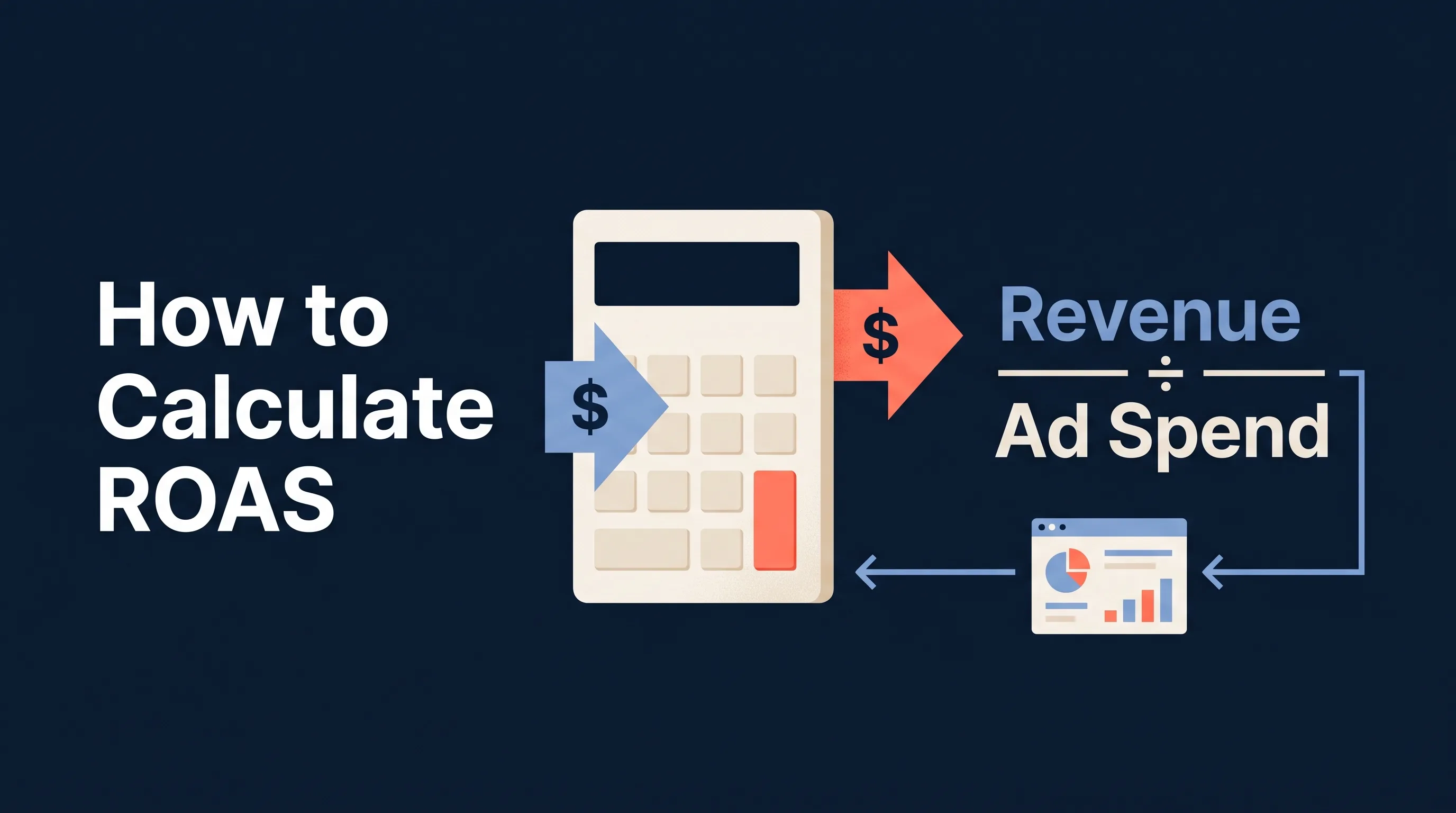
ROAS – return on ad spend – is the metric most advertisers check first and think about last. The formula is simple: revenue divided by ad spend. What’s less obvious is that the standard formula assumes e-commerce-style direct attribution: the customer clicks the ad, buys something, revenue gets reported back to the ad platform, and the algorithm learns. For lead-generation businesses, that chain is broken by design. Revenue happens weeks or months later, it happens in the CRM rather than the ad platform, and if you’re not feeding it back you’re effectively flying blind.
This guide covers the formula, an interactive calculator, realistic benchmarks by industry, and the one fix that separates lead-gen advertisers who scale from ones that stall – closing the loop between your CRM and your ad platform with the Conversions API.
Key Takeaways
- ROAS formula:
ROAS = Revenue ÷ Ad Spend. A ROAS of 4x means $4 in revenue for every $1 spent.- Benchmarks vary by industry: e-commerce 3–5x, B2B SaaS 2–3x, local services 5–10x, home services 5–15x. Anything below 1x means you’re losing money on ads.
- The standard formula breaks for lead-gen because revenue is delayed (the sale happens weeks after the lead) and reported in the CRM, not the ad platform. Meta’s algorithm optimises toward whatever event it sees, so if it only sees form fills it optimises for cheap form fills, not customers.
- Fix with CAPI: fire a downstream conversion event (qualified lead, demo booked, deal won) from your CRM back to Meta. The algorithm then optimises toward actual revenue.
- ROAS is only as honest as your attribution. If revenue includes organic sales, brand traffic, or repeat customers, the number is flattering but wrong. Pull revenue from the CRM, tagged by first-touch lead source.
What ROAS Actually Is
Return on ad spend is a ratio: how much revenue you generated, divided by how much you paid to generate it. If you spent $1,000 on a campaign and booked $5,000 in revenue from leads or customers it produced, ROAS is 5x – five dollars back for every dollar in.
Marketers sometimes say “ROAS” when they mean ROI (return on investment) or CAC (customer acquisition cost). They’re not the same thing – we’ll untangle them later. For now: ROAS is gross revenue ÷ ad spend, unadjusted for cost of goods, overhead, or refunds.
It’s the first number most ad-platform dashboards surface because it’s the easiest for the ad algorithm to optimise toward. That simplicity is also the trap – most businesses make money (or lose it) at a stage of the funnel the platform can’t see.
The ROAS Formula
$$ \text{ROAS} = \frac{\text{Revenue}}{\text{Ad Spend}} $$
Or in plain English: total revenue attributed to a campaign, divided by everything you paid the ad platform for that campaign.
Expressed as a multiple: 5.0x means $5 revenue per $1 spent.
Expressed as a percentage: multiply by 100. 5.0x = 500%.
Both forms are equivalent. Ad platforms tend to default to the multiple; CFOs tend to prefer the percentage. Either is fine, just be consistent inside one team.
Worked Examples
E-commerce
An apparel brand spends $4,000 on Meta ads in a month. Meta’s pixel tracks $18,200 in attributed purchases during the campaign window.
- ROAS = $18,200 ÷ $4,000 = 4.55x
- As a percentage: 455%
This is clean because the purchase happens on the same device, in the same session, reported directly back to the pixel. Standard e-commerce case – pixel-tracked revenue flows straight back to Meta, the algorithm optimises, and the ROAS number on the dashboard is honest.
Lead generation
A B2B SaaS company spends $6,000 on LinkedIn Lead Gen Ads and generates 40 leads. Over the next 90 days, 6 of those leads close at an average contract value of $8,000.
- Revenue: 6 × $8,000 = $48,000
- ROAS = $48,000 ÷ $6,000 = 8x
But LinkedIn’s dashboard has no idea any of that happened. It sees 40 form fills. If the team lets LinkedIn optimise toward “lead form fill” as the conversion event, the algorithm will cheerfully deliver more cheap form fills, which might or might not close. The 8x ROAS exists in reality; it doesn’t exist in the ad platform unless you put it there.
That gap is the whole reason the rest of this guide exists.
What’s a Good ROAS?
There’s no universal benchmark. A 3x ROAS is a disaster for a dropshipper with 15% margins and a triumph for a luxury service business with 70% margins. The useful question isn’t “what’s a good ROAS?”, it’s “what ROAS do I need to hit, given my gross margin, to be profitable on this channel?”
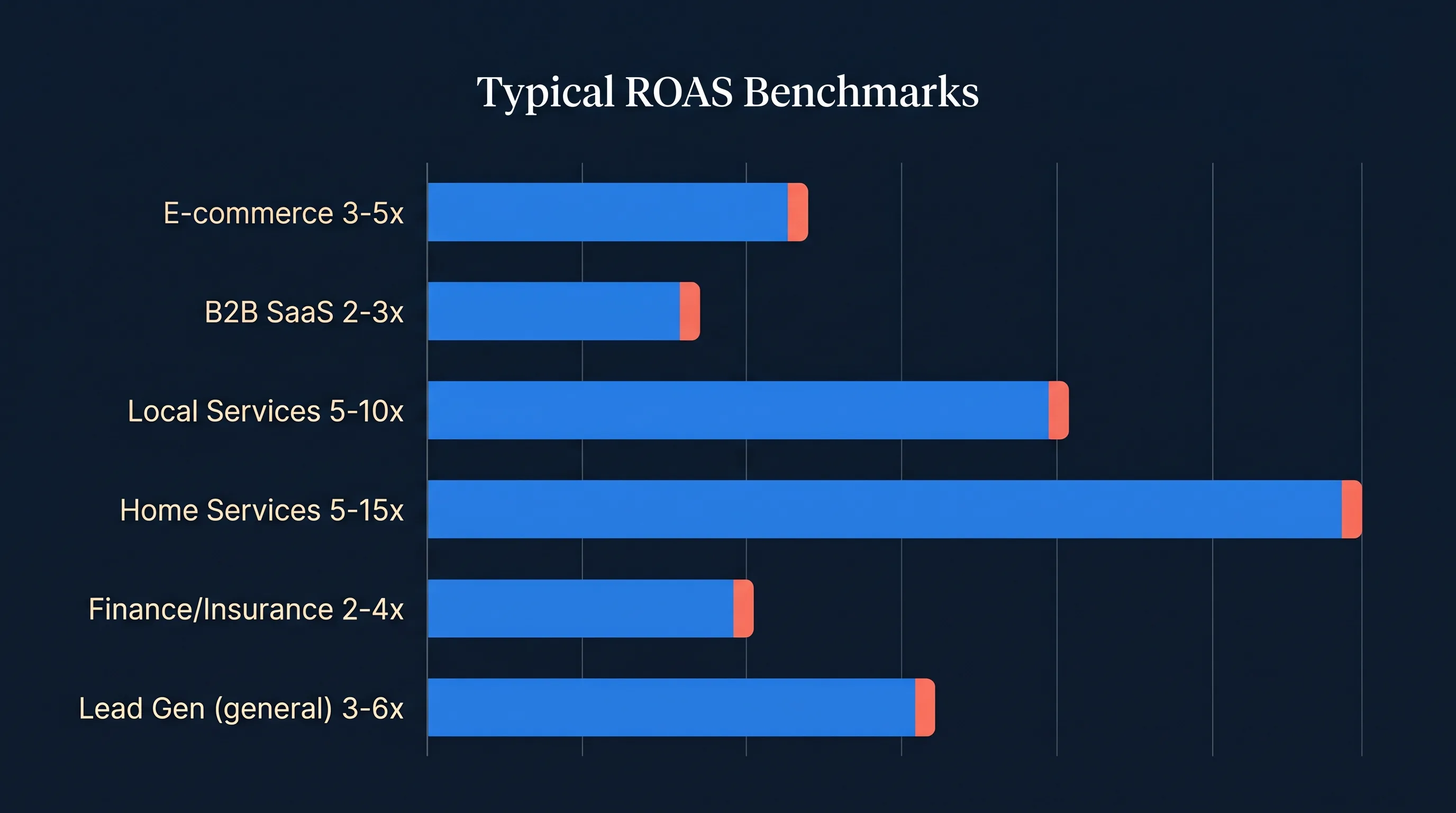
That said, industry averages are a reasonable sanity check:
| Vertical | Typical ROAS range | Notes |
|---|---|---|
| E-commerce (DTC) | 3–5x | Direct-response, pixel-tracked, short cycles |
| B2B SaaS | 2–3x | Longer cycles, higher LTV offsets lower ROAS |
| Local services | 5–10x | High margin, low fulfilment cost per lead |
| Home services (HVAC, roofing, etc.) | 5–15x | One closed job can pay for months of ads |
| Finance / insurance | 2–4x | High CPLs, competitive keywords |
| B2B lead generation (general) | 3–6x | Varies wildly by deal size and sales velocity |
Break-even ROAS – the number that actually matters
Break-even ROAS is 1 ÷ gross margin. If your gross margin is 40%, break-even ROAS is 2.5x. If it’s 70%, break-even ROAS is about 1.43x. Anything above that is profit before overhead; anything below is a loss.
For most e-commerce brands, 2–3x is break-even territory. Scaling reliably usually means targeting 1.5–2x above break-even so there’s room for advertising to cover some of the overhead too.
Why the Standard Formula Breaks for Lead Ads
Three problems kick in the moment you move from direct-response e-commerce to lead generation.
1. Revenue is delayed. Lead → qualified lead → demo → proposal → close. For a B2B deal, that chain commonly runs 30–90 days. For home services it might be 2–14 days. The ad platform’s attribution window maxes out at 7 days by default on Meta. Most real lead-gen revenue falls outside that window and gets attributed to nothing.
2. Revenue lives in the CRM, not the ad platform. Meta, LinkedIn, and Google never see the closed deal. They see the form fill – full stop. Unless you explicitly send the downstream event back, the platform has no idea which leads turned into revenue.
3. The ad algorithm optimises toward what it sees. If the only conversion event Meta sees is “form fill,” Meta’s algorithm will work overtime to find people who fill out forms cheaply. Those aren’t necessarily people who buy. This is the source of the most common complaint about Meta Lead Ads: “the quality is terrible.” The quality is often fine, it’s that the platform is optimising toward the wrong event.
Fixing Lead-Gen ROAS with CAPI / Offline Conversions
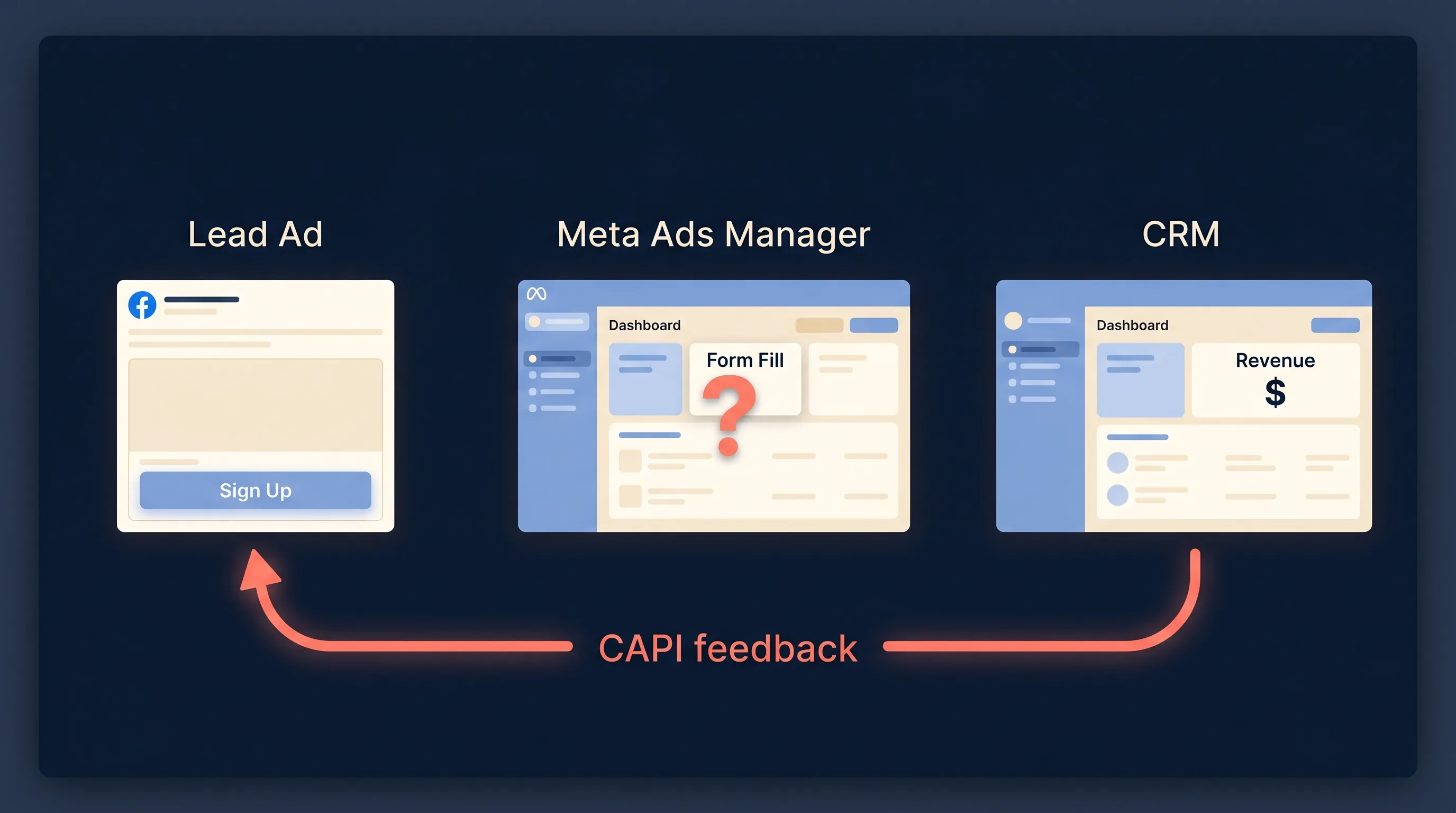
The fix is to close the loop – report a meaningful downstream event from the CRM back to the ad platform so the algorithm can optimise toward that event instead of the form fill.
Meta calls this the Conversions API (CAPI). Google and TikTok have equivalents (Offline Conversions Import and Events API respectively). The mechanics differ; the pattern is the same.
The flow:
- A lead submits the form. Meta records it as a standard Lead event.
- The lead syncs into your CRM – via LeadSync, a native integration, or a CSV you import manually.
- Sales follows up. Days or weeks later, the lead converts to a qualified opportunity, a demo, or a closed deal.
- At each downstream stage, your CRM fires a server-side event back to Meta via CAPI, tagged with the original lead’s email / phone / click ID so Meta can match it to the original ad click.
- Meta’s algorithm now has two signals to optimise against – the cheap Lead event, and the high-value CompleteRegistration / Purchase / CustomEvent. You tell it to optimise against the downstream event, and it stops chasing cheap form fills and starts chasing people who look like buyers.
Two practical notes that matter more than they sound:
- Send the event with a monetary value, not just a flag. Meta can bid more aggressively for a $50,000 deal than a $500 one, but only if you tell it the value.
- Match quality matters. Send hashed email + phone + last known click ID. The higher the match rate, the more of your events Meta can attribute back to clicks.
This is where LeadSync earns its keep: the sync that delivers leads into your CRM in under a minute is the same pipeline that can fire the CAPI events back to Meta. It’s one connection, both directions.
How to Improve Your ROAS
Five levers, roughly in order of impact for most lead-gen businesses:
1. Close the CAPI loop
Covered above. If you haven’t done it, this is the biggest single lever available and most campaigns see 20–40% CPL reduction within a month of exiting the learning phase on the new event.
2. Get the offer right
A 10% improvement in offer specificity beats a 50% improvement in creative. “Free consultation” underperforms “Free 20-minute HVAC efficiency check – we’ll tell you if your system is costing you more than it should.” Name the problem, promise a concrete result, and give a time-bounded way to get it.
3. Shorten speed-to-lead
Contact rates drop by 10× between five minutes and 30 minutes after a lead submits. If your leads are sitting in an inbox or a CSV waiting for someone to notice, the downstream half of your ROAS calculation is leaking. Wire every form submission to a real-time Slack alert or CRM round-robin assignment with a 5-minute SLA.
4. Tighten your audience
Broad audiences are cheap per impression but convert like broad audiences. Narrow audiences – ABM lists, Lookalikes modelled on closed customers (not leads), first-party data uploads – cost more per impression but close at dramatically higher rates. On a closed-deal-based ROAS calculation, narrow wins.
5. Qualify leads before they reach sales
If 80% of your form fills are junk, sales will learn to ignore marketing and your close rate tanks. Add a qualifying question on the form (industry, team size, budget range) and use it to auto-route. Fewer leads, more revenue.
ROAS vs ROI vs CPL
All three measure the same underlying thing – whether the money you’re spending is coming back, but at different points in the funnel.
| Metric | Formula | What it measures | When to use |
|---|---|---|---|
| ROAS | Revenue ÷ Ad Spend | Top-line revenue return on ad spend | Comparing campaigns/channels at the revenue level |
| ROI | (Revenue − Cost) ÷ Cost | Net return after all costs (ad spend, COGS, overhead) | Evaluating profitability end-to-end |
| CPL | Ad Spend ÷ Leads | What a single lead costs | Diagnosing campaign health before any sales happen |
| CAC | Ad Spend ÷ Customers | What acquiring a paying customer costs | Comparing channel efficiency at the customer level |
Rule of thumb: track CPL weekly, ROAS monthly, and ROI / CAC / LTV:CAC quarterly. Short-cycle metrics catch campaign problems fast; long-cycle metrics catch channel-economics problems before they compound.
Common ROAS Mistakes
Including revenue you didn’t earn. If your Shopify “attributed revenue” includes every purchase from anyone who saw the ad in the last 28 days, your ROAS is wildly overstated. Meta’s last-touch attribution is particularly generous with branded-search and email-list repeat-buyer credit. Cross-check against a UTM- or first-touch-attributed revenue number in your CRM or analytics.
Ignoring refund rate. A 6x ROAS with a 20% refund rate is effectively a 4.8x ROAS. Track net revenue, not gross.
Judging a campaign on week 1. Both Meta and Google run a learning phase of roughly 50 conversions before delivery stabilises. Below that, the ROAS number you’re looking at is statistical noise. Give campaigns at least 14 days before making optimisation calls.
Only optimising for ROAS. If your goal is scale, ROAS and volume trade off. A $2,000/day campaign might run at 4x ROAS; pushing to $5,000/day might drop it to 3x. If the incremental revenue at 3x is still above break-even, you’re strictly better off scaling, even though the ROAS number gets worse.
Not segmenting by channel or campaign. A single blended ROAS number hides which campaigns are winning. Compare by campaign, audience, and creative – pause the losers, double-budget the winners.
Frequently Asked Questions
What is the ROAS formula?
ROAS = Revenue ÷ Ad Spend. If a campaign produced $10,000 in revenue from $2,000 in ad spend, ROAS is 5x (or 500%). It’s a ratio, not a dollar amount, and it’s unadjusted for cost of goods or overhead.
What’s a good ROAS for Facebook (Meta) ads?
It depends on your industry and gross margin. E-commerce brands typically target 3–5x on Meta, while lead-gen businesses often run at 5–10x because the downstream revenue per lead is higher. The more meaningful benchmark is your break-even ROAS – the point at which the campaign pays for itself after gross margin.
How is ROAS different from ROI?
ROAS is gross revenue ÷ ad spend – it doesn’t subtract cost of goods, fulfilment, overhead, or anything else. ROI subtracts those costs: ROI = (Revenue − Total Costs) ÷ Total Costs. A campaign with a 4x ROAS might still have a 0% ROI if margins are tight. Use ROAS to compare campaigns; use ROI to judge whether a channel is profitable overall.
What is break-even ROAS?
Break-even ROAS is 1 ÷ gross margin. At 40% gross margin, break-even is 2.5x, meaning you need to earn at least $2.50 in revenue per $1 of ad spend just to cover the cost of goods. Anything above that contributes to overhead and profit; anything below is a loss.
Why is my ROAS dropping over time?
The most common causes: (1) audience saturation – you’ve shown the ad to most of your target audience and are now reaching less-qualified people; (2) seasonal shift in consumer intent; (3) a creative has fatigued and CTR has dropped; (4) a competitor has entered the auction and raised CPMs. Less commonly but more seriously: your attribution window changed or a tracking event broke. Check pixel/CAPI event counts against CRM counts to rule that out first.
Should I use gross or net revenue for ROAS?
Technically, ROAS is defined using gross revenue, that’s the industry-standard formula and what ad platforms report. But internally, net-revenue ROAS (after returns and refunds) is almost always the more honest number. For any reporting that touches commercial decisions, report both.
How is ROAS different for lead-gen campaigns vs e-commerce?
For e-commerce, the sale happens in the same session as the click, so the ad platform sees the revenue directly and ROAS is accurate. For lead-gen, the sale happens in your CRM days or weeks later – the ad platform never sees it unless you explicitly send the event back via CAPI or offline conversion imports. Without that loop, ad-platform ROAS for a lead-gen campaign is effectively meaningless.
How often should I check ROAS?
Weekly at the campaign level to catch creative fatigue and audience saturation. Monthly at the account level to track trends. Quarterly alongside ROI, CAC, and LTV:CAC to evaluate whether the channel itself is working. Daily ROAS checks are usually noise – the sample size is too small to separate signal from variance.
Can I calculate ROAS by hand or do I need a tool?
The formula is trivial – any calculator does it. The hard part isn’t the math; it’s getting accurate revenue attribution. The calculator embedded earlier in this post is useful for quick what-ifs and break-even modelling. For real campaign ROAS, pull revenue from your CRM tagged by lead source and compare against ad-platform spend by campaign.
Wrapping Up
The ROAS formula is simple. The data behind it is not.
For e-commerce, the standard formula works because the sale happens inside the ad platform’s line of sight. For lead generation, you need a CRM, clean attribution, and a feedback loop back to the ad platform – otherwise the number you’re looking at is measuring the wrong thing. The fix is infrastructural, not tactical: wire your CRM to fire downstream events via CAPI, sync new leads in under a minute so sales can act on them while they’re warm, and optimise against events that correspond to real revenue.
Once that infrastructure is in place, ROAS becomes a reliable number. And a reliable number is the one you can actually run a business on.