Recently I was chatting with a client about her Facebook lead ad campaigns. She was trying to target high net-worth individuals via Meta Lead Ads, to generate new clients for her real estate business. High net-worth individuals is really just a fancy way of saying “rich people”; the folks with the means to purchase high cost products or services like real estate, luxury vehicles or designer fashion.
It occurred to me that this is something I’ve done regularly when running Facebook and Instagram ad campaigns, and something many businesses struggle with. It is also something Meta has made harder every year: net worth targeting is gone, individual income targeting is gone, and in the US, anyone advertising real estate or financial products loses most of the remaining proxies too (more on that in a moment).
Often advertisers will try targeting people based on their occupation: CEOs, CMOs, Founders, to name just a few examples. This is all fine in theory, however, you’re relying on people having entered their profession into the Work and Education section of their Facebook profile. Not only that, we’re relying on them keeping it up to date.
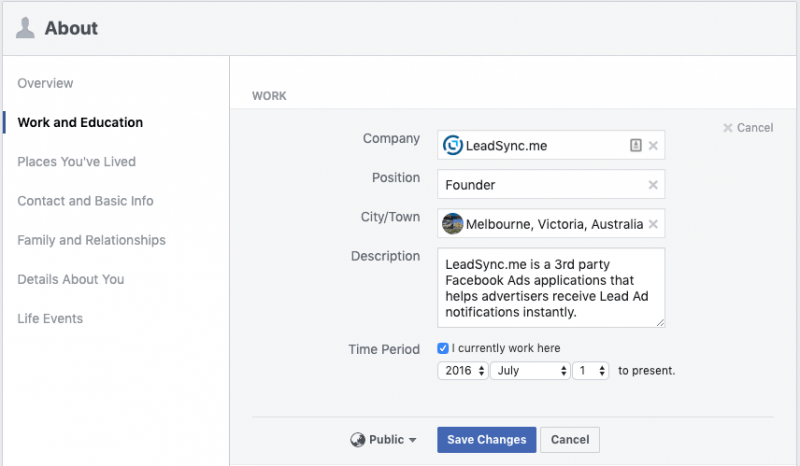
When writing this article, I checked my own Facebook profile. I hadn’t updated it in 4 years! When was the last time you checked or updated your Facebook profile? If we can’t rely on profile data, then how else can we target higher income earners? In practice, I believe it’s best to target rich people based on what they do, not what they say they do. There may be a life lesson in there somewhere.
Following are twelve targeting options to help you get your Facebook and Instagram ads in front of high net worth individuals (aka: the rich folks). The first one is the only direct income signal Meta still offers, and it is US-only, so US advertisers should start there.
I like to use these techniques when running Facebook & Instagram Lead ad campaigns to help improve the quality of the leads being generated and to increase ROAS (Return on Ad Spend). They work particularly well for promoting high end motor vehicles, boats, business coaching, luxury travel and SaaS products. Pretty much any high ticket item.
Selling real estate, mortgages, insurance or investments in the US? Read this first.
Like my client above, a lot of people searching for “how to target rich people on Facebook” are in real estate or finance. In the US (and Canada), those campaigns must be declared as a Special Ad Category: Housing for property sales, rentals and mortgages, and Financial products and services (which replaced Credit in October 2024) for loans, insurance, bank accounts and investments.
Declaring the category removes most of what this guide relies on: the household income tiers, ZIP code targeting, radius targeting under 15 miles, age and gender ranges, detailed targeting exclusions, lookalike audiences and saved audiences. Age is fixed at 18 to 65+.
What still works: Custom Audiences (your own client list, website visitors and lead form submissions, for inclusion and exclusion), Advantage+ Audience, city and state level location, a trimmed list of interests, and qualifying questions on the lead form (price range, timeframe, pre-approval) so that your creative and form do the filtering the targeting can’t. If that is you, skip to tactics 3 and 5 for the interest and behaviour layers that survive, and put the rest of your effort into the lead list and the form.
Before you start: Advantage+ Audience or Original Audiences?
Every option below is set at the Ad Set level in Ads Manager, and how Meta treats it depends on the audience type.
Advantage+ Audience is now the default for most objectives. Under it, the income tiers, locations, interests and behaviours you enter are starting signals, and the algorithm will expand past them if it finds people more likely to convert. That is fine for a conversion campaign with a strong pixel history. It is not what you want when the whole point is to keep budget away from people who can’t afford the product.
Original Audiences (Meta’s name for manual targeting) makes your selections a fence. For high-ticket lead ads, especially with a new account or a small budget, I set the ad set to Original Audiences, build the layered audience below, and only move to Advantage+ once I have a few hundred qualified leads to feed it. There is more on when each one wins in our Advantage+ audiences for lead gen guide.
The real power is in combining the options below to laser target your audience. Let’s take a look at the strategies I use to target high income earners.
1. Household Income by ZIP Code (US only)
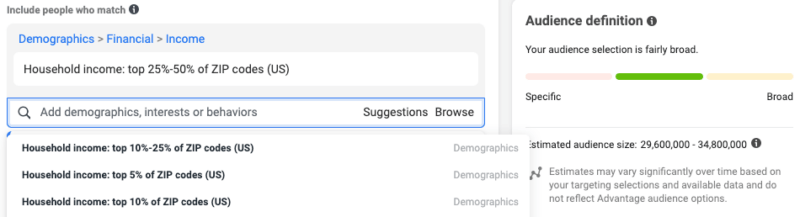
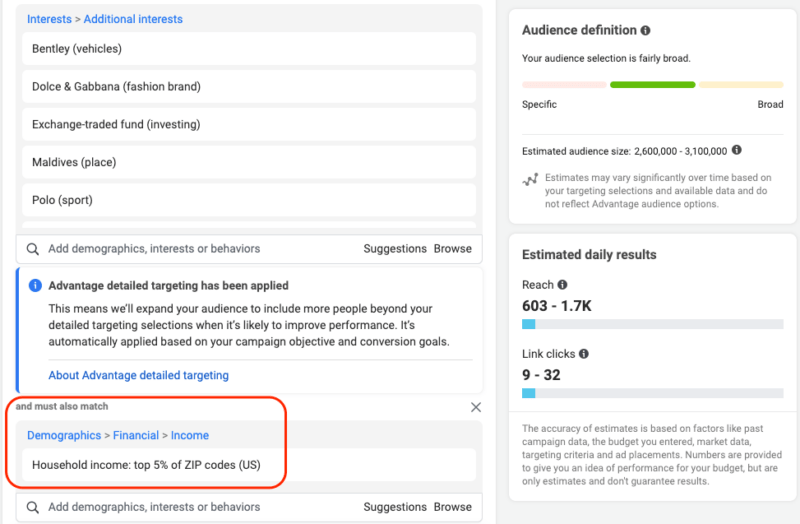
This is the only direct income option Meta still offers, and if your audience is in the United States it should be the first thing you add. You will find it under Demographics > Financial > Income in detailed targeting.
Meta ranks every US ZIP code by its average household income (from public census data, not individual accounts) and lets you pick a tier:
| Tier | What it means | Best suited to |
|---|---|---|
| Top 5% of ZIP codes | The highest average household income ZIP codes in the US | Luxury real estate, wealth management, private aviation, high-end jewellery |
| Top 10% of ZIP codes | Includes the top 5% | Premium cars, luxury travel, cosmetic and private medical, business coaching |
| Top 10 to 25% of ZIP codes | Upper-middle income areas, excludes the top 10% | Home renovation, solar, premium home services, higher-end e-commerce |
| Top 25 to 50% of ZIP codes | Above the median, the broadest tier | Volume campaigns where you want to exclude lower-income areas without shrinking reach |
Three things to know before you use it:
- It is ZIP code level, not person level. A nurse in a top 5% ZIP code is in; a founder in a cheaper ZIP code is out. It is a proxy, which is why I still layer it with one or two of the options below.
- It is US only. Advertisers in Australia, the UK, Canada and Europe will not see it, and will need to lean on location, interests and behaviours instead.
- It is unavailable in Housing, Employment and Financial products and services campaigns. See the box above.
You can select more than one tier in the same ad set. Start with the top 10% and test the top 5% separately if your product price point justifies the smaller reach.
2. Location Geo-Targeting
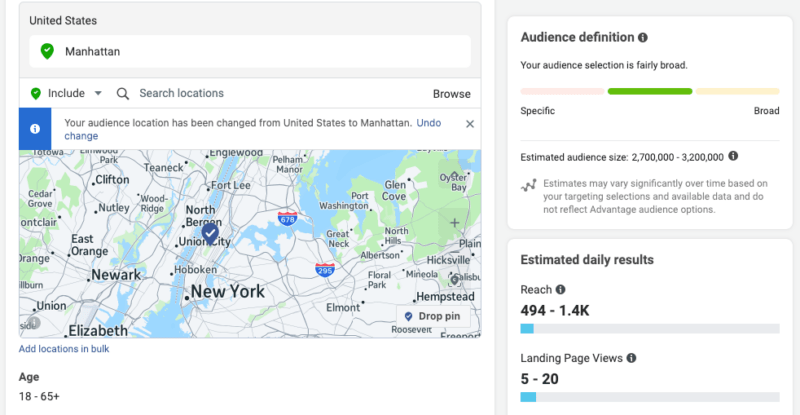
In every city around the world, there are wealthy areas and there are not so wealthy areas. If you’re a local, you’ll be familiar with which ZIP codes, postcodes or suburbs are expensive to live in.
Armed with this knowledge you can target people living in that location (not “recently in”, which pulls in commuters and visitors). In the US, enter ZIP codes directly: Manhattan’s Upper East Side (10021, 10028), Greenwich CT (06830), Palo Alto and Atherton CA (94301, 94027), Beverly Hills (90210), Palm Beach FL (33480). Here’s a longer list of wealthy US ZIP codes to get you started.
This works outside the US too. In Australia I use Toorak and Brighton in Melbourne, Mosman and Vaucluse in Sydney, and Ascot in Brisbane. The same logic applies to Kensington in London or Westmount in Montreal.
Location is the strongest proxy after the income tier, and the two combine well: top 10% income ZIP codes and a 10-mile radius around your showroom, for example.
3. Frequent International Travelers
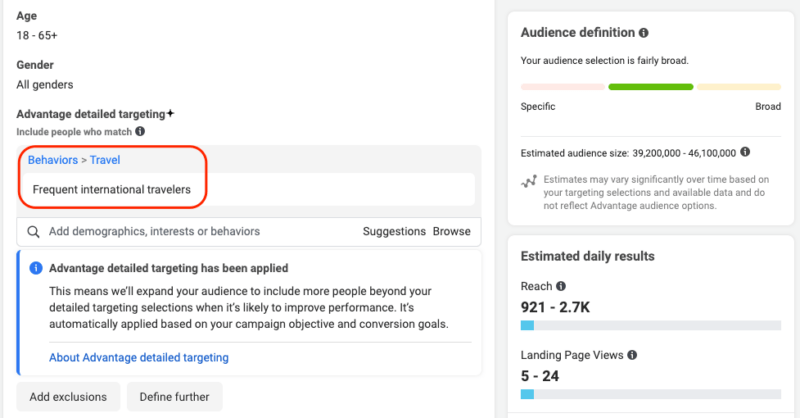
This is a “behavior” and a costly one at that! Hence it’s an obvious one to choose if you want to target high net worth individuals.
Facebook knows where people are located geographically, unless they’ve turned off the Location option in app settings. I have no idea what the definition of “frequent” is, but based on the reach numbers in the screenshot above, it’s broad.
This behaviour works best in large countries where international travel is expensive: the US, Canada and Australia. It is a weaker signal in Europe, or anywhere close to an international border, such as San Diego.
4. High-End Device Users
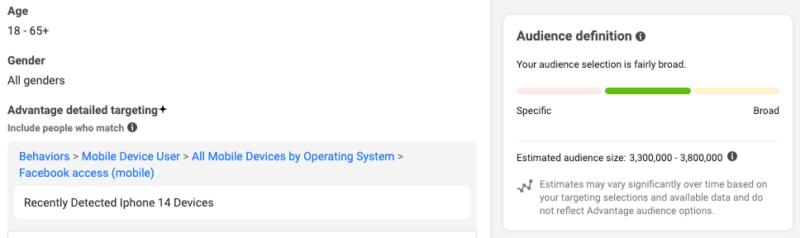
On its own, targeting high-end devices isn’t necessarily an indicator of high net wealth, however, combined with other targeting options, it may help refine your audience by focusing on high-income individuals.
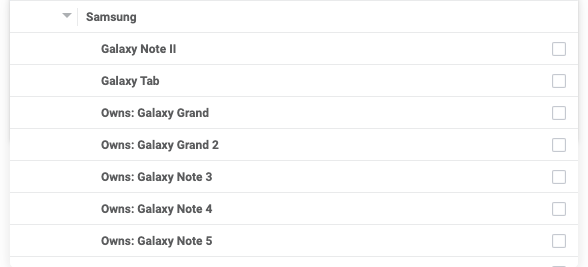
The latest Samsung and Apple phones are pretty pricey. High-end device ownership will also vary from country to country, so check the audience size in your own market: this option tends to be a stronger signal in emerging markets than in the US, where the latest iPhone is close to the default.
5. Rich Interests Targeting
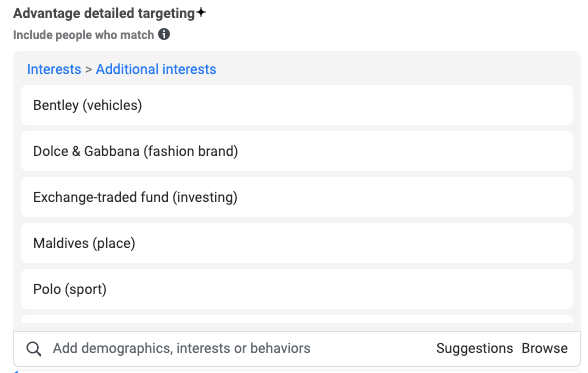
On its own this might not be the most powerful targeting method. For example, I love Audi R8s but that doesn’t mean I can afford one. However, when you combine multiple Interests along with other targeting options it will help you build a targeted persona. For example:
- High-end fashion labels
- Luxury motor vehicle brands
- Luxury travel destinations
- Property investing
- Stock market
- Yachting, polo
- Venture capital financing
- Kopi Luwak coffee drinkers
Targeting interests related to luxury brands can help in reaching affluent individuals who are likely to have a high net worth. This is also the layer that survives in Special Ad Category campaigns, so real estate and finance advertisers will lean on it more than everyone else.
Think outside the box with this one and combine interests using Define Further options to “and MUST ALSO match at least ONE of the following”.
6. People Who Prefer High-Value Goods
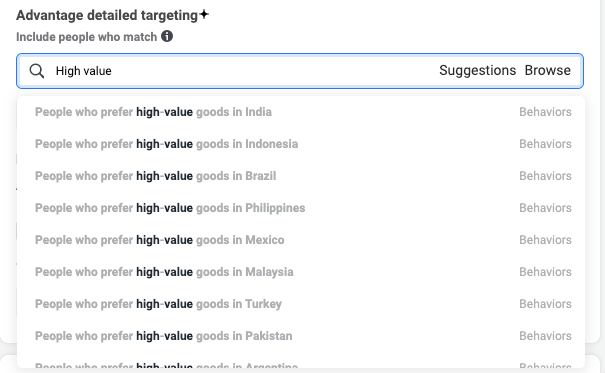
“People who prefer high-value goods” appears to be available to many typically non-English speaking countries (excluding the EU of course!). US advertisers generally won’t see it.
I’m not even going to try to guess why these countries made the cut, however, this is a targeting option worth testing if your audience is in one of these lucky countries. By targeting people who prefer high-value goods, businesses can reach a more relevant audience for luxury products.
7. Facebook Payments Users
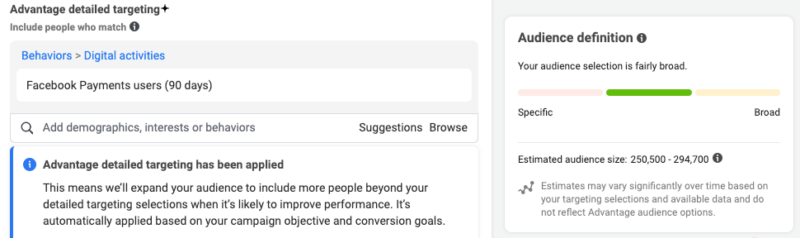
While not available in all countries, the “Facebook Payments” behaviour lets you target people who have transacted using, you guessed it, Facebook Payments.
I’m uncertain as to how popular Payments is, so throw this one in the mix for testing in your campaigns.
8. Facebook Business Page Admins
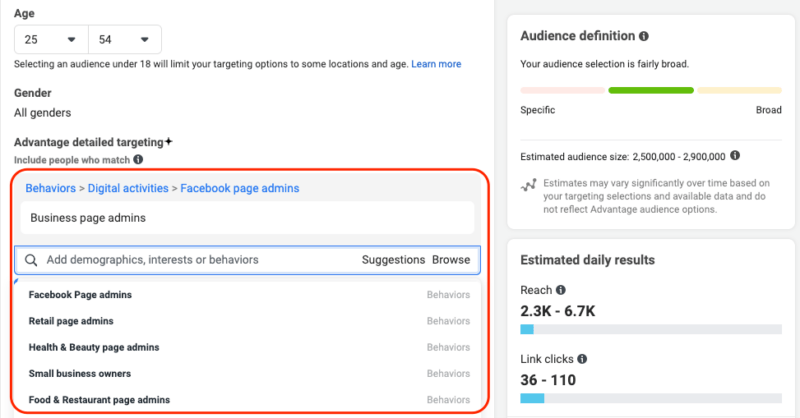
Did you know you can target various types of Facebook Page admins? Again, this can work well when it’s combined with other targeting options.
For example, you could combine “Business page admins” with “Frequent international travelers”, to build a targeted high net-worth business owner ad set. Meta has since added “Small business owners” and “New active business” behaviours alongside it, which are worth testing for the same persona.
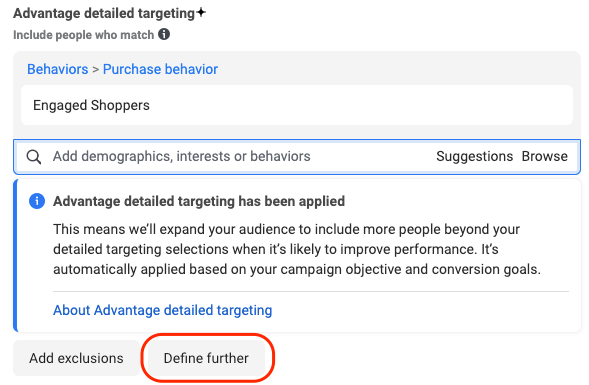
9. Engaged Shoppers
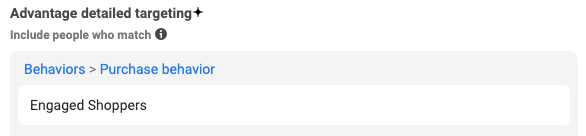
If you’re selling expensive stuff online, then you might try adding Engaged Shoppers, found under Behaviours > Purchase behavior. This way you’ll know your ads are getting in front of people willing to shop online.
Additionally, re-targeting existing customers who shop online can increase the likelihood of repeat purchases.
10. Apple Mac Users
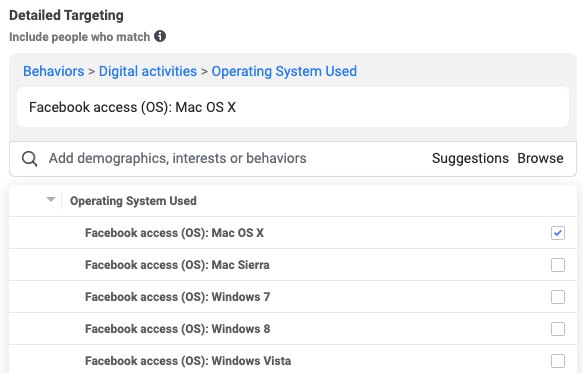
This is a little bit of a contentious one. I own a Mac, but certainly don’t consider myself a high net worth individual. However, if I was working on a Mac while living in certain parts of the world, compared to others, I would be considered quite well off.
You can target people based on the operating system they have used while logged into their Facebook account. See the Mac OS X option available under Behaviours > Digital activities > Operating System Used.
11. High-end Publications
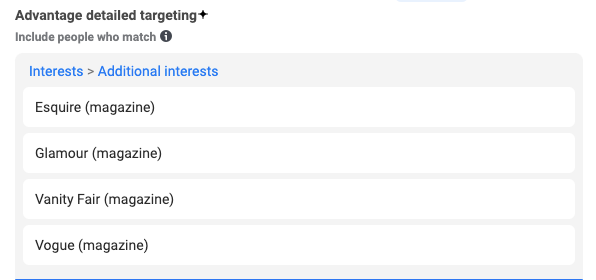
Targeting people interested in high-end publications, particularly business and investment titles, is another way to build a high net worth audience. In the US try The Wall Street Journal, Bloomberg, Forbes, Barron’s and the Robb Report; for fashion and lifestyle, Vogue, Esquire and Vanity Fair.
Additionally, targeting interests related to luxury fashion brands can help in reaching affluent individuals who have shown an interest in high-end fashion, exclusive events, and premium lifestyle magazines.
12. Combine Targeting Options for Maximum Effect
If you’ve made it this far, by now you should realize that the power isn’t in any one particular targeting option. The real magic comes when you combine audience targeting options.
When you’re building your rich audience, be sure to use the Define Further option to combine some of the options listed above. A US example that I’d start with for a high-ticket lead ad:
- Location: the metro area you serve, “people living in this location”.
- Demographics > Financial > Income: top 10% of ZIP codes.
- Define further, must also match: Frequent international travelers or Business page admins or two or three luxury interests.
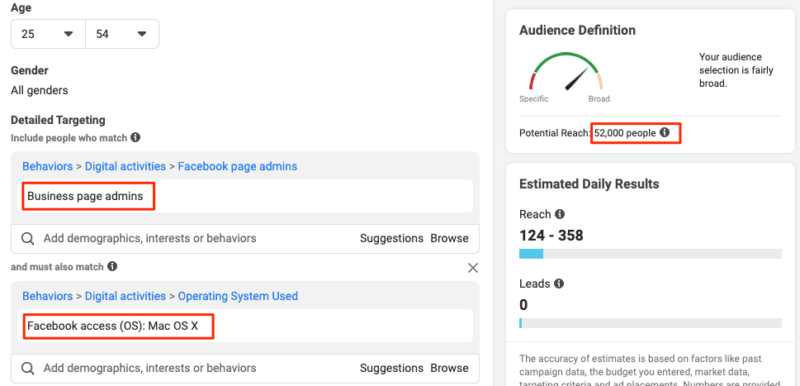
Here’s an older example of an audience that targets Facebook Business Page admins who are also Mac OS X users. As you can see, the potential reach is quite small at 52,000 people, but this also means it’s highly targeted.
Expect higher CPMs than a broad consumer audience; affluent segments are competitive, and the narrower you go, the more each impression costs. The trade-off is lead quality, which is the whole point.
For more tips on audience targeting, check out our free Facebook Ads Targeting Guide, which includes a live explorer of every detailed targeting option Meta currently offers.
FAQs: Targeting High-Net-Worth Individuals with Facebook Ads
1. Can you target by income on Facebook ads?
Only in the United States, and only at ZIP code level. Under Demographics > Financial > Income, Meta offers four tiers: the top 5%, top 10%, top 10 to 25% and top 25 to 50% of US ZIP codes by average household income. It is based on the ZIP code’s average, not the individual’s income. Outside the US there is no income option, and it is also unavailable in Housing, Employment and Financial products and services campaigns.
2. Can I target wealthy people directly on Facebook?
Not by net worth. Meta removed net worth and individual income targeting for privacy reasons. In the US you can target by ZIP code household income tier; everywhere you can layer locations (wealthy suburbs or ZIP codes), interests (luxury travel, premium brands) and behaviours (frequent international travellers, engaged shoppers) to reach affluent audiences.
3. What defines a high-net-worth individual (HNWI)?
A high-net-worth individual is typically someone with investable assets of over $1 million, excluding their primary residence. Meta does not know anyone’s net worth, so you infer HNWI traits through income tier, location, interests and behaviours.
4. What if I sell real estate, mortgages, insurance or investments in the US?
Declare the campaign as Housing or Financial products and services. In those categories Meta removes the household income tiers, ZIP code targeting, radius targeting under 15 miles, age and gender ranges, detailed targeting exclusions, lookalike audiences and saved audiences. Custom Audiences (inclusion and exclusion), Advantage+ Audience, city and state targeting, and qualifying questions on your lead form still work, and that is where to put your effort. Full details in our Special Ad Category guide.
5. Does Advantage+ Audience ignore my detailed targeting?
It treats it as a starting signal, not a boundary. Advantage+ Audience is the default for most objectives and will expand beyond the interests, behaviours and income tiers you enter if it finds people more likely to convert. To make the targeting in this guide a hard fence, switch the ad set to Original Audiences.
6. What are the best interest-based targeting options for reaching affluent users?
Try targeting interests like:
- Luxury cars (e.g. Tesla, Porsche, BMW M series)
- High-end fashion brands (e.g. Gucci, Louis Vuitton)
- Luxury travel and airlines (e.g. Emirates First Class)
- Financial publications (e.g. Bloomberg, The Economist, The Wall Street Journal)
- Investment interests (e.g. hedge funds, venture capital, private equity)
7. How can I use Lookalike Audiences to reach HNWIs?
Upload a customer list of existing high-value clients or newsletter subscribers with high lifetime value. Then create a Lookalike Audience from that list. Meta will find users with similar behaviours and demographics, many of whom may also be affluent. Lookalikes are not available in Housing, Employment or Financial products and services campaigns.
8. Can I target job titles like ‘CEO’ or ‘Investor’?
Yes, though Meta’s job title targeting is limited. Use job titles such as CEO, CFO, Founder, Investor, or Entrepreneur, and combine with high-income ZIP codes or luxury interests for better precision. Keep in mind that people don’t typically keep their job titles updated on their Facebook profiles, unlike LinkedIn.
9. What locations should I target for wealthy audiences in the US or Australia?
In the US: Manhattan (NY), Greenwich (CT), Palo Alto and Atherton (CA), Beverly Hills (CA), Palm Beach (FL) and The Hamptons (NY) are common high-income areas, and you can target them by ZIP code.
In Australia: try suburbs like Toorak (VIC), Mosman (NSW), or Ascot (QLD).
10. How can LeadSync help when targeting high-value leads on Facebook?
LeadSync delivers leads from Facebook Lead Ads to your CRM or email within seconds, ensuring you follow up fast, which is critical when dealing with HNWIs who expect responsive, high-touch service. Before launching your campaign, use the Lead Ads Testing Tool to verify your integration is working, and make sure your lead form includes a privacy policy as required by Meta.