The Meta Lead Ads Testing Tool is a free developer tool at developers.facebook.com/tools/lead-ads-testing that lets you send fake leads through your live Facebook and Instagram lead forms to verify that webhooks, CRM connections, and email notifications are firing correctly, without spending ad budget. You need admin or advertiser access on the connected Page to use it.
This guide walks through how to use the tool in 2026, how test leads differ from real ones, how long delivery should take, what to do when the tool stops working, and the common error codes you’ll see in Track Status. It applies whether you’re using LeadSync, Zapier, Make, or a direct CRM integration.
Key takeaways
- The tool lives at
developers.facebook.com/tools/lead-ads-testingand is free; only one test lead can be submitted per form at a time.- You need Page admin or advertiser access to send test leads.
- Preview Form opens your real form so you can submit real values; Create Lead sends generic placeholder data. If Preview Form isn’t showing for you, see Tool Not Working? for the real-data workaround.
- Track Status shows webhook delivery within seconds, so use it to debug CRM integrations and identify the error code. Most integrations then deliver the lead within a few minutes.
- Test leads trigger the same webhook as live leads, so your CRM treats them identically, but they don’t count toward campaign results or ad spend.
- If you use LeadSync, the ⋯ menu on each form has its own Send Test Lead and Delete Test Lead buttons, so you can test and clear test leads without opening Meta’s tool.
- Meta’s tool broken? Our free Meta Lead Ads Testing Tool creates the test lead through Meta’s API instead and emails it to you. Sign in with Facebook, pick the form, done. No LeadSync account needed to start.
How Do You Use the Meta Lead Ads Testing Tool?
Basic Steps
Navigate to the Testing Tool: Go to Facebook’s Lead Ads Testing Tool.
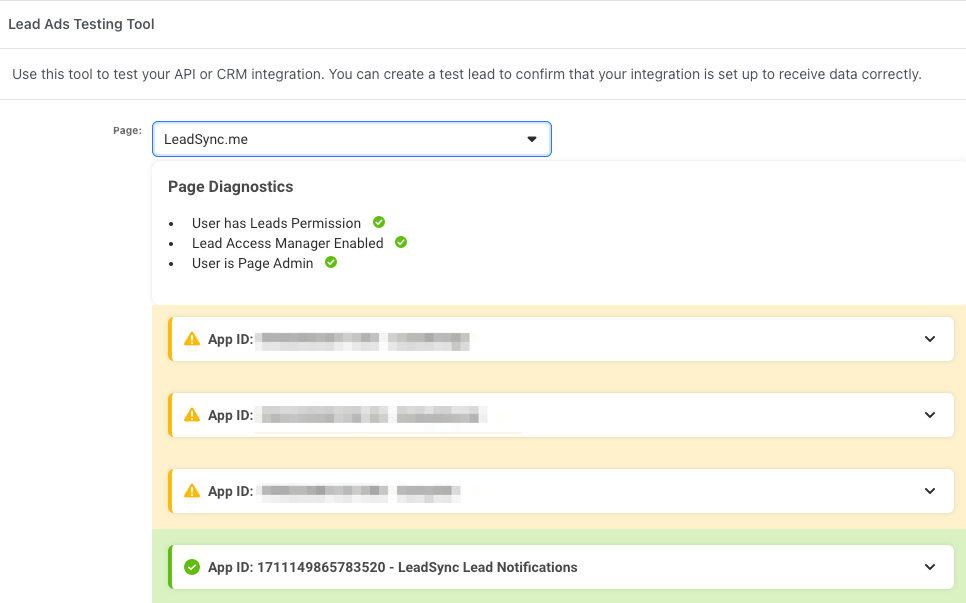
Select Your Page: Choose the relevant Facebook Page from the dropdown. Facebook will automatically show you if you have permissions to access leads, if you have Lead Access Manager enabled, and if you are a Page Admin. Under this section you’ll also be able to see which Applications have access to your leads. If you’re using LeadSync, make sure this is showing with a tick. If you’re seeing an orange warning icon, click on the arrow on the right for more details about the issue.
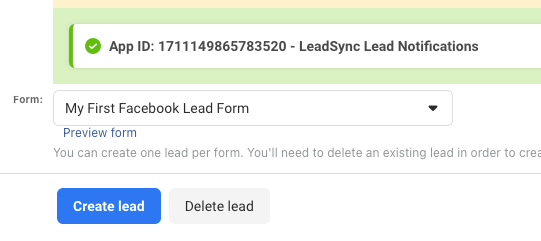
- Select Your Form: From the dropdown, select the form that you want to test, making sure that this is the same form you have setup in the integration tool you’re using AND the same form you’re using in your Meta Ads.
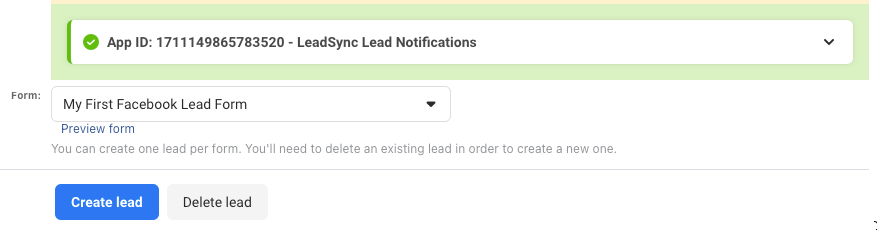
Create a Lead: Click the Create Lead button and test lead form data will be sent through the form. Remember, only one test lead can exist per form at a time, so it’s crucial to test each form individually. Note that Create Lead sends generic placeholder data; some CRMs with strict field validation may reject it, in which case use the Ads Manager Test Form workaround to submit real values instead.
A note on Preview Form: the Preview Form button next to Create Lead opens your actual form so you can type real values into it, which is the safer option if your CRM rejects generic placeholder data. If you don’t see the button, see Preview Form button missing below.
- Test Lead Sent: You should now see the “Your test lead has been sent” message.
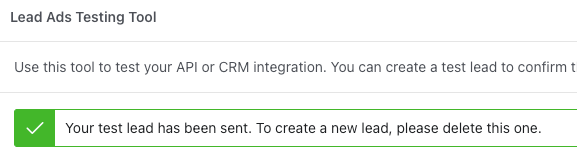
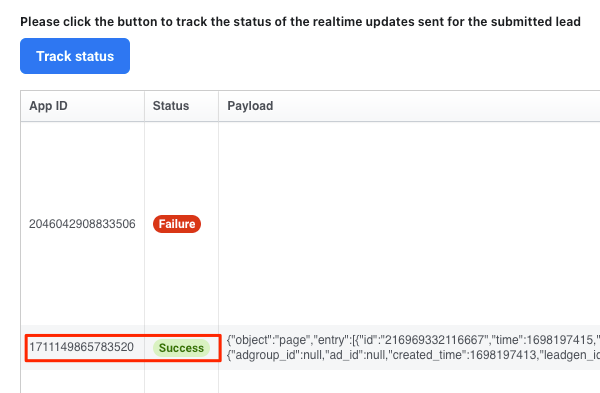
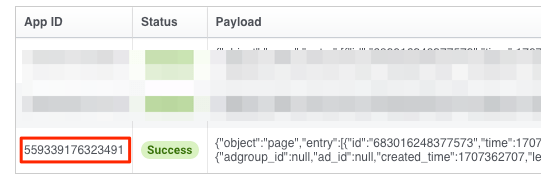
- Track Status: After a few seconds, click on “Track Status” to see if the lead has been successfully created. If it says pending, wait 10 seconds and click Track Status again. If you’re using LeadSync, you should see the following success message.
The LeadSync App ID will either be 1711149865783520 or 559339176323491
- Check your Email, CRM or App: Make sure you’ve received the test data at the connection you’ve set up in LeadSync or Zapier.
Once Track Status shows success, it’s worth confirming the lead also landed on Meta’s side. Our guides to the Facebook Leads Center and checking your Facebook ad leads cover where to find lead records inside Meta’s own tools.
What’s the Difference Between a Test Lead and a Real Lead?
A test lead travels the exact same delivery path as a real lead: same webhook, same payload structure, same treatment by your CRM. The differences are in where it comes from and what it counts toward.
| Test lead | Real lead | |
|---|---|---|
| Created by | You, via the testing tool or LeadSync’s Send Test Lead | A person submitting your live form |
| Triggers webhooks to connected apps | Yes, delivered like a live submission | Yes |
| Counts toward campaign results | No, it’s not attached to a campaign | Yes |
| Costs ad spend | No, free and unlimited | Generated by your paid campaign |
| How many can exist | One per form at a time | No limit |
| Can it be deleted? | Yes, by whoever created it | No |
| How your CRM treats it | Identically to a live lead | As a normal lead |
Because your CRM can’t tell the difference, a test lead will trigger any automations attached to new leads: welcome emails, sales notifications, autoresponders. Delete or tag test records in your CRM after a successful test so your sales team doesn’t chase a lead named “test”.
One caution on the “no ad spend, no campaign impact” point. That holds for the testing tool and for LeadSync’s built-in tester. It does not hold for submitting a form through a live ad’s preview link, which creates a real lead and distorts your campaign conversion data. More on that in the workaround section.
How Long Should a Test Lead Take to Arrive?
Short answer: seconds for Meta’s side, a few minutes end to end. Here’s the breakdown by stage:
| Stage | What to expect |
|---|---|
| Meta webhook fires (Track Status) | Seconds. If Track Status says “pending”, wait 10 seconds and click Track Status again |
| Sync tool processing (LeadSync, Zapier, etc.) | Typically within a few minutes of the webhook firing |
| Email notification in your inbox | Adds a little longer depending on your email provider; check spam before assuming failure |
If Track Status shows success but nothing has arrived after five minutes, the problem is downstream of Meta: check your field mapping, your spam folder, and whether your integration’s Facebook connection needs reconnecting. If Track Status shows failed, jump to the error code table below. And if Track Status never resolves at all, see the stuck on Pending fix.
This timing applies to test leads specifically. If test leads arrive fine but real campaign leads are going missing, that’s a different problem with different causes, usually permissions or an expired webhook subscription.
Which Facebook Lead Testing Method Should You Use?
There are three ways to send a test lead in 2026. They differ in the data they send, what they can break, and where you clean up afterwards.
| Meta Lead Ads Testing Tool | Ads Manager Test Form | LeadSync Send Test Lead | |
|---|---|---|---|
| Best for | Quick webhook checks | Real field values | Testing without leaving your form list |
| Data sent | Generic placeholder data | Values you type in | Test payload to your connected app |
| Works when Meta’s tool is down | No | Yes | Yes |
| Campaign impact or ad spend | None | None | None |
| Delete the test lead from | Same tool, Delete Lead button | Testing Tool afterwards | Same menu, Delete Test Lead |
| Where | developers.facebook.com/tools/lead-ads-testing | Ads Manager > All Tools > Instant Forms | Your LeadSync Lead Forms list |
If the testing tool is throwing “Something went wrong” (a recurring Meta-side issue through 2026), skip straight to the Ads Manager route: it triggers the same webhook and takes real data. Or use our free testing tool, which sends the same placeholder lead through Meta’s API (the part that keeps working when the interface does not), emails you the result, and shows which apps are subscribed to your Page.
Send and Delete Test Leads Inside LeadSync
If your forms are connected through LeadSync, you don’t have to open Meta’s testing tool every time you want to test. Each form in your Lead Forms list has a ⋯ menu with two test actions:
- Send Test Lead sends a test lead to the connection you’ve set up for that form, doing the same job as Meta’s Create Lead button. Use it to confirm your CRM, email notification, or webhook receives the lead.
- Delete Test Lead clears the form’s existing test lead so you can send a fresh one. Facebook only allows one test lead per form at a time, so this saves you a trip back to the testing tool whenever a previous test is in the way.
One Facebook rule still applies: a test lead can only be deleted by whoever created it. If the current test lead was created inside Meta’s own Lead Ads Testing Tool, LeadSync cannot remove it for you. In that case the Delete Test Lead button tells you so and points you to the testing tool with the exact steps to clear it there.
Tool Not Working? Common Errors and Fixes
For errors outside the testing tool, such as terms of service, privacy policy URL or CRM access revoked, see our Facebook lead ads errors guide.
Meta’s testing tool has been intermittently broken throughout 2026: blank screens, vanished Preview buttons, and “Something went wrong” errors. Here’s what users on r/PPC, r/FacebookAds, and r/zapier have actually confirmed works in the past few months. If none of the fixes below resolve your issue, Workaround: Use Ads Manager’s Test Form feature at the bottom is the reliable fallback.
“Something went wrong. Please try again later.”
This error became widespread in 2026 and appears intermittently, and multiple users report it resolving on its own without any changes on their end, which strongly suggests it’s a Meta backend issue rather than a configuration problem.
Things to try first, in order:
- Clear cookies for
developers.facebook.comandfacebook.com, then sign back in. This is the most commonly reported fix inr/PPCandr/zapierthreads. - Try Chrome incognito or a different browser to rule out a corrupted session.
- Verify your Business Manager account if the tool prompts you. Some users report being asked to re-verify when the error first appears.
If none of the above works, treat it as a Meta-side outage and use the Workaround below, or skip the interface entirely: LeadSync’s free testing tool creates the test lead through the API and emails it to you in seconds.
Preview Form button missing
Some accounts intermittently don’t see the Preview Form button. When it’s missing it’s a Meta-side display issue rather than something in your setup, so the usual checks (Page admin role, form not archived, creative attached) won’t bring it back. Try a different browser or an incognito window first, since a stale session is the most common cause.
While it’s missing, Create Lead still works, but it only sends generic dummy data, so you can’t fill out the form with real values that way. For real-data testing, use the Workaround below.
Track Status shows “failed” with code 100, 103, or 190
These are token or permission errors, not tool bugs:
| Code | Subcode | Meaning | Fix |
|---|---|---|---|
| 100 | 33 | You’re using a Page token to test an ad-level integration | Switch to a Business System User token |
| 103 | CRM access has been revoked in Lead Access Manager | In Business Settings, go to Integrations > Lead Access, select your Page, and assign the CRM app again | |
| 190 | Your CRM’s connection token has expired | Reconnect the integration in your CRM’s Facebook settings |
LeadSync customers can reconnect their Facebook account from their account connections page, or contact LeadSync support to have a token verified directly.
Test lead stuck on “Pending” status
This is a known issue in 2026: some test submissions never resolve to “success” or “failed”. The reliable fix:
- In the Lead Ads Testing Tool, select the same Page and Form.
- Click Delete Lead to clear the pending submission.
- Submit a fresh test via the Workaround below.
Form dropdown is empty after selecting a Page
If no forms appear after picking your Page, the usual causes are:
- The Page genuinely has no published lead forms yet (check Forms Library in Meta Business Suite).
- Your account doesn’t have Lead Access for the Page (Business Settings > Integrations > Lead Access).
- The API call returned stale data, so switch to a different Page in the dropdown and back to force a refresh.
“Terms of service not accepted” when you try to run the ad
Testing often surfaces this one, because the testing tool works fine while the ad itself refuses to run. If Ads Manager blocks your campaign with “You can’t run lead ads until your Facebook Page accepts Facebook’s Lead Generation Terms of Service” (reference #1815089, #1892181, or #1892291 for partnership ads), the block is on the Page, not the form or the tool.
A Page admin needs to accept the terms at facebook.com/ads/leadgen/tos, one Page at a time. Full walkthrough, including why it still appears after you’ve accepted: how to fix the Terms of Service not accepted error.
Still not receiving the test lead?
If the tool itself is behaving but the test lead never shows up at the other end, run through this checklist before contacting LeadSync support:
- The lead form you’re testing hasn’t been set up in your LeadSync account. Check that you’ve connected the correct lead form.
- Your lead notification is sitting in your spam folder.
- The email address you’re sending leads to is incorrect.
Workaround: Use Ads Manager’s Test Form feature
When the testing tool is broken (Preview button missing, page won’t load, or tests stuck on Pending), this sequence is the verified workaround that has been reported working repeatedly in 2026:
- Open Ads Manager and select the Page connected to your form.
- Navigate to All Tools > Instant Forms.
- Find your form in the list and click Test Form.
- Fill out the form with real test data. The submission triggers webhooks identically to a live lead, so your CRM, email integration, or Zap will receive it.
- Return to the Lead Ads Testing Tool, select the same Page and Form, and click Delete Lead to clear the test submission so the form remains testable again.
Some users have warned that submitting via a live ad’s dark-post preview link (an older workaround) is risky because it counts as an actual lead and distorts campaign conversion data. The Instant Forms > Test Form path above avoids that.
Can You Create Test Leads via the API?
Yes. Developers can create a test lead by making a POST request to /{FORM_ID}/test_leads, provided there’s no existing test lead on the form and your Page role is Advertiser or above. If you would rather not write code, our free testing tool makes that exact call for you and emails you the lead. If you’re building directly against Meta’s API, our Meta Lead Gen API guide covers webhooks, payloads, and setup in full.
Frequently Asked Questions
How do I access the Meta Lead Ads Testing Tool?
Go to developers.facebook.com/tools/lead-ads-testing in your browser. You must be logged into Facebook with an account that has admin or advertiser access to the Page connected to your lead ad forms.
Why aren’t my test leads showing up in my CRM?
Common reasons include: 1) Your integration tool doesn’t have permission to access leads from your Page. Check the Facebook Business Settings > Integrations section. 2) You selected the wrong form in the testing tool. 3) Your CRM field mapping is misconfigured. 4) The webhook subscription has expired and needs to be reconnected.
How long does a test lead take to arrive in my CRM?
Track Status in the testing tool usually updates within seconds. If it says pending, wait 10 seconds and check again. Once Track Status shows success, most sync tools and CRM integrations deliver the lead within a few minutes. If nothing has arrived after five minutes, check your field mapping, your spam folder, and whether the integration’s Facebook connection needs reconnecting.
Do test leads affect my campaign results or ad spend?
No. Test leads sent from the Lead Ads Testing Tool or from LeadSync aren’t attached to a campaign, so they don’t count toward campaign results and cost nothing. One warning: submitting a form via a live ad’s preview link creates a real lead and distorts campaign conversion data, so avoid that method.
Can I test Instagram Lead Ads with the testing tool?
Yes. The Meta Lead Ads Testing Tool works for both Facebook and Instagram lead ad forms. Select the Facebook Page linked to your Instagram account, then choose the form you want to test. Instagram lead forms appear in the same dropdown as Facebook forms.
How many test leads can I send?
You can send as many test leads as needed. There is no limit. Test leads are free and don’t count toward any ad spend. However, only one test lead can be submitted per form at a time.
How do I delete a Facebook test lead?
Facebook allows only one test lead per form, and it can only be deleted by whoever created it. In Meta’s Lead Ads Testing Tool, select the same Page and Form and click Delete Lead. If your forms are connected through LeadSync, open the three-dot menu on the form in your Lead Forms list and click Delete Test Lead to clear it without opening the testing tool. A test lead created inside Meta’s tool can only be removed from that same tool.
What is the difference between the testing tool and a form preview?
The Lead Ads Testing Tool sends a real webhook notification to all connected apps, exactly like a live lead submission. A form preview in Ads Manager only shows you what the form looks like. It does not trigger webhook delivery to your CRM or integration tools. Always use the testing tool to verify your integration is working end-to-end.
Why am I not receiving leads from Facebook?
Common reasons include: the lead form hasn’t been set up in your integration account, notifications are in your spam folder, incorrect email address configuration, or permissions issues with your Facebook Page. Use the testing tool to send a test lead and check the Track Status results.
The Meta Lead Ads Testing Tool shows “Something went wrong”. How do I fix it?
Clear cookies for developers.facebook.com and facebook.com, then sign back in. This is the most commonly reported fix on Reddit. If that doesn’t work, try Chrome incognito or a different browser. Multiple users in 2026 have reported the error resolving on its own, suggesting it’s often a Meta backend issue rather than a problem with your account. While you wait it out, you can test forms via Ads Manager > All Tools > Instant Forms > Test Form, or use LeadSync’s free testing tool, which creates the test lead through Meta’s API and emails it to you.
Why is the Preview Form button missing from the Lead Ads Testing Tool?
Some accounts intermittently don’t see the Preview Form button. When it’s missing it’s a Meta-side display issue, not a problem with your Page configuration, permissions, or form status, so try a different browser or an incognito window first. If it still doesn’t appear, test with real form data via Ads Manager > Select Page > All Tools > Instant Forms > Test Form, then delete the resulting lead from the Testing Tool afterwards.
What do error codes 100, 103, and 190 mean in Track Status?
Code 100 (subcode 33) means you’re using a Page token to test an ad-level integration. Switch to a Business System User token. Code 103 means CRM access has been revoked. Reassign the CRM under Business Settings > Integrations > Lead Access. Code 190 means your CRM’s connection token has expired. Reconnect the integration.
What’s the best way to test Facebook lead ads in 2026?
Use Meta’s Lead Ads Testing Tool at developers.facebook.com/tools/lead-ads-testing for quick webhook checks. If the tool is down or you need real field values, submit via Ads Manager > All Tools > Instant Forms > Test Form. LeadSync users can send and delete test leads from the Lead Forms list without opening either tool.
Next Steps
Once you’ve confirmed your test leads are coming through, here are some useful resources to help you get the most out of your lead ad campaigns:
- Run a form split test: Now that your integration is verified, see how to split test Meta lead forms without losing leads. Meta’s new Form testing feature creates up to 5 new forms with new form IDs, and the routing implications are exactly what this tool helps you debug.
- Improve your targeting: Use our complete Facebook & Meta Ads targeting guide to find the right audience for your campaigns.
- Stay compliant: Generate a free privacy policy for your lead ads, required by Meta for all lead forms.
- Target high-value leads: Learn 12 ways to target high net worth individuals on Facebook & Instagram.
- Get instant lead notifications: Learn how to send Facebook leads to email so you receive every lead in your inbox the moment it comes in.
- Connect to your CRM: See our complete integration guide for connecting your lead ads to Mailchimp, HubSpot, ActiveCampaign, and 20+ other tools.