Everyone who runs lead ads has felt this: you open Ads Manager on Monday morning and the weekend’s leads are sitting there, hours old, with the best ones already talking to someone else. We wanted to know how common that is, so we measured it.
LeadSync syncs lead form submissions from Facebook, Instagram, Google, LinkedIn and TikTok into CRMs, inboxes and phones for a few thousand businesses. That gives us something most advertisers never see: the exact minute every lead was submitted, across every industry and timezone, converted to the advertiser’s own local time. This report covers 1.69 million Facebook and Instagram leads from 27 November 2025 to 30 September 2026.
The headline is simple. Three out of four leads arrive when a typical business is closed.
What time of day do Facebook leads come in?
The evening. Lead volume is lowest at 3am, climbs steadily from 6am, holds roughly flat through the working day, and then rises again after 5pm to a peak at 9pm. The three busiest hours, 8pm to 10pm, carry 16.8% of all leads between them. The hour after midnight is still busier than any hour between 1am and 6am, and busier than 6am itself.
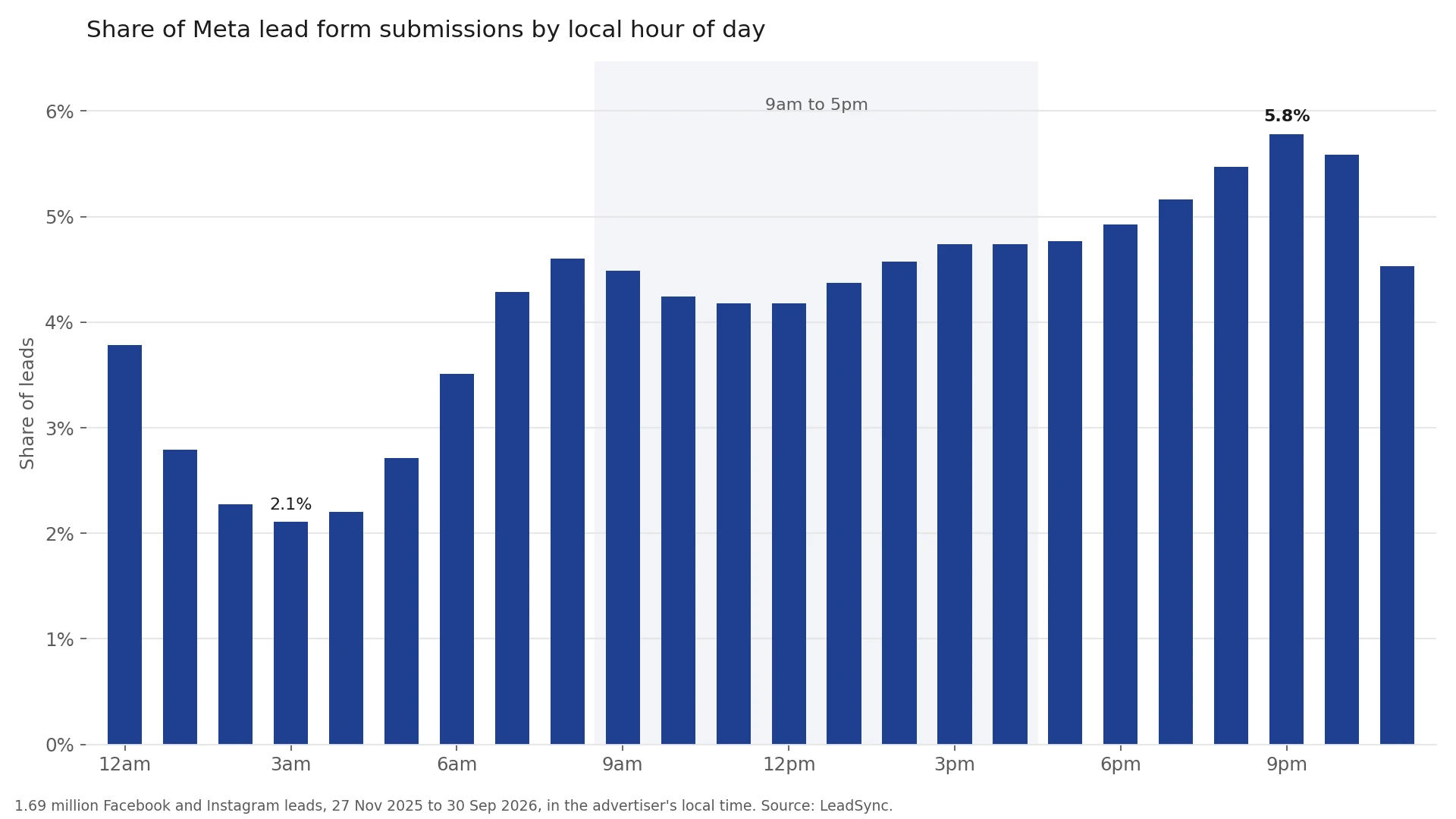
This is the full distribution, in the advertiser’s local time:
| Hour | Share | Hour | Share |
|---|---|---|---|
| 12am | 3.8% | 12pm | 4.2% |
| 1am | 2.8% | 1pm | 4.4% |
| 2am | 2.3% | 2pm | 4.6% |
| 3am | 2.1% | 3pm | 4.7% |
| 4am | 2.2% | 4pm | 4.7% |
| 5am | 2.7% | 5pm | 4.8% |
| 6am | 3.5% | 6pm | 4.9% |
| 7am | 4.3% | 7pm | 5.2% |
| 8am | 4.6% | 8pm | 5.5% |
| 9am | 4.5% | 9pm | 5.8% |
| 10am | 4.2% | 10pm | 5.6% |
| 11am | 4.2% | 11pm | 4.5% |
Grouped into the blocks that matter for staffing:
| Block | Share of leads |
|---|---|
| Office hours, Monday to Friday 9am to 5pm | 24.8% |
| Evenings, 6pm to midnight, all days | 31.5% |
| Overnight, midnight to 6am, all days | 15.9% |
| Early morning, 6am to 9am, all days | 12.4% |
| Weekends, all hours | 29.2% |
The office-hours share and the other rows overlap (a Saturday afternoon lead is both a weekend lead and a daytime lead), so they do not sum to 100. The number to keep is the first one: a quarter of leads arrive while the office is open, and three quarters do not.
Why evenings? A lead form is two taps on a phone, usually from a feed, usually on a couch. People scroll Instagram after dinner, not at their desk at 10am. The ad is seen, the form is pre-filled, the submit button is pressed, and the person goes back to scrolling. The lead is as warm as it will ever be at that moment, and it is 9pm.
Which day of the week gets the most Facebook leads?
Sunday, narrowly. The spread across days is much smaller than the spread across hours.
| Day | Share of leads |
|---|---|
| Sunday | 15.7% |
| Monday | 14.7% |
| Tuesday | 14.5% |
| Wednesday | 14.0% |
| Thursday | 13.8% |
| Friday | 13.7% |
| Saturday | 13.4% |
Put the two together and the picture sharpens. The single busiest hour of the week is Sunday at 9pm (0.90% of all leads), followed by Monday at 9pm (0.87%). The whole Sunday evening block is dark on the heatmap, which is exactly the block most businesses are furthest from a phone.
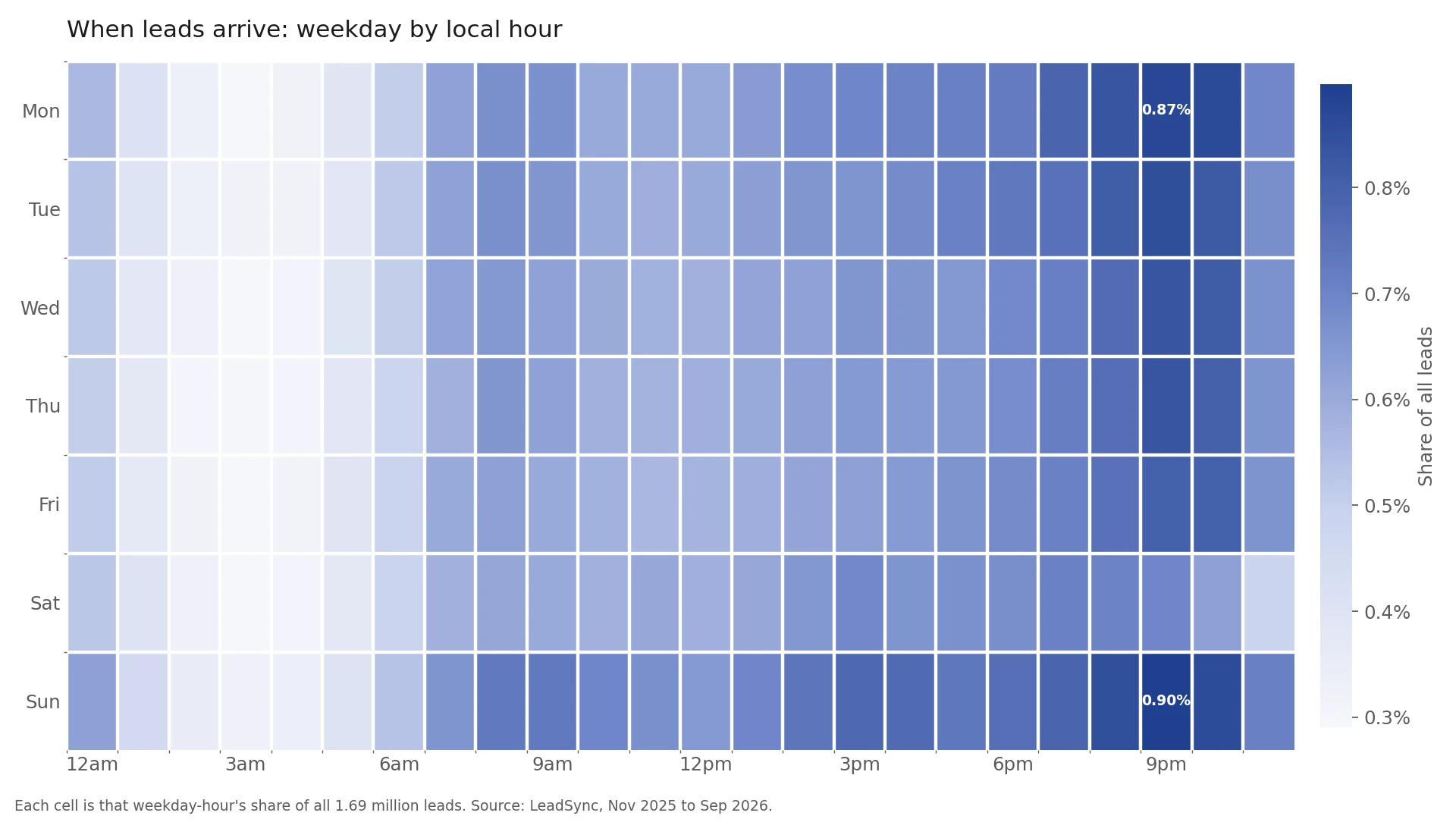
Saturday is the one day with a different shape. It is busy through the daytime and quieter in the late evening than any other day, which fits a day spent out rather than in.
Does Instagram differ from Facebook?
Barely. We split the Meta leads by the placement the form was submitted from.
| Placement | Leads | Peak hour | Evening share (6pm to midnight) | Weekend share |
|---|---|---|---|---|
| 1,235,931 | 9pm | 31.3% | 29.4% | |
| 427,779 | 10pm | 32.0% | 28.7% |
Instagram runs about an hour later and a fraction heavier in the evening. If your campaigns are Instagram-only, the 10pm lead is your normal lead. Otherwise the channel is not the variable that matters; the hour is.
How does it vary by country?
Every market we have enough data for shows the same shape, shifted by an hour or two. The United States peaks earliest and has the flattest daytime; India peaks latest and has the sharpest evening spike.
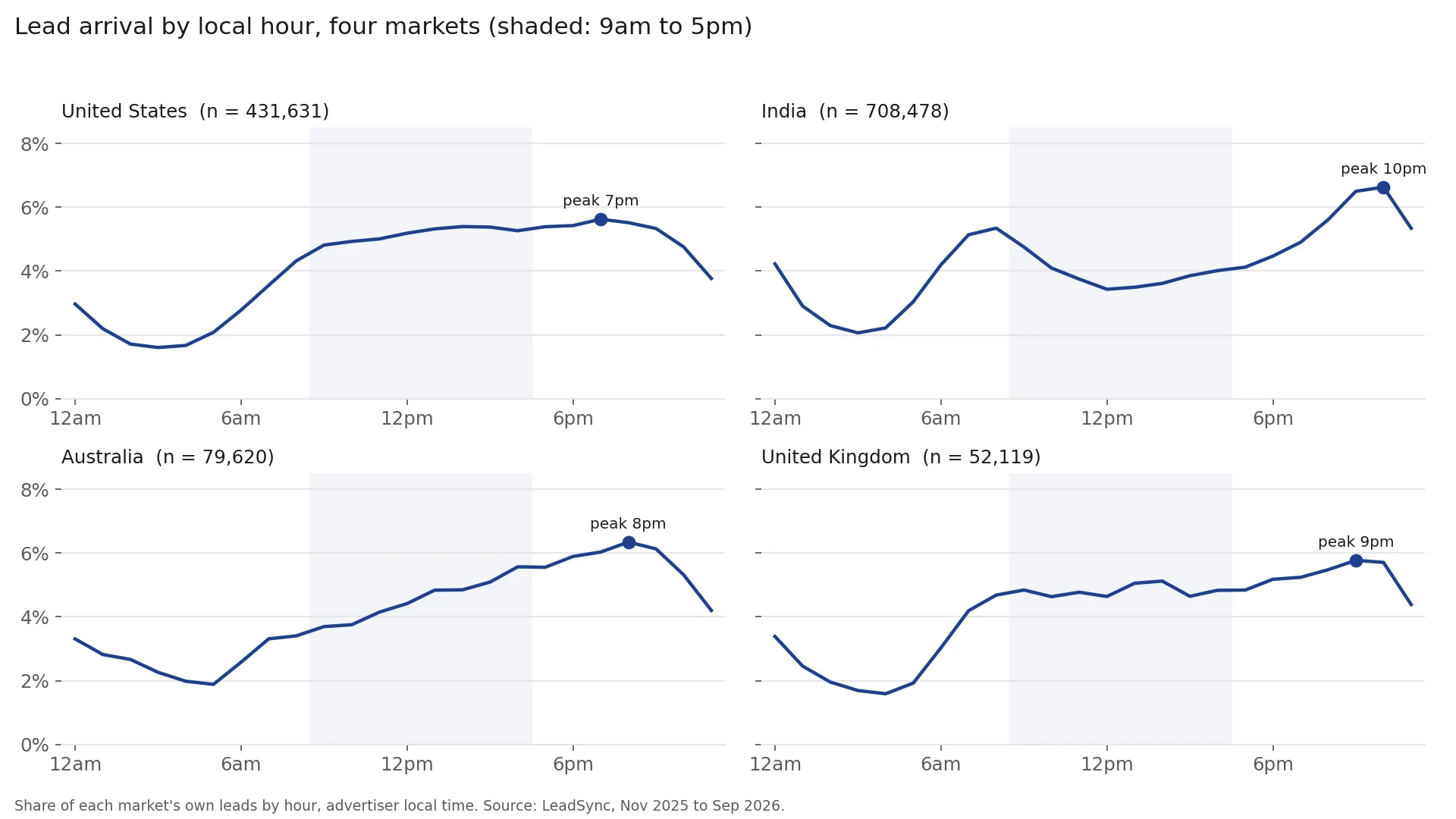
| Market | Leads | Peak hour | Share 9am to 5pm (all days) | Evening share | Overnight share |
|---|---|---|---|---|---|
| United States | 431,631 | 7pm | 41.3% | 30.4% | 12.2% |
| India | 708,478 | 10pm | 31.0% | 33.5% | 16.7% |
| Australia | 79,620 | 8pm | 36.3% | 33.9% | 14.9% |
| United Kingdom | 52,119 | 9pm | 38.5% | 31.7% | 13.0% |
| Ireland | 32,338 | 9pm | 39.3% | 34.2% | 11.8% |
Two things stand out. First, even in the United States, where daytime volume is strongest, fewer than half of leads arrive in the 9-to-5 window across all days, and the weekday-only figure is lower again. Second, India’s evening spike is so pronounced that an Indian advertiser who stops checking leads at 6pm misses the busiest third of the day.
What does this mean for lead response time?
This is where the timing data meets the speed-to-lead research. The MIT study of 15,000 leads found that a response inside five minutes is 100 times more likely to reach the person, and 21 times more likely to qualify them, than a response at 30 minutes. The average business takes about 47 hours.
Our distribution lets us ask a sharper question: if a business only responds during office hours, how long does its typical lead actually wait? We took every one of the 1.69 million leads, assumed it was answered at the next moment the business was open, and averaged the gap.
| Response policy | Leads answered immediately | Average wait | Leads waiting over 12 hours | Leads waiting over 24 hours |
|---|---|---|---|---|
| Monday to Friday, 9am to 5pm | 24.8% | 15.5 hours | 43.4% | 22.9% |
| Monday to Friday, 9am to 6pm | 28.2% | 14.6 hours | 40.0% | 22.2% |
| Seven days, 8am to 8pm | 55.0% | 3.1 hours | 0% | 0% |
A 9-to-5 responder is not a little slow. For the typical lead it is 15 hours slow, and for one lead in four it is more than a day slow, because a Friday evening lead waits until Monday morning. That is the 47-hour average from the research, explained by a calendar rather than by laziness.
The third row is the interesting one. Extending cover to 8am to 8pm, seven days, does not mean staffing a call centre. It means one person able to send a text from their phone in the evening and on weekends, and it removes every wait over 12 hours.
Should you schedule Facebook ads to run only in business hours?
Some advertisers look at this and reach for ad scheduling: run the ads 9 to 5 so the leads arrive when someone can call. It is almost always the wrong move.
- It throws away 75% of the volume. Meta’s delivery system is already weighting spend toward the hours that convert for your account; restricting the schedule removes the hours people actually submit forms, and the cost per lead goes up.
- Dayparting on Meta needs a lifetime budget rather than a daily one, which changes pacing and makes the campaign harder to manage.
- The person who filled the form at 9pm did not choose a bad time. They chose the time they were free. Being there is the advantage, not avoiding them.
The right response to a 9pm lead is a reply at 9:03pm, and that is a process problem, not an ad scheduling problem.
How to handle leads that arrive at 9pm on a Sunday
The businesses in our data who respond fast outside office hours all run the same four-part setup, and none of it requires anyone to be at a desk.
- An instant alert to a phone, with the lead’s details in it. Meta does not notify you when a form is submitted; the lead sits in Leads Center until someone looks. An SMS alert or WhatsApp alert within seconds of submission is what makes a 9pm reply possible.
- An automatic first reply to the lead. An email or SMS autoresponder that confirms receipt and sets an expectation (“Thanks Sam, I will call you first thing tomorrow”) holds the lead until a human is free. It is not a substitute for the call. It is what stops the person assuming nobody is there.
- A way to act from the alert. LeadSync’s alerts carry a link to a lead page with one-tap Call, Text and WhatsApp buttons and a status you can set after the call, so a Sunday evening lead can be texted from the couch and marked Contacted without opening a laptop.
- A next-morning cadence for the rest. For the leads that genuinely have to wait, the morning sequence should be the first thing the day starts with, not the last. Our real estate lead follow-up plan has a 30-day schedule that works for most ad leads.
If you are still deciding how to structure the ads themselves, start with the Meta lead ads guide and the instant forms guide. The timing data applies to both.
Methodology
- Dataset: 1,692,754 lead form submissions received by LeadSync customers from Facebook and Instagram lead ads between 27 November 2025 and 30 September 2026. Google, LinkedIn and TikTok leads were excluded because their volumes in the period were too small to report separately.
- Local time: each submission timestamp was converted to the advertiser’s account timezone. For the 1.6% of leads from accounts with no timezone set, the account’s country was used to assign a representative zone, with half-hour offsets and daylight-saving differences spread across adjacent hours.
- Hour of week: hours use the advertiser’s local clock; days follow the same clock, so a 1am Monday submission counts as Monday.
- Office-hours wait: for each submission, the wait is the time until the next moment the business is open under each policy. A lead that arrives inside the window has a wait of zero. Averages are weighted by lead volume.
- Market mix: India (42%) and the United States (26%) dominate the sample, followed by the Netherlands, Australia, Hong Kong, the United Kingdom and Ireland. Per-market figures are reported separately where the sample is large enough; the headline figures are for the whole dataset.
- What this is not: a measure of how fast businesses actually respond. LeadSync began recording lead status events in October 2026 and will report response times once there is enough history.
You are welcome to cite these figures. Please link to this page as the source.
Frequently Asked Questions
What time of day do most Facebook leads come in?
In the evening. Across 1.69 million Facebook and Instagram lead form submissions, the busiest hour was 9pm in the advertiser’s local time, and the three busiest hours (8pm, 9pm and 10pm) carried 17% of all leads. Volume climbs steadily from 6am, holds roughly flat through the working day, then rises again after 5pm to the evening peak. The quietest hour is 3am.
What day of the week gets the most Facebook leads?
Sunday, with 15.7% of all leads, followed by Monday at 14.7%. Saturday is the quietest day at 13.4%. The spread between days is small compared with the spread between hours, so the hour a lead arrives matters more than the day.
What percentage of Facebook leads arrive outside business hours?
75%. Only 24.8% of leads arrive between 9am and 5pm, Monday to Friday, in the advertiser’s local time. Evenings (6pm to midnight) account for 31.5%, weekends for 29.2%, and the hours between midnight and 6am for 15.9%.
Is the best time to run Facebook lead ads the evening?
The evening is when most people submit lead forms, but scheduling ads to run only in the evening is usually a mistake. Meta’s delivery system already shifts spend toward the hours that convert, and restricting the schedule removes the 69% of leads that arrive at other times. The better response to this data is to be able to reply to a 9pm lead at 9pm, with an instant alert and an automatic first reply, rather than to stop advertising at other hours.
How long do leads wait if you only respond during office hours?
On average, 15.5 hours. Measured against the actual distribution of 1.69 million leads, a business that responds only between 9am and 5pm on weekdays would leave 43% of its leads waiting more than 12 hours and 23% waiting more than 24 hours. Extending response to 8am to 8pm, seven days a week, brings the average wait down to 3.1 hours and the share waiting more than 12 hours to zero.
Does the pattern differ between Facebook and Instagram leads?
Only slightly. Instagram leads peak at 10pm and Facebook leads at 9pm, and Instagram sends a marginally larger share in the evening (32.0% against 31.3%). The weekend share and the overnight share are almost identical. The channel matters far less than the hour.
The lead is warm at 9pm. Be the business that answers.
Most of your competitors read this data and shrug, because they have no way to act on a Sunday evening lead. That is the whole opportunity. Set up the alert, the automatic reply and the lead page once, and the 75% of leads that arrive after hours become the 75% you answer first. You can start a free trial and have the first alert on your phone in ten minutes, with no credit card needed.