Why Facebook Ads Are a Goldmine for Contractors
If you’re a contractor relying solely on word-of-mouth or Google Ads for leads, you’re leaving money on the table. Facebook (Meta) has over 3 billion monthly active users, and the homeowners you want to reach are scrolling their feeds every single day.
Here’s what makes Facebook ads uniquely powerful for home services lead generation:
The cost advantage is massive. Google Ads for contractor keywords can cost $20-50+ per click. Pest control keywords hit $222 per click on Google. On Facebook, you can generate full leads (not just clicks) for a fraction of that cost.
You reach people before they start searching. Most homeowners don’t wake up thinking “I need to find a roofer today.” Facebook lets you put your services in front of homeowners who match your ideal customer profile — before they ever open Google.
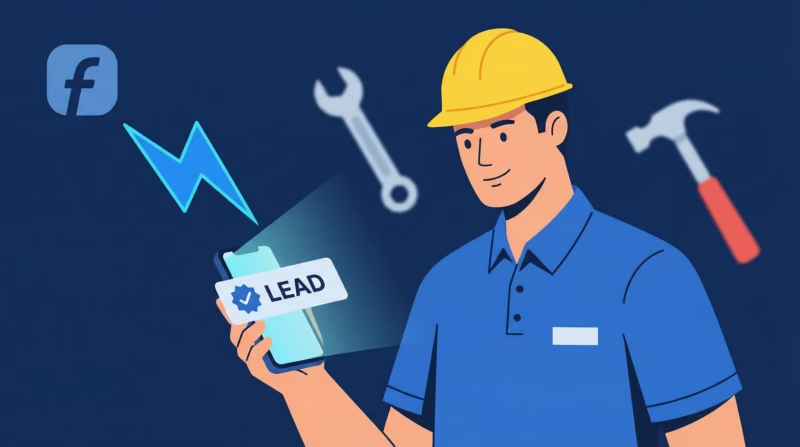
Lead forms keep everything on Facebook. With Meta Lead Ads, potential customers fill out a form without ever leaving the app. No landing page needed. No slow-loading website. Just a quick tap, and you have their name, phone number, and project details.
What Contractors Can Realistically Expect to Pay Per Lead
One of the most common questions contractors ask is “how much will this cost me?” The answer depends on your trade, your market, and how well your campaigns are optimized.
Here are realistic cost-per-lead (CPL) benchmarks by trade based on industry data:
HVAC: $30–$75 per lead. HVAC has strong seasonal demand (summer AC, winter heating), which means you can scale spend during peak months and pull back in slower periods. For more on generating HVAC leads, see our HVAC lead generation guide.
Roofing: $50–$150 per lead. Roofing leads are more expensive because the job values are higher ($8,000–$25,000+ per project). Even at $150 per lead, closing one job from every 10-15 leads is extremely profitable.
Landscaping: $25–$60 per lead. Landscaping benefits from broad appeal — nearly every homeowner is a potential customer. Lower ticket sizes mean lower CPLs. Check out our landscaping lead generation guide for more strategies.
Plumbing: $40–$80 per lead. Emergency plumbing leads convert fast and at high rates. Non-emergency leads (bathroom remodels, water heater installs) are cheaper to acquire.
Pest Control: $20–$50 per lead. This is where Facebook ads shine brightest. Google Ads CPC for pest control averages $222 per click. On Facebook, you can generate complete leads for under $50. The ROI difference is staggering.
Electrical: $35–$70 per lead. Electrical contractors see strong results with Facebook ads, especially for panel upgrades, EV charger installs, and whole-home rewiring campaigns.
Pressure Washing: $15–$40 per lead. Low barrier to entry for homeowners means high conversion rates. Learn more in our pressure washing lead generation guide.
Setting Up Your First Facebook Lead Ad Campaign
Let’s walk through the exact steps to launch a lead generation campaign in Meta Ads Manager. If you want the full deep-dive, check our complete Facebook Lead Ad campaign setup guide.
Step 1: Choose the Leads Objective
In Meta Ads Manager, click “Create” and select the Leads campaign objective. This tells Facebook’s algorithm to show your ads to people most likely to submit a lead form — not just click or watch a video.
Choose “Instant Forms” as your conversion location. This keeps the entire experience inside Facebook, which dramatically increases completion rates compared to sending people to a website.
Step 2: Set Your Budget and Schedule
Start with $20–$50 per day. This gives Facebook’s algorithm enough data to optimize without burning through your budget. You can always scale up once you see which ads are working.
For seasonal trades like HVAC and landscaping, schedule campaigns around peak demand. Run AC campaigns starting in late spring. Push leaf cleanup and snow removal in fall.
Step 3: Build Your Targeting
This is where most contractors either over-target or under-target. Here’s what works:
Location: Set a radius around your service area. For most contractors, 15–30 miles around your base is the sweet spot. Don’t go too wide or you’ll pay for leads you can’t service.
Age: Target 25–65+. Homeowners skew older, but younger homeowners are buying more than ever.
Detailed targeting: Layer in homeowner-related interests like “Home improvement,” “DIY,” “Homeownership,” or specific interests related to your trade. For a deeper look at targeting options, read our Facebook Ads targeting guide.
Pro tip: Don’t over-narrow your audience. Facebook’s algorithm is incredibly good at finding the right people within a broader audience. An audience of 100,000–500,000 in your service area is ideal.
Step 4: Create Your Ad
Your ad creative is what stops the scroll. Here’s what works for contractors:
Before/after photos are the single best-performing ad format for home services. Show a worn-out deck next to the refinished version. Show a cluttered yard transformed into a manicured landscape. Real photos outperform stock images every time.
Video walkthroughs of completed projects build trust instantly. Even a 30-second phone video of a finished kitchen remodel or roof replacement gets massive engagement.
Ad copy formula that works: Lead with the problem or desire. State your offer. Add urgency. Example: “Is your AC ready for summer? Book a tune-up this week and get 15% off. Limited spots available — tap below for a free quote.”
Step 5: Design Your Lead Form
Your lead form is where the conversion happens. Keep it short — every extra field reduces submissions.
Essential fields: Full name, phone number, email address. That’s it for most contractors.
One qualifying question: Add a single custom question like “What service do you need?” with multiple-choice options. This helps you prioritize leads and route them to the right team member.
For tips on getting higher-quality submissions, read our guide on getting higher quality leads from Meta Lead Ads.
Targeting Strategies That Work for Home Services
Generic targeting wastes budget. Here are contractor-specific targeting strategies that deliver results.
Homeowner Targeting
Facebook lets you target people based on homeownership status. Layer “Likely to move” with your services if you do work that new homeowners need (painting, landscaping, HVAC inspection).
Combine homeownership with household income targeting to reach homeowners who can actually afford your services. This is especially important for higher-ticket trades like roofing and remodeling.
Lookalike Audiences
Upload your past customer list (even 100 customers works) and let Facebook find people who look like your best clients. Lookalike audiences consistently outperform interest-based targeting for contractors.
Create separate lookalikes for different services. Your roofing customers probably look different from your gutter cleaning customers.
Retargeting Website Visitors
Install the Meta Pixel on your website. Then run retargeting ads to people who visited your site but didn’t request a quote. These leads already know who you are, so they convert at 3-5x the rate of cold audiences.
Seasonal and Weather-Based Targeting
Smart contractors align their campaigns with seasons and weather events. Run storm damage ads after severe weather hits your area. Push winterization services in early fall before the rush. Launch spring cleanup campaigns as soon as temperatures rise.
The Speed-to-Lead Problem (And Why It Kills Your ROI)
Here’s a stat that should keep every contractor up at night: leads contacted within 5 minutes are 10x more likely to convert than leads contacted after 30 minutes.
For a full breakdown of why response time matters, read our speed-to-lead guide.
The problem? Most contractors are on a job site when a lead comes in. They can’t stop mid-project to check Facebook, download a CSV, and call someone back. By the time they check their leads at the end of the day, those leads have already called two other contractors.
This is the single biggest reason contractors think “Facebook ads don’t work.” The ads are generating leads. But if you’re waiting hours to follow up, those leads have gone cold.
How to Fix It: Automate Your Lead Delivery
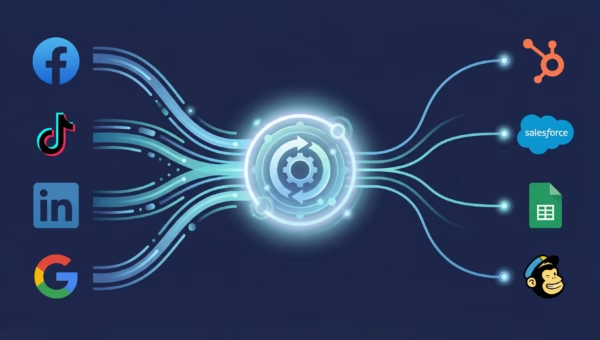
LeadSync solves this by instantly syncing your Facebook and Instagram lead ad submissions to wherever you need them — the moment someone fills out your form.
Instead of logging into Facebook to download leads, LeadSync can:
- Send an instant SMS or email notification so you (or your office manager) can call the lead within minutes
- Push leads directly to your CRM — whether that’s HubSpot, Salesforce, or a simple Google Sheet
- Sync to Jobber or HouseCall Pro so leads become new jobs in your scheduling software automatically. See our full guide to HouseCall Pro integrations
- Trigger an automated email response to the lead confirming you received their request and will call shortly
The difference between a 5-minute callback and a 5-hour callback is often the difference between winning the job and losing it to a competitor.
Ad Creative Tips Specifically for Contractors
What to Show
Before/after transformations stop the scroll better than anything else. Roofing, painting, landscaping, concrete — every trade has dramatic before/afters. Photograph every project.
Your team at work builds trust. Homeowners want to see real people, branded trucks, and professional equipment. A photo of your crew on a job site is more persuasive than any graphic design.
Video testimonials from happy customers are conversion gold. Ask satisfied clients for a quick 30-second video review. These outperform written reviews by a wide margin on Facebook.
What to Write
Lead with the pain point. “Tired of your sky-high energy bills?” works better than “We offer HVAC installation services.”
Include a specific offer. “Free estimate,” “$50 off your first service,” or “Book this week and save 15%” all give people a reason to act now.
Add social proof in the ad copy. “Rated 4.9 stars with 200+ reviews” or “Over 500 homes serviced in [City]” builds instant credibility.
Keep it conversational. You’re showing up in someone’s feed between photos of their kids and funny dog videos. Write like a human, not a billboard.
Lead Form Best Practices for Contractors
Keep Forms Short
Three to four fields maximum. Full name, phone number, email, and one qualifying question. Every field you add after that drops your conversion rate by 10-15%.
Use a Qualifying Question
Add one multiple-choice question to filter leads. Examples:
- “What service do you need?” (list your top 3-4 services)
- “When do you need this done?” (ASAP / Within 2 weeks / Within a month / Just exploring)
- “Are you the homeowner?” (Yes / No / Renter with permission)
This simple step dramatically improves lead quality without hurting conversion rates.
Use Higher Intent Form Types
Meta offers a “Higher Intent” form option that adds a review step before submission. Leads must confirm their information before submitting. This reduces junk leads by 20-30% while keeping your best prospects.
Customize Your Thank You Screen
Don’t leave the default “Thanks for submitting” message. Add a clear next step: “We’ll call you within 15 minutes to discuss your project.” This sets expectations and reduces no-answer rates when you call back.
Trade-Specific Campaign Strategies
HVAC Facebook Ads
Run separate campaigns for maintenance, repair, and installation. A $99 AC tune-up offer converts at a much higher rate than a generic “HVAC services” ad. Use the tune-up as a foot-in-the-door to upsell larger jobs on-site.
Target seasonal urgency. “Don’t get caught without AC this summer — schedule your tune-up now” works because it triggers loss aversion.
Roofing Facebook Ads
Storm damage campaigns after severe weather events generate the hottest leads. Have a “storm response” campaign template ready to launch within 24 hours of a major weather event in your service area.
For non-emergency roofing, focus on financing. “New roof, $0 down, payments as low as $149/month” makes a $15,000 project feel accessible.
Plumbing Facebook Ads
Offer a specific, low-cost service as a lead magnet. “$49 drain cleaning” or “Free water heater inspection” gets people in the door. Focus on non-emergency services for Facebook — emergency plumbing leads convert better on Google.
Landscaping Facebook Ads
Before/after photos are your superpower. A dramatic yard transformation stops the scroll every time. Run seasonal campaigns — spring cleanup, summer lawn care programs, fall leaf removal, holiday lighting.
Pest Control Facebook Ads
This is the biggest Facebook ads opportunity for any home service trade. With Google Ads CPC averaging $222 for pest control keywords, Facebook’s $20-50 CPL is 5-10x more cost-effective.
Run campaigns around pest seasons — termite swarming in spring, mosquito season in summer, rodent intrusion in fall/winter. “See one roach? There are 100 more hiding” is the kind of copy that drives immediate action.
Electrical Contractor Facebook Ads
EV charger installation is a fast-growing niche with high-intent homeowners. Panel upgrades and whole-home surge protection are strong offers. Target new homeowners — they often need electrical work after moving in.
Common Mistakes Contractors Make with Facebook Ads
Mistake #1: Boosting posts instead of running lead ads. Boosted posts optimize for engagement (likes, comments), not leads. Always run proper lead generation campaigns through Ads Manager.
Mistake #2: Not following up fast enough. We covered this above, but it bears repeating. If you’re not calling leads within 5 minutes, you’re wasting ad spend. Use LeadSync to get instant notifications.
Mistake #3: Targeting too narrow. A 5,000-person audience is too small for Facebook’s algorithm to optimize. Keep audiences at 50,000+ in your service area.
Mistake #4: Only running one ad. Always test 3-4 ad variations (different images, different headlines) and let Facebook’s algorithm find the winner. Kill the underperformers after 3-5 days.
Mistake #5: Giving up too soon. Facebook’s algorithm needs 50+ conversions per week to fully optimize. Give campaigns at least 7-14 days before judging performance. Early results are rarely representative.
Measuring Success: The Metrics That Matter
Cost per lead (CPL): The most important metric. Track this against the benchmarks for your trade listed above.
Lead-to-appointment rate: What percentage of leads become booked appointments? A healthy rate is 20-40% depending on your trade.
Cost per acquisition (CPA): Divide your total ad spend by the number of closed deals. This tells you the true cost to acquire a customer.
Return on ad spend (ROAS): For every $1 you spend on ads, how much revenue do you generate? Most successful contractors see 5-15x ROAS on Facebook ads.
Response time: Track how quickly you or your team contacts each lead. Set a goal of under 5 minutes during business hours.
Frequently Asked Questions
Do Facebook ads actually work for contractors?
Yes. Facebook ads work extremely well for contractors when set up correctly. The key factors are using the Lead Ads format (not boosted posts), targeting homeowners in your service area, and following up with leads within minutes — not hours. Contractors across HVAC, roofing, plumbing, landscaping, and pest control consistently generate leads at a lower cost than Google Ads.
How much should a contractor spend on Facebook ads?
Start with $20-$50 per day ($600-$1,500/month). This gives Facebook’s algorithm enough data to optimize your campaigns. Once you identify winning ads, scale to $50-$150/day. Most successful contractor advertisers spend $1,000-$5,000/month on Facebook ads.
Are Facebook leads lower quality than Google leads?
Facebook leads are earlier in the buying process than Google search leads, but they’re not “low quality.” Google captures active searchers, while Facebook generates demand. The key is using qualifying questions on your lead forms and responding to leads instantly. Contractors who follow up within 5 minutes see conversion rates comparable to Google leads.
How do I get Facebook leads sent to my phone instantly?
Use LeadSync to automatically sync Facebook lead ad submissions to your phone via SMS, email, or directly into your CRM. Leads are delivered in real-time — within seconds of someone submitting your form. No manual downloading or checking Facebook required.
Should I use Facebook ads or Google Ads for my contracting business?
Use both. Google Ads captures people actively searching for your services right now. Facebook Ads reaches a much larger pool of potential customers at a lower cost. For most contractors, Facebook generates more volume at a lower CPL, while Google generates higher-intent leads. A balanced approach maximizes your total lead flow.
What’s the best Facebook ad format for contractors?
Lead Ads (Instant Forms) are the best format for contractors. They let potential customers submit their info without leaving Facebook, which dramatically increases conversion rates. Use before/after photos or short video as your creative, and keep the form to 3-4 fields maximum.
How long does it take to see results from Facebook ads?
You can start seeing leads within 24-48 hours of launching a campaign. However, Facebook’s algorithm needs 7-14 days and 50+ conversions to fully optimize. Don’t judge a campaign’s performance in the first few days. Give it at least two weeks with consistent daily budget before making major changes.
Start Generating Leads Today
Facebook ads give contractors a massive competitive advantage — lower costs than Google, the ability to reach homeowners before they start searching, and a frictionless lead form experience that drives submissions.
But none of that matters if leads sit uncontacted for hours. The contractors winning with Facebook ads are the ones who respond in minutes, not hours.
Try LeadSync free to instantly sync your Facebook lead ads to your CRM, phone, or email. Set it up in under 5 minutes and never miss another lead.