Nurture Leads with Email & Content Marketing
Solar lead generation is the process of capturing contact information from homeowners interested in solar panel installation, energy audits, or solar-related services. In 2026, the solar industry is experiencing unprecedented growth, fueled by the federal Investment Tax Credit (ITC) offering homeowners a 30% tax credit on installation costs through 2032. For solar companies competing in this expanding market, the ability to generate qualified leads efficiently has become a competitive necessity. Whether you’re using Facebook Lead Ads, Google Lead Forms, or traditional landing pages, the strategy remains the same: reach the right audience at the right time with the right message.
This guide covers the most effective strategies for generating solar leads in 2026, including paid advertising tactics, audience targeting, lead qualification, and automation tools that help your team respond faster. If you’re also generating HVAC or roofing leads, many of these tactics crossover—see our HVAC lead generation guide and roofing leads guide for related insights.
Key Takeaways
- The solar industry is booming in 2026 thanks to the federal ITC tax credit (30% through 2032), creating a steady stream of homeowners researching solar solutions.
- Facebook Lead Ads generate solar leads at $30–$80 per lead (CPL), with Google Lead Forms running higher at $50–$150+, depending on targeting and creative.
- Speed to lead matters even in the solar industry—while the sales cycle is longer than HVAC, responding to leads within 5 minutes increases conversion probability by 21x.
Understanding Your Solar Lead Audience
Successful solar lead generation begins with understanding who you’re trying to reach. The typical solar prospect is a homeowner aged 35–65 with above-average household income (typically $75,000+), high monthly electricity bills, and a genuine interest in sustainability and cost savings. These homeowners are actively researching solar because they’ve experienced rising utility costs or want to reduce their carbon footprint before the ITC incentives expire.
Your audience is likely already comparing multiple solar companies. They’re reading reviews on Google and Facebook, watching YouTube videos about solar ROI, and may have already received quotes from competitors. Your ads need to stand out by addressing specific pain points: “How much will solar save me?” “Will solar work on my roof?” “Can I get a zero-down installation?” and “How do I claim the tax credit?”
When researching your competition, look at what ad copy, offers, and call-to-actions leading solar companies are using. Pay attention to their testimonials, guarantees, and financing options. Many solar companies emphasize warranty lengths (25–30 years), financing flexibility (zero money down, low APR), and speed to installation. These are strong signals of what resonates with your audience. Your ad strategy should either match or differentiate from these themes depending on your competitive position.
Solar Ad Campaign Examples
Before diving into tactics, let’s examine real-world examples of successful solar lead ad campaigns. These examples show how top solar companies are using visuals, copy, and targeting to capture leads in 2026.
Solar Paradise
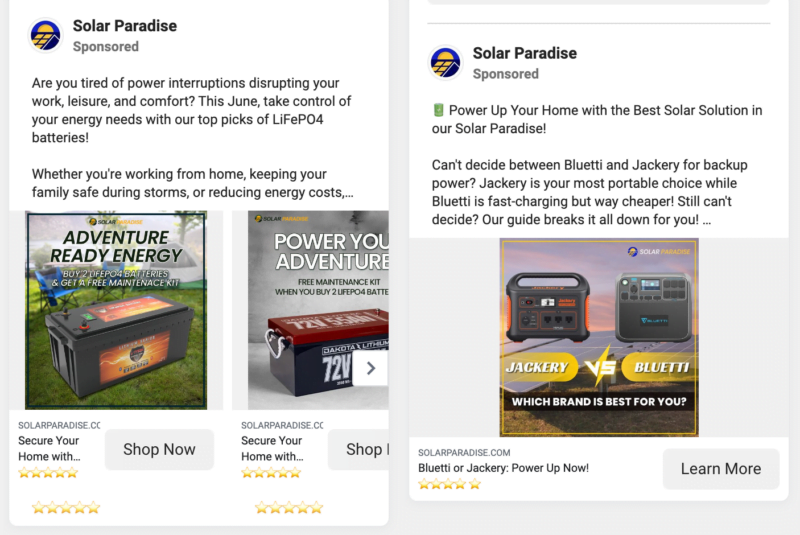
Solar Paradise’s lead ad uses bright, clean visuals of solar panels installed on a residential home. Their headline is direct: “Free Solar Savings Estimate.” The ad immediately conveys value (free estimate, no obligation) and uses a contrasting CTA button. The targeting likely focuses on homeowners in high-cost utility regions with demonstrated interest in solar energy and home improvement.
SunVena Solar
SunVena Solar emphasizes financing and the federal tax credit in their campaigns. Their typical offer includes “Zero Money Down + Federal Tax Credit,” positioning solar as an affordable, government-backed solution. The ad speaks directly to the ITC incentive, which is a major pain point for homeowners—many don’t know they can claim a 30% tax credit, and SunVena makes this benefit clear upfront.
KB Home
Facebook Lead Ads for Solar Companies
Facebook Lead Ads are one of the most cost-effective channels for solar lead generation. Unlike traditional landing pages that require users to leave Facebook, Lead Ads let prospects submit their information without navigating away from the platform. This frictionless experience dramatically improves conversion rates, making Facebook an ideal channel for solar companies.
Campaign Ideas & Offers
The strongest Facebook Lead Ad campaigns for solar use one of these core offers:
- “Free Solar Savings Estimate” – Position as a no-obligation analysis of how much the prospect can save by going solar. Include a specific timeframe (“Within 24 hours, our solar expert will calculate your custom savings estimate”).
- “Going Solar? Get Your Custom Quote in 60 Seconds” – Emphasize speed. Prospects appreciate efficiency, especially when comparing multiple solar companies.
- “Federal Tax Credit – Lock In 30% Savings Before 2033” – Lead with the ITC as the primary benefit. Many homeowners don’t realize the credit exists or think it will expire soon. This creates urgency.
- “$0 Down Solar Installation – Find Out If You Qualify” – Financing is a primary objection. Address it directly in the headline, and use the lead form to qualify based on credit, home ownership, and other factors.
Targeting Strategy
Facebook’s targeting options are granular enough to reach qualified solar prospects. Your core targeting should include:
- Age: 35–65 (primary demographic for homeowners researching solar)
- Location: Regional or service area (if you serve specific states or cities)
- Interests: Solar energy, renewable energy, home improvement, sustainability, environmental activism, alternative energy
- Behaviors: Homeowners, high net worth (household income $75K+), energy-conscious consumers
- Lookalike Audiences: Create lookalike audiences based on your existing customer list to expand reach to similar prospects
- Custom Audiences: Retarget website visitors who viewed your solar service pages but didn’t convert (see our custom audiences guide)
For high-net-worth targeting specifically, consult our guide on targeting wealthy audiences, which covers income-based segments and premium lifestyle interests.
Lead Form Questions & Qualification
Your Facebook Lead Ad form should gather enough information to qualify the prospect without being so long that people abandon it. Recommended questions:
- “What’s your first name?” (required)
- “What’s your email address?” (required)
- “What’s the best phone number to reach you?” (required)
- “Do you own your home?” (yes/no – critical qualifier; renters can’t install solar)
- “What’s your average monthly electricity bill?” (dropdown: $0–$100, $100–$200, $200–$300, $300+)
- “What’s your primary goal?” (dropdown: Save on energy costs, Reduce environmental impact, Increase home value, Combine these)
Keep the form to 5–6 fields maximum. The fewer questions, the higher your conversion rate. Pre-fill data where possible (Facebook auto-fills name, email, and phone for logged-in users).
Cost Per Lead & Budget Allocation
Facebook Lead Ads for solar typically cost between $30–$80 per lead (CPL), depending on competition, creative quality, targeting specificity, and geographic market. In competitive markets like California or Florida, CPL may exceed $80. In less saturated markets, you may achieve $25–$35 CPL.
To manage costs effectively, start with a small daily budget ($10–$25/day) and test multiple ad creatives simultaneously. Pause underperforming ads after collecting 50–100 results, and scale winning ads. Over time, Facebook’s algorithm improves targeting, and CPL typically decreases as your audience data enriches.
For more in-depth guidance on Facebook Lead Ads mechanics, see our guides on creating Facebook Lead Ad campaigns, improving lead quality in Meta Lead Ads, and benchmarks for cost per lead.
Google Lead Form Extensions for Solar
While Facebook Lead Ads are excellent for awareness and mid-funnel prospects, Google Lead Forms capture high-intent searchers already looking for solar solutions. When a homeowner searches “solar installation near me” or “solar panel cost,” they’re ready to act.
Google Lead Forms are embedded in search ads and allow prospects to submit contact information without leaving Google. The targeting is intent-based rather than demographic, making CPL higher but lead quality stronger.
- Cost Per Lead: $50–$150+ (higher intent, higher cost)
- High-Intent Keywords: “Solar installation near me,” “Solar panel cost,” “Solar companies near me,” “Free solar estimate,” “Residential solar panels,” “Best solar panels for home”
- Advantages: Captures ready-to-buy prospects, lower impression spend needed, higher conversion rates
- Disadvantages: Smaller audience size, limited demographic targeting, higher CPL
A balanced solar lead generation strategy uses both Facebook (broad reach, awareness) and Google (high intent, conversion). For more on setting up Google Lead Forms, see our guide to creating Google Lead Ad campaigns.
Automating Solar Lead Follow-Up
The solar sales cycle is longer than HVAC or roofing—prospects may take weeks or months to decide. However, this does not mean you should delay follow-up. In fact, speed to lead is critical: companies that respond to leads within 5 minutes are 21x more likely to convert. Early contact sets expectations, answers initial questions, and prevents prospects from shopping with your competitors.
Here’s where automation becomes essential. When a homeowner submits a Facebook Lead Ad or Google Lead Form, your solar CRM should receive that lead within seconds—not hours. This allows your sales team to follow up immediately while interest is highest.
Solar CRM Platforms
Popular CRM platforms for solar companies include Jobber, HubSpot, Salesforce, Pipedrive, and GoHighLevel. These platforms offer lead management, scheduling, customer communication, and reporting. However, none of them natively sync with Facebook Lead Ads or Google Lead Forms. This gap is where lead synchronization tools become valuable.
Automated Lead Sync Workflow
Here’s the ideal workflow for solar lead automation:
- Lead Submission: Homeowner submits Facebook Lead Ad or Google Lead Form with name, email, phone, home ownership status, and electricity bill estimate.
- Lead Sync: LeadSync (or similar tool) captures the lead and instantly pushes it to your solar CRM (Jobber, HubSpot, etc.) with no manual data entry.
- CRM Workflow: The CRM automatically creates a contact record, assigns it to an available sales rep based on territory or capacity, and logs the lead source (Facebook or Google).
- Immediate Notification: The sales rep receives an SMS or push notification that a new lead arrived, triggering immediate follow-up.
- First Contact: The sales rep calls or texts within 5 minutes, introduces themselves, answers the homeowner’s initial questions (solar cost, timeline, financing options), and schedules a free site assessment.
- Lead Nurturing: The CRM logs all communication, tracks the assessment, and sends automated follow-up emails to nurture the prospect through the sales cycle.
This automation is critical because it removes manual work and delays. Without it, leads sit in Facebook or email inboxes until someone manually exports them, copies them into the CRM, and notifies the sales team—a process that can take hours or days.
Lead Notification & Response Tools
For deeper insights on lead notification strategies, see our guide on real-time Facebook lead notifications. This covers SMS alerts, Slack integration, and in-app notifications that keep your team responsive.
Cost of Lead Sync Tools
Lead sync tools vary in price. LeadsBridge, a popular alternative, charges $29–$1,549 per month depending on volume and integrations. LeadSync, by contrast, charges a flat $19/month regardless of lead volume, making it significantly more affordable for growing solar companies.
The ROI is straightforward: if automating lead sync saves your team 2–3 hours per day of manual data entry, and your fully-loaded sales rep costs $30–$50/hour, you’re saving $60–$150 daily—quickly paying back the tool investment.
Additional Tips for Solar Lead Generation Success
Diversify Your Lead Channels
Relying solely on Facebook or Google introduces risk. If one platform changes its algorithm or increases costs, your lead volume drops. Diversify across Google Search, Facebook, Instagram, TikTok (for younger homeowners), YouTube, and organic search. Each channel attracts different audience segments.
Track ROI at the Lead & Customer Level
Know your cost per lead (CPL) and cost per customer acquisition (CAC) by channel. If Facebook delivers leads at $40 CPL and your average solar install has a 25% conversion rate, your effective CAC is $160. Compare this across channels and pause underperforming ones.
Nurture Leads with Email & Content Marketing
Not all leads convert immediately. Build an email nurture sequence that educates prospects on solar benefits, financing options, tax credits, and ROI. Pair this with blog content about “How Much Do Solar Panels Cost,” “Solar Panel Installation Timeline,” and “Is Solar Worth It,” which address common objections and drive organic search traffic.
Collect & Use Social Proof
Testimonials, before-and-after photos, and case studies dramatically improve conversion rates. Ask recent customers for reviews and video testimonials highlighting their experience, savings, and the ease of installation. Feature these in your ads and website.
Summary
Solar lead generation in 2026 is thriving thanks to the federal ITC and rising energy costs. Facebook Lead Ads and Google Lead Forms are the most cost-effective channels for capturing qualified prospects at scale. Success requires understanding your audience (35–65-year-old homeowners with above-average income), crafting compelling offers (free estimates, tax credit emphasis, zero-down financing), and automating lead sync to your CRM so your team responds within minutes. By combining smart advertising with fast follow-up and continuous nurturing, solar companies can generate consistent, high-quality leads and convert them into long-term customers.
Frequently Asked Questions
How much do solar leads cost?
Solar lead costs vary by source and market. Facebook Lead Ads typically cost $30–$80 per lead, while Google Lead Forms run $50–$150+ depending on keyword competition and targeting. Third-party lead marketplaces (shared leads sold to multiple companies) range $20–$100 per lead. Your actual cost depends on your geographic market, offer strength, creative quality, and sales conversion rate.
How do I automatically send Facebook leads to my solar CRM?
Use a lead synchronization tool like LeadSync, which connects Facebook Lead Ads to your CRM (Jobber, HubSpot, Salesforce, etc.) and automatically pushes new leads with zero manual work. This eliminates data entry delays and ensures your sales team is notified immediately, enabling faster follow-up.
Are Facebook Lead Ads effective for solar?
Yes. Facebook’s targeting tools allow you to reach homeowners aged 35–65 with demonstrated interests in solar, home improvement, and sustainability. Lead Ads eliminate friction by keeping prospects on Facebook while capturing their contact information. When paired with strategic qualifying questions (home ownership, electricity bill) and quick follow-up, Facebook Lead Ads convert well for solar companies.
What’s the best CRM for solar companies?
Top CRM platforms for solar include Jobber (field service–focused, popular with installers), HubSpot (all-in-one marketing and sales), Salesforce (enterprise, highly customizable), and GoHighLevel (local service agencies). Choose based on your team size, budget, and required features. Pair your CRM with a lead sync tool like LeadSync to automate lead flow from Facebook and Google.
How quickly should solar companies follow up with leads?
Companies that respond within 5 minutes are 21x more likely to convert leads. While the solar sales cycle is longer than HVAC or roofing, early contact is still critical. Use SMS alerts and CRM automation to ensure your sales team is notified the moment a lead arrives, enabling immediate follow-up calls or texts.